
Popular games for collection Balance of Power
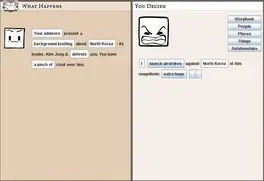
Sequel to Chris Crawford's highly influential Cold War simulation. This time the game tackles modern conflicts in Asia and the Middle-East.
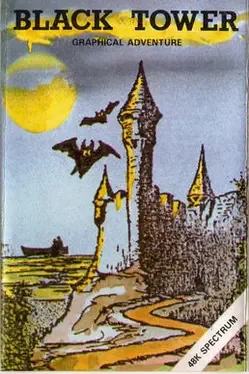
A text adventure game.
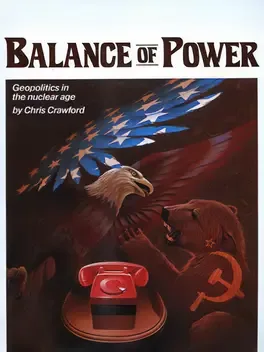
Take on the role of the US President or the Russian General Secretary and make your country the most powerful over your eight years in office. Use diplomacy, make treaties, use direct military force or use covert CIA/KGB agents. Just remember there's a big red button.
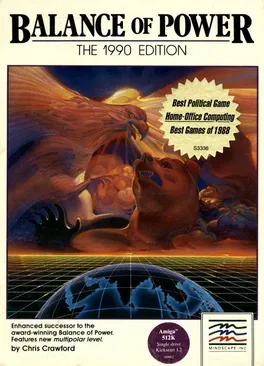
Balance of Power is a computer strategy game of geopolitics during the Cold War, created by Chris Crawford and published in 1985. The game is notable for engaging the player in brinkmanship. The goal of the game is simple: the player may choose to be either the President of the United States or the General Secretary of the Communist Party of the Soviet Union, and must lead the chosen superpower for eight years, seeking to maximize "prestige" and avoiding a nuclear war. Each turn is one year long; at the beginning of each year, the player is presented with a set of incidents and crises in various countries around the globe, and must choose a response to each one. Responses may range from no action, to diplomatic notes to the other superpower, to military maneuvers. Each response is then met with a counter-response, which may vary from backing down to escalation. The player then gets a chance to initiate actions, and deal with the opponent's responses. This core mechanic is similar to that of Bruce Ketchledge's 1983 game Geopolitique 1990, published by SSI. One difference from the earlier game is how negotiations are resolved. In both games, backing down in a negotiation results in a loss of prestige, which will reverberate politically. Likewise, in both games brinkmanship may result in a global war. In Geopolitique, such wars were actually fought in-game, after which the game continued. In Balance of Power, such a war ends the game instantly, with the following message: "You have ignited a nuclear war. And no, there is no animated display of a mushroom cloud with parts of bodies flying through the air. We do not reward failure."
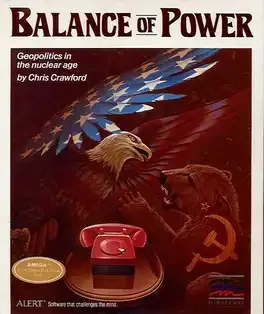
It has been more than forty years since the first nuclear bomb exploded. In that time, the shape of the world has changed dramatically. The power to destroy civilization rests in the hands of the superpowers and now, as either the president of the U.S. or as the General Secretary of the U.S.S.R., you have total responsibility for your nation's course. To succeed, you must enhance your country's prestige without infringing too much on your adversary's interests. If you play the isolationist, you will find yourself alone in a world dominated by your opponent. If you are too aggressive, you could unleash the war that annihilates humankind- and both sides lose. Balance Of Power uses a huge statistical database, a meticulously detailed display of the world, and advanced artificial intelligence techniques to put you in command of one of the world's superpowers. You have vast amounts of information available as you press your country's interest and resist the pressure of the other side. Noted game designer Chris Crawford has created a model of the world which will entertain, educate, challenge, and perhaps frighten you in ways no computer game has ever done before. Covers the eight years from 1986 to 1994.