
Popular games published by company Apollo, Inc.
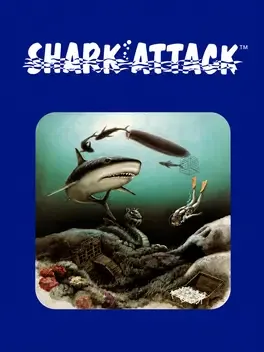
You are a diver in an underwater maze. Throughout the maze are valuable diamonds, and your goal is to retrieve as many as you can. In the middle of the screen is a shark cage where you begin. As you collect diamonds you need to bring them back to the shark cage in order to earn points. Swimming back and forth constantly is a deadly shark. If the shark encounters any of the diamonds, it will eat them; likewise you can also be eaten by the shark, causing you to lose a life. You have no defense against the shark, however you are immune if you are in the shark cage and the doors are closed. Somewhere in the maze the Loch Ness monster remains hidden. If you disturb the monster, it will continuously chase you unless you can lead it back into one of the caves located in the corners of the screen.
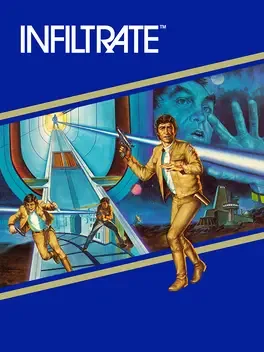
You are a secret agent on a mission of crucial importance. Your mission is to infiltrate a top secret fortress. You must capture enemy documents and get out alive. Your challenge: the diabolical maze of corridors and elevators designed to confuse you and keep you from the documents. Your danger: enemy assassins programmed to shoot on sight. Your weapon: a high-power laser gun as powerful as that of the enemy. Your advantage: you're sharp enough to duck when they shoot. It's a hectic chase. Hop an elevator. Survive enemy fire. Fire back. Duck. Infiltrate...if you dare!
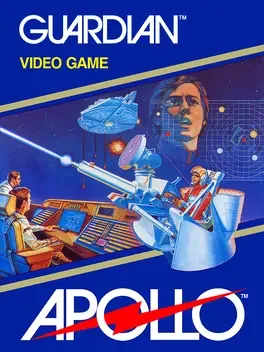
Guardian is an arcade action game for one or two players. In an intergalactic war, an enemy ship called Dromeda is attacking your home planets and you need to defend them! The planets are located at either the top or the bottom of the screen, and are defended by a shield. Dromeda is in the middle of the screen, and will be launching explosive devices at the planets. You control a spaceship which is the last hope to save the planets. Unfortunately, your ships lasers are unable to reach Dromeda, so you you must shoot the explosives as they come in. If you miss any explosives, they will destroy part of the shield. If a large enough hole forms, an explosive could get through and destroy an entire planet. The game ends when all of your planets have been destroyed.
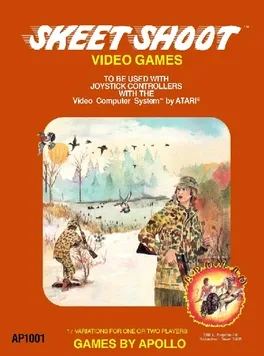
Pull! The trap springs, and the clay pegeon -- alive with flight -- soars away from you at an unexpected angle. With a fluid motion, you raise your gun to your shoulder as you pivot toward you target. You lead your pegeon, finger on the trigger...your mind racing...challenged by the speeding target before you. Will your reactions be too slow? Too fast? Or right on course? Suddenly you squeeze the trigger!
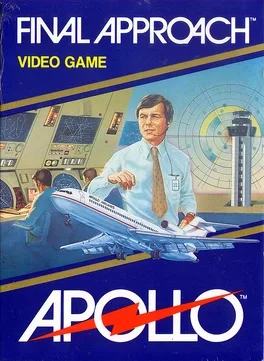
You are an air traffic controller at an international airport. You must guide planes in to landing safely. Your first screen is the Approach Control Radar screen or ARC. You must guide the aircraft , using the cursor, until they are headed left to right along the yellow line headed towards the black stripe. Make sure the other planes are headed where they won't immediately head towards each other or off screen. After the plane gets near the black stripe, move the cursor to the center red light and press the button. You will then be on the Ground Control Approach screen or GCA. Here you must center the plane's nose on the glide slope and localizer before it arrives at the end of the runway. If the landing is successful, the plane will disappear from the ARC screen and a new one will appear soon to take its place. If not, when you press your joystick button and return to the ARC screen, the plane will still be there. If a plane starts flashing on the ARC and you hear an emergency sound, this plane has an emergency and must be landed first. Scoring Successful landing=25 points Successful emergency landing if landing before other planes=50 points Aircraft wanders off radar=lose 5 points You get a control error (lose a life) if you allow a near miss or do not immediately land an aircraft in distress. You are allowed an additional control error (extra life) every 500 points. Game variations Games 1, 3, 5, and 7 are one player. Games 2, 4, 6, and 8 are two player. Maximum number of planes on radar: Games 1, 2, 3, and 4=4 Games 5 and 6=3 Games 7 and 8=2 There are crosswinds on landings in games 3 and 4 only. Difficulty switch A=faster planes B=slower planes
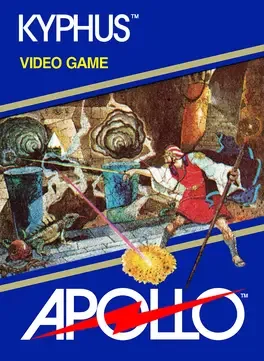
Over the years Apollo has released some strange games. From the airline luggage simulator Lost Luggage to the egg throwing antics of Wabbit, Apollo was never afraid to release something different. Therefore it's no surprise that when a new unknown Apollo prototype surfaced, it featured some interesting gameplay. However Kyphus may be the strangest game from Apollo yet... Looking a little like a cross between Racquetball and Space Cavern, Kyphus is an odd game in which the player must maneuver a dumpy looking guy through a pseudo-3D maze of rooms avoiding what appears to be a glowing cloud that shoots lasers, while being followed by a multi-colored robot that just might be a monkey in disguise. Like I said, this game is weird!. Unfortunately, this prototype is very incomplete. There appears to be no collision detection, few sounds, and almost no gameplay. The only thing one can really do in this prototype is to move run from room to room, although with no collision detection implemented there is no threat from the robot or cloud. Each room of the maze appears to have a different color, and has three to four exits (two on the sides and one at the top and bottom). The maze is made up of 64 rooms, but doesn't appear to have a set pattern. As you move through maze, you may notice the score and life counters start displaying odd letters and numbers. These number and letters are actually variable values in hex decimal notation. The programmer used these numbers to help determine the values of various game variables while developing the game. The counters at the top of the screen display the players position coordinates, the left two digits in the score are a timer of some sort that is continually counting down, while the right two digits appear to be the room number. It is unusual to see these in game unless it is very early in the development cycle. Although the prototype isn't very playable, by taking a look in the game itself we can puzzle out some planned gameplay. Hidden in the code are three words: Protect, Destroy, and Invoke. It is thought that these are commands the player would give the robot to make it do certain things. Also hidden in the game code are graphics for what appears to be a large monkey that would have replaced the robot. It is currently unknown how the monkey would be used in the game, and there is no way to trigger it (without hacking the code) in the current prototype. Although Kyphus is unplayble in its current state, it shows quite a bit of promise. Getting the 2600 to display anything that looks remotely like 3D is an amazing feat. It is thought that in the final version of the game the player would have a weapon of some type to shoot at the cloud and robot, but the object of the game is still unclear. Hopefully a more complete version of the game will turn up someday, but for now we can be happy in that another lost prototype has finally been found. Only one prototype of Kyphus is known to exist. It is thought that in the final version of the game the player would have a weapon of some type to shoot at the cloud and robot, but the object of the game is still unclear. A picture of the box was shown in a few Apollo advertisements. It appears to show a wizard battling evil clouds in a temple which is fairly close to the gameplay in the current prototype. Hidden in the code are three words: Protect, Destroy and Invoke. It is thought that these are commands the player would give the robot to make it do certain things. Also hidden in the game code are graphics for what appears to be a large monkey that would have replaced the robot. It is currently unknown how the monkey would be used in the game, and there is no way to trigger it in the current prototype.
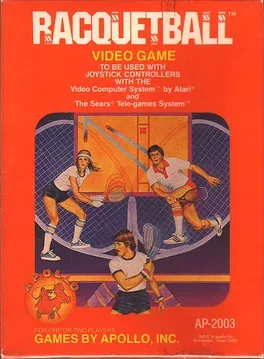
To serve, press the red button. You hit the ball by moving your player to where the shadow of the ball is about level with your feet. The racquet will swing automatically. When you serve, the ball must hit the front wall before it hits the floor. Your opponent can then hit the ball before it lands on the floor or he can let it bounce but you can only let it bounce once. It cannot bounce twice. You serve every time until you miss. If you are serving and your opponent misses, you get one point. You can only get points on rounds where you serve. First player to twenty-one points, wins.

You are a farmer, named Billie Sue, trying to protect your crops. One patch in particular is giving you trouble. It's surrounded by ten holes from which wabbits dart into your field. Scare off the pesky creatures by throwing rotten eggs at them.