
Electrician

Buy
Could be interesting


Nagagutsu wo Haita Neko: Sekai Isshuu 80-nichi Daibouken is a 1986 video game based on the third film of The Wonderful World of Puss 'n Boots that was released exclusively in Japan for the Family Computer. Four years later, the game (with several modifications) was released in North America under the title Puss 'n Boots: Pero's Great Adventure. The main character is the Puss in Boots character from the tale; a cat named Pero (Toei Animation's mascot) He is also known as 'Perrault' in the game, as that was the name of the original author of the Puss In Boots story; Charles Perrault. He is known for helping an impoverished master attain wealth through the use of trickery.
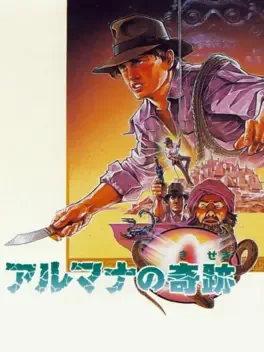
A magic red jewel, known as the Arumana, is stolen from an unnamed village. A thief runs off with the jewel and turns the entire village into stone. Kaito must travel through six cavernous levels in search of the stolen jewel, Arumana. The player begins with thirty throwing knives as his weapon of attack. As they venture through the levels, they can find various other weapons. These include bombs, a handgun, bolas, a crystal ball that destroys everything on screen, and mines. He must destroy various cave-dwelling creatures as well as soldiers, who sometimes drop weapons.
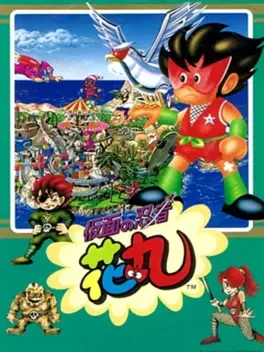
Kamen no Ninja Hanamaru, is a Japan-only side-scrolling platformer developed by Capcom for the Famicom Disk System. The game's mechanics were later used (with an almost complete visual overhaul), for the game Yo! Noid.
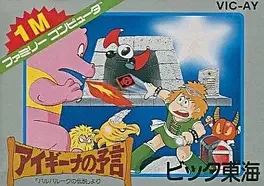
An action/platformer with an RPG facade, in which the player searches dungeons for treasure. It was the first NES game Vic Tokai ever produced.
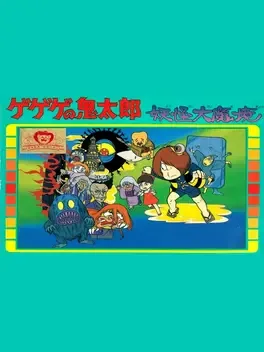
GeGeGe no Kitaro: Yokai Daimakyou, known as Ninja Kid in the West, is an NES game developed by TOSE and published by Bandai. It was based on the manga series GeGeGe no Kitaro. This game was followed by a sequel titled Gegege no Kitarou 2: Youkai Gundan no Chousen, which was released the following year only in Japan also by Bandai. It was the eighth best selling Famicom game of 1986, selling 1,250,000 copies. The original Japanese version is notably different from the American version (Ninja Kid). The main character is Kitarō, and his main weapon is his hair rather than darts. His sub-weapons are a flying finger instead of shuriken, his vest instead of the feather, and a geta instead of a boomerang. All of these weapons function the same as the ones of the protagonist of the American version, Kyo; they just use different sprites. The fireball sub-weapon remains the same. Certain levels are inhabited by "western" film monsters like Frankenstein's Monster and Count Dracula; the boss of these levels is the character Buckbaird, the leader of the "western youkai". The scroll which unlocks the fortress is a crystal ball in the original version. The familiars are also different, being characters from the manga: the Pegasus was originally Nurikabe, the Eagle was Konaki Jiji, and the Mirror was Sunakake Babaa. Finally, a few of the minor enemies are different; most notably the "Pirate Ninja" found in some of the Guerilla Warfare levels was originally Nezumi Otoko, and Kitaro rides on Ittan Momen during the Dog Fight levels.
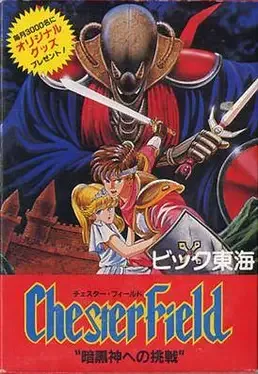
As with many other ball-and-paddle games (including Namco's own Gee Bee trilogy), the player must take control of a paddle at the bottom of the screen, and move it left and right to deflect a ball into the formation of bricks above it (and if you can keep that ball in play for a preset period of time, it will split into three balls) - certain bricks will also leave powerups when destroyed that will increase the size of the paddle, generate several extra balls in force-field when the initial ball goes into it and even create a line below the paddle that will prevent the balls from going out of play when collected. The seventh, fourteenth, twenty-first and twenty-eighth rounds are also "bonus rounds", where you have to destroy all the bricks in the formation within a preset time limit (unless all your balls go out of play); the thirty-third and final round is also a "boss round", where you are up against "Burida" (who is protected by a metal wall with a vulnerable spot on its top side, but does not attack by spitting lethal mirrors like Doh did to both Vaus in Arkanoid and the human Bubblun & Bobblun in Rainbow Islands). Once you have hit that vulnerable spot on the top side of the wall five times, it will leave Burida vulnerable - and once you have hit him, you will receive 100000 points for every life you have left and the game will be over.
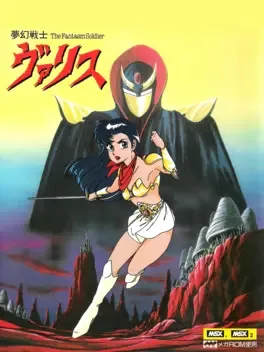
Yuko Ahso was once an ordinary high school girl. Or least her life used to be ordinary. Her friend Reiko went out on a date with a Dark King named Rogles, and has vanished. Immediately, monsters attacked her. She thought she would die for sure, but a mystic sword named Valis appeared before her. Using the sword, Yuko defended herself against the monsters, and was whisked to a strange land, where she was told that she was the chosen Valis Warrior and must defeat Rogles, or the human world and the dream world would both be plunged into chaos. Valis: The Fantasm Soldier is a side-scrolling platformer. Yuko can jump and attack enemies with her Valis sword, which can be upgraded and used as a ranged weapon by collecting power-ups found in the stages. She can also find and use items that grant her powerful all-screen attacks or temporary invincibility. Each stage culminates with a boss battle, after which Yuko's hit points and attributes increase.
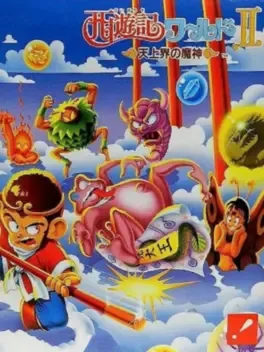
A game based in "Journey to the west" book.