
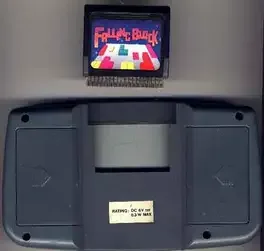
Falling Block
Buy
Could be interesting
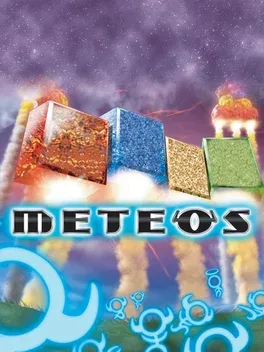
An evil planet named Meteo is sending storms of world-ending meteors across the galaxy, and only your puzzle skills can stop them. As blocks drop down on the lower screen, you must use the DS's stylus to match up blocks of the same color. Once you have enough blocks connected, they'll shoot back into the sky to form planets on the upper screen.
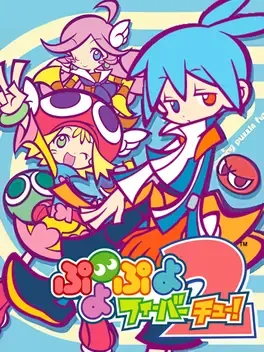
Puyo Puyo Fever 2 is a video game developed by Sonic Team and published by Sega. The game was released as a sequel to the previous title, Puyo Pop Fever. The gameplay remains relatively unchanged, but several new modes are introduced.

Pop'n Taisen Puzzle Dama Online is a block-building game. It is part of the Pop'n Music series and Taisen Puzzle-Dama series. The gameplay is similar to the others Taisen Puzzle-Dama games, just the balls have been changed to Pop-kuns instead, in order to fit the Pop'n music theme. The game also uses an online feature to download and unlock content, such as secret characters and songs.

A "Breakout" type game with interesting characters such as Mr. Chin and the Thunder Warrior. Mr. Chin holds a stick over his head that acts as the paddle. If your ball hits one of the power-up carriers (Flying Saucer, Submarine or Airplane) you have to try and pick up the released power-up while continuing to keep the ball in play.

An updated version of Semicom's "Hyper Pac-man" but having dropped the Pac-man name, most likely to avoid copyright issues.

A maze game.

Everyone's a Wally was the first arcade adventure game to feature multiple playable characters - a revolutionary feature at the time. Players began in control of Wally (a builder and handyman), but could switch to Wilma (his wife), and their friends Tom (a punk mechanic), Dick (a plumber) and Harry (a hippie electrician) - these last three names drawn from the placeholder phrase Tom, Dick and Harry. Herbert (their baby son) also appeared in the game as a mobile hazard NPC. The player cannot freely change character; the player begins in control of Wally and in order to switch must be on the same screen as the desired character. Those not being controlled by the player wander randomly around the map controlled by extremely simple AI - another feature that at the time had never been seen before. Lives and health (called "endurance") were tracked independently for each character, but the game ended if any character died. The aim of the game is to complete a day's worth of work for each character; each character has a job to do stereotypical of their skill - for instance, Wally has to build a wall, Wilma has to take back three books to the library, etc. Completing the job awards the character with a letter, which spells out a password to open a safe holding everyone's wages. The eventual password is "BREAK" - knowing this does not spoil the game since most of the letters can be seen before jobs are complete; the game requires them to be actually collected before allowing the safe to open.
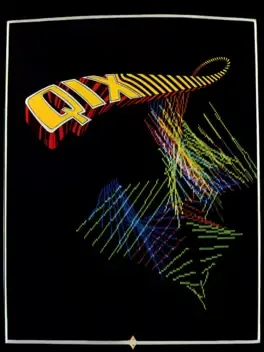
Draw boxes to claim as much screen as possible without getting in the path of the "Qix" and "Sparx". Draw slower for more points and hope that you have enough coins. Simple but very addicting!
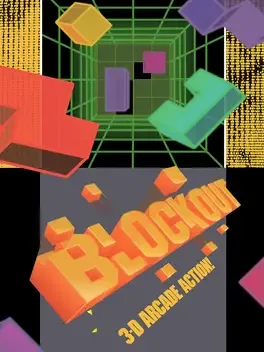
Blockout is a puzzle videogame, created in 1989 by Polish developer - California Dreams, designed by Aleksander Ustaszewski and Mirosław Zabłocki. The game is the logical extension of Tetris into the third dimension. In Tetris, the player manipulates a set of tetrominoes which fall into a two-dimensional pit (seen from the side). The aim is to solve a real-time packing problem by forming complete rows, which then disappear and score points. Poor play leads to incomplete rows, caused by inefficient arrangements of tiles; these rows do not disappear, giving the player progressively less space and less time to play subsequent pieces. Similarly, in Blockout, the player manipulates a set of polycubes which fall into a three-dimensional pit (seen from above; the pieces appear in the foreground and fall away). The pieces can be rotated around all three axes, and moved horizontally and vertically. The aim is to form complete layers.

Build a skyscraper by stacking floors on top of each other. You do this by dropping them from a crane.