
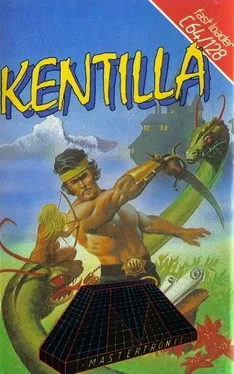
Kentilla


Buy
Could be interesting
1812 The Heart of Winter is an unusual Polish production, realized in the form of an audiobook with minimal graphic design.
The beautiful life is always damned, they say. As for you, you've overexpended yourself: fifteen years of prominence, champagne, carriage rides in the Tuileries, having your name whispered behind manicured hands, getting elegant ladies out of elegant fixes - and you're in debt. Bound by oath and honor to a pack of scoundrels. Your father, old peasant that he was, could have warned you against their type. A piece of interactive fiction written by Emily Short.
A.D. 14. Agrippa Postumus, grandson of the recently deceased Augustus, tries to avoid death at the hands of the next emperor, Tiberius. At his disposal: a couple of old manuscripts, a lamp and a recalcitrant slave. And a powerful knowledge of the Art of Venus Genetrix, of course—the magic eventually known as the Lavori d'Aracne. A work of interactive fiction written by Emily Short.

Beyond Zork: The Coconut of Quendor is an interactive fiction computer game written by Brian Moriarty and released by Infocom in 1987. It was one of the last games in Infocom's Zork series It signified a notable departure from the standard format of Infocom's earlier games which relied purely on text and puzzle-solving: among other features, Beyond Zork incorporated an on-screen map, the use of character statistics and levels, and RPG combat elements. The game, Infocom's twenty-ninth, was available on the Amiga (512kb), Apple (128kb), Atari ST, Commodore 128, and IBM (192kb), and the Macintosh (512kb) computers The player explores the Southlands of Quendor somewhat aimlessly at first. Soon, however, a task is bestowed by the Implementors, a group of godlike creatures jokingly based on Infocom's game designers. The Coconut of Quendor, an incredibly powerful artifact that embodies the whole of Magic, has fallen into the claws of an unspeakably foul beast: an Ur-grue. Rumoured to be the spirits of fallen Implementors, Ur-Grues can surround themselves in a sphere of darkness that only sunlight can pierce. The player must recover the Coconut from this monster's grasp or face the unthinkable consequences.

Isaac Newton receives a mysterious letter inviting him to investigate a new scientific phenomenon.
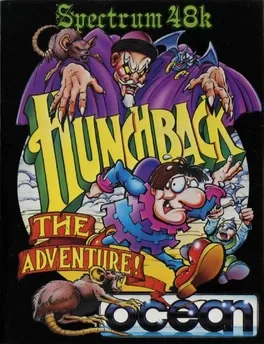
As they went on to demonstrate with Nightbreed, Ocean wasn't afraid to try a few different approaches to licensed material once they'd gotten their mitts on it, which is how you explain following up not one but two run-and-jump platform games with a text adventure game -- the change in approach a breath of fresh air and, perhaps, a response to critics suggesting that rehashing the same old thing is getting tired and stale. Many arcade games of the period would have a hard time with the transition, lacking enough of a skeleton of plot to flesh out with characters and events, but the Hunchback franchise has always enjoyed descent from one of the greatest works of French fiction (not incidentally long since in the public domain, hence ripe for free squeezing), Victor Hugo's Notre-Dame de Paris... even if it hadn't made terribly extensive use of its heritage up to this title. You are still Quasimodo, deformed ward of the Church, and you still quest for the favour and well-being of gypsy Esperalda, but for once you don't do so by jumping over pits and ducking under arrows (and, uh, participating in organised sporting events)! Instead, you navigate sites in, around and under Paris, including the Cathedral of Notre Dame, collecting inventory items to use to solve puzzles and overcome minions of the Bishop and Cardinal -- foes who no longer cause you to lose a life at the merest contact. The narrative does sustain a bit of garbling along the way in the transition from high literature to action arcade game and back to crypto-literary interactive fiction, but they take what they've learned about design along the way and present things clearly, possessions and companions continually visually indicated above a baroque text input/output field. The interface is as intuitive as those of the prior games in the franchise, despite the enormous gulf between their respective styles of gameplay. Now you can give your twitchy fingers a rest and let your brain take over for a while.
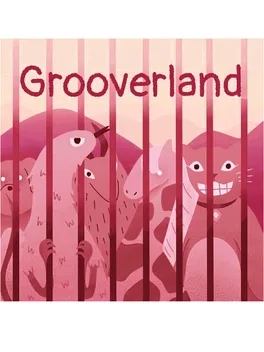
"Magic comes with a price. But on your birthday, all your expenses are paid. Welcome to Grooverland." Grooverland is a large parser game that takes over two hours to complete. It is based on the works of author and programmer Chandler Groover, although it does not require previous knowledge of his games to play.

You play as a novice glyph support clerk but no one's around but an animated burin. It seems the more experienced support clerks are either lost, got themselves un-implemented, or got stuck in a timeloop. And, of course, everyone else in Zork wants assistance too. No one said your first day on the job would be easy!

A game about a tea party, a monarchy, and the unpredictability of language.
Playing Games is a short fantasy game about an trial of initiation in a semi-secret club.