
Myth


Buy
Could be interesting
It figures that your pickup would die on a night like this and leave you stranded in the dark New Mexico desert. But nothing else figures about this night, man. Nothing at all. An example game for Aaron A. Reed's book Creating Interactive Fiction with Inform 7.

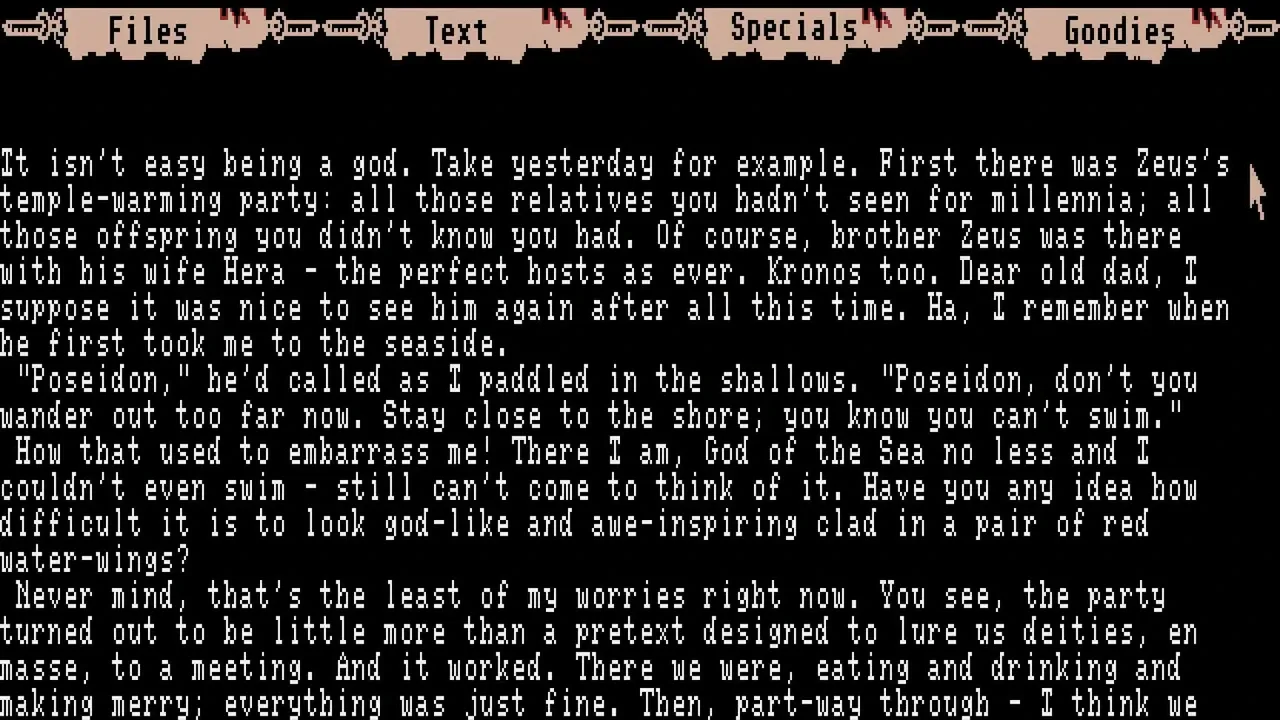
Beyond Zork: The Coconut of Quendor is an interactive fiction computer game written by Brian Moriarty and released by Infocom in 1987. It was one of the last games in Infocom's Zork series It signified a notable departure from the standard format of Infocom's earlier games which relied purely on text and puzzle-solving: among other features, Beyond Zork incorporated an on-screen map, the use of character statistics and levels, and RPG combat elements. The game, Infocom's twenty-ninth, was available on the Amiga (512kb), Apple (128kb), Atari ST, Commodore 128, and IBM (192kb), and the Macintosh (512kb) computers The player explores the Southlands of Quendor somewhat aimlessly at first. Soon, however, a task is bestowed by the Implementors, a group of godlike creatures jokingly based on Infocom's game designers. The Coconut of Quendor, an incredibly powerful artifact that embodies the whole of Magic, has fallen into the claws of an unspeakably foul beast: an Ur-grue. Rumoured to be the spirits of fallen Implementors, Ur-Grues can surround themselves in a sphere of darkness that only sunlight can pierce. The player must recover the Coconut from this monster's grasp or face the unthinkable consequences.
A train journey abruptly cut off. An enforced stay in a strange City. Intrigue, madmen, and growing sense of being watched... A work of interactive fiction by Emily Short.
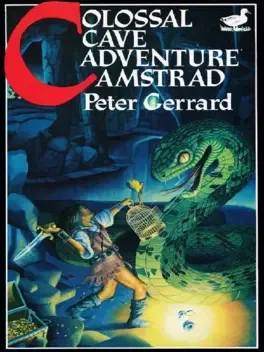
Colossal Cave Adventure is a text adventure game, developed originally in 1976, by Will Crowther for the PDP-10 mainframe. The game was expanded upon in 1977, with help from Don Woods, and other programmers created variations on the game and ports to other systems in the following years. In the game, the player controls a character through simple text commands to explore a cave rumored to be filled with wealth. Players earn predetermined points for acquiring treasure and escaping the cave alive, with the goal to earn the maximum amount of points offered. The concept bore out from Crowther's background as a caving enthusiast, with the game's cave structured loosely around the Mammoth Cave system in Kentucky.
"Magic comes with a price. But on your birthday, all your expenses are paid. Welcome to Grooverland." Grooverland is a large parser game that takes over two hours to complete. It is based on the works of author and programmer Chandler Groover, although it does not require previous knowledge of his games to play.

You play as a novice glyph support clerk but no one's around but an animated burin. It seems the more experienced support clerks are either lost, got themselves un-implemented, or got stuck in a timeloop. And, of course, everyone else in Zork wants assistance too. No one said your first day on the job would be easy!

A game about a tea party, a monarchy, and the unpredictability of language.
Playing Games is a short fantasy game about an trial of initiation in a semi-secret club.
You play as Alice Armstrong, the new Professor of Muggle Studies at Hogwarts School of Witchcraft and Wizardry in Scotland, even though you've never heard of "muggles" before and never knew magic was real until the headmaster proved it to you. But when you arrive at the school, you discover that a botched spell has made everyone disappear and you're now trapped within the castle. Is this something you can fix without magic? A work of interactive fan fiction by Flourish Klink.
No, not a prison, though stone stands around you, as expressionless as a mirror awaiting face and form; and in the silence you hear no plaint of flute or roar of gong, but instead the crash of porcelain shattering. A work of interactive fiction by Yoon Ha Lee.