
Sweeky Land



Buy
Could be interesting

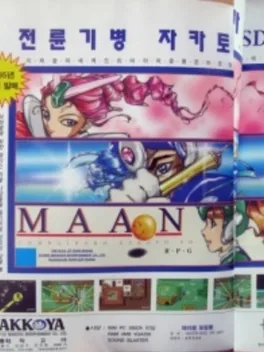
The title might misleadingly imply a sequel to the above mecha shooter, but Maan has actually nothing in common with thata, other than the name of its protagonist. Instead Makkoya created their first traditional RPG, with heavy influences from both Secret of Mana and Chrono Trigger. While the graphics at times can even be confused with the former at times, the combat system leans more towards the latter. Enemies are seen on the map at all times, but when the heroes approach them, the game switches into an active turn-based combat mode. It lacks the finesse of its role model and interesting features like the combination techs, though. The background story is rather silly: A kid wants to play a video game but get smacked in the head by his mother, so he cries himself into the video game somehow. In a world full of strange anthropomorphic characters, he is Zakato, the robotic warrior, and has to team up with two goddesses to fight an evil godess' threat to world peace. On the quest further allusions to Squaresoft games ensue, like a pseudo mode-7 world map flight mode, although the view is completely static, without the little palette animations that made the dragon ride in Secret of Mana so adorable. The game unfortunately is heavy on grinding, especially in the beginning stages, where one has to waste a couple of hours to get into shape so one can even reach the other party members. Worst of all, the game's sequence can easily be glitched, and at one point it's almost easier to force oneself to hours of mindless grinding and end up on the wrong path than finding the right one, only noticing the mistake after suddenly people that aren't there start talking in the cutscenes.
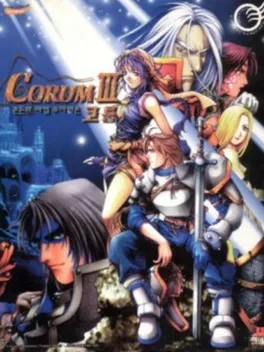
The final part of the trilogy makes the other two almost look like beta versions in comparison. To begin with, the story appears much less stereotypical than before. Three mythical sages seek to bring balance to the world by unleashing the power of an ancient magical artefact, the Jumarion. As they can't seize it themselves, they seek out the help of a mortal mage, who longed for the artifact all his life, and leaves a less than thrustworthy impression. Of all this the young knight Kaien knows nothing when he embarks on his pilgrimage. Rather he has to deal with a bunch of supersticious villainers and an alledgedly cursed little girl with a really strange personality... For the first time the prerendered graphics are rather good-looking, though they still appear sterile. The combat system has also been improved greatly and now stands nothing short of the greatest of beat 'em up-esque ARPGs like Terranigma or Story of Thor. Magic has never been a strength of the Corum series. Now some of the spells actually come in form of special moves that have to be executed during combos, making their usage much more natural. During the course of the game, Kaien gathers a party of three characters overall. Rather than fighting at the same time at his side, they're available to the player to switch in between them during the game. It goes without saying that each of them comes with their individual strengths and weaknesses. Unusual for action RPGs, Corum III comes with a network version. The three playable characters would have suited well for cooperative play, but instead the game offers several arena modes, as well as a dungeon rush. It is a nice extra, but amounts to little more than a gimmick in the end. The music is by far the best in the series as well. The game was originally released on three CDs, whith the last one entirely dedicated to the CD-audio sountrack. Did the first two games suffer from a rather small selection of songs available, Corum III got the right tune for every mood. Altogether, Corum III may be the best single player action RPG ever developed in Korea, and it was a loss for Germany that this was passed for a localization in favor of its still rather unpolished predecessor. This time Japan got more lucky, as Bothtec provided a translated version over there. The most funny and at the same time most sad thing is, Corum III actually made it to the US, yet hardly anyone ever got to play it there as the localization was handled by Gobe Software, then publisher of BeOS. Thus the game was only available for that not exactly widespread operating system.
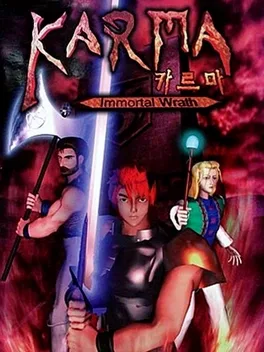

"Tahl": Uncover the Evil Within is an isometric action RPG dungeon crawler where the player fights against hordes of ghosts and demons from East Asian mythology using point-and-click controls. There is no safe hub, so the player has to survive using the loot gained from enemies alone. This makes the game close to a roguelike, even though the dungeons are not randomly generated.
The turn-based Strategy/RPG developed by a team called Shin's Deko was another of the Korean 3DO exclusives LG pushed forward, and because of that also one of the rarest games of its time.
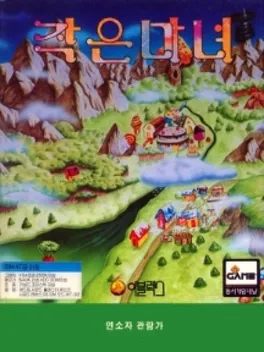
Ablex' first game follows the titular Little Witch on her quest to become a full-blown witch. In a platformer/adventure hybrid she has to explore woods and caves, learn new spells and solve the problems of numerous people and magical creatures on her way. The game's mechanics and progression are similar to some of the Wonder Boy episodes, with slightly more emphasis on "RPG elements". It is also text heavy for this kind of game, and pages over pages on a special story book screen are no rarity. The game world is divided into seperate areas, but some of the dungeons are huge and map-drawing is almost obligatory. Most of the witch's spells are used to fight the many imaginative enemies, but "talk" is a spell too, which results in frequent inconvenient switching in the menu. Without some serious grinding, most enemies are capable to kill the witch fast, resulting in many frustrating game over screens, but at least it is possible to save the game at any time. Yet the function should be handled with care, because it is also possible to save in unwinnable situations. Little Witch has enough inspiration and fun ideas to be a very entertaining little game (it even uses pictures as doors to jump through between areas, two years before Super Mario 64), however done by a bunch of university students, the technical execution leaves much to be desired. There's hardly ever been choppier scrolling in a retail game and everything flickers like crazy, making enemies much harder than they need to be and not seldom rendering the game almost unplayable. The potential for a great game was there, and the graphics look really nice (if amateurish), but it would have needed a bit more programming expertise to truly shine.

A+'s development debut was at times hailed as the first Korean RPG, during the temporal collective amnesia regarding the 80s home computer generation. In more recent times, this claim had to be corrected to "first Korean colored RPG for MS-DOS PCs", which sounds much less impressive. However, it can also be labeled as the first to follow the JRPG route a la Dragon Quest, because previous games all either stemmed from Western influences or were action RPGs. As one of the many games based on the story of Hong Gildong and thanks to its screentexts kept completely in Han'geul (it even sacrificed the full VGA color palette for a higher resolution to make it more readable, though everything other than the text was just upscaled) in a time when even the wave of Taiwan-localizations had just started to catch some current, it caught a bit of attention. A+ sold 7,000 copies of the game3, which wasn't that bad for a Korean game in 1993, but even then most reviews weren't that favorable because of a number of flaws. First and foremost stands the obfuscated design, that often leaves players not knowing what they are even expected to do. Then there's the overly simple and boring combat system, especially due to the lack of a party, which really limits the tactical depth. The rest is done by a fair share of bugs and glitches, as well as some more incomprehensible decisions like having an option to throw away items permanently while pretty much everything picked up except weapons and armor is quest-related.
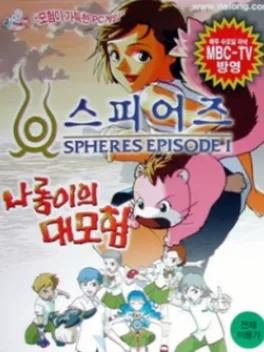
Game based on the South Korean animated series, Spheres
