
Popular games for collection Bust-a-Move
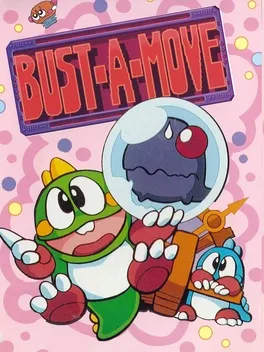
Bust-A-Move (also known as Puzzle Bobble) is a real-time puzzle game in which the player controls a device called "pointer" at the bottom of the screen, aiming and releasing randomly colored bubbles upwards. Depending on the aiming, the bubbles may float up directly or bounce off the walls, changing their trajectory. The goal is to aim the bubbles in such a way that they will touch identically colored ones. When such bubbles form a group of three or more, they pop and disappear from the screen. If the ceiling of the area is covered by too many bubbles, it will gradually descend; the game is over when it nearly reaches the player-controlled pointer. Should the player fail to release the bubbles within a specific time limit, they will be released automatically, unaffected by the pointer's aiming.
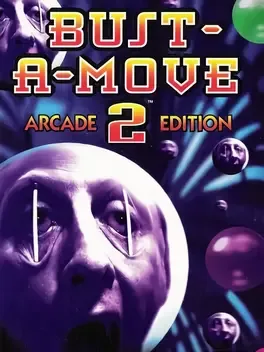
Bub and Bob are back! Like in Tetris in reverse, you shoot bubbles at an array of different-colored bubbles stuck in an ever descending ceiling, attempting to match them up three by three to make them disappear. This edition contains both puzzle challenges, multiplayer and normal progressive stages.
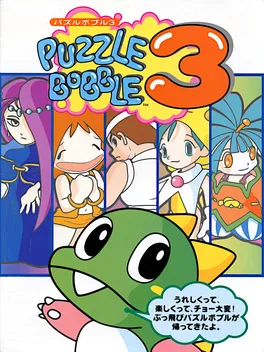
The second sequel to Puzzle Bobble. It was released into arcades in September 1996 and later ported to the Sega Saturn, Sony PlayStation, Game Boy, Nintendo 64 and Microsoft Windows. It would be the final appearance of Puzzle Bobble on the Sega Saturn. Like its predecessors, the player is tasked with shooting balls at groups of balls, creating groups of 3 or more, which are then removed from play. A European remake is entitled Bust-a-Move 3 DX. released in America as Bust-a-Move '99.
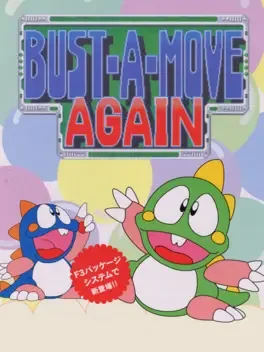
Puzzle Bobble 2 is a tile-matching video game by Taito. The first sequel to Puzzle Bobble, it was titled in Europe and North America as Bust-A-Move Again on the arcade and Bust-A-Move 2 Arcade Edition on the home consoles. The game builds on the original by adding a tournament style variation on the two player game for play against the computer and by adding a branching map to the one player game, allowing the player to periodically select one of two groups of five levels to play next, leading to different game endings. Some of the contestants in the new tournament mode are based on characters from Bubble Bobble, including variations on a Monsta and a Mighta. Completion of the single player game gives the player a code which can be entered to unlock 'Another World' for the single player game, which features subtle changes to the existing levels to increase their difficulty and changes to all backdrops to resemble levels from Bubble Bobble. The various enemies from Bubble Bobble also make an appearance in the background of the credits sequence. The North American version of the original arcade release is much different than the other versions. One of the most major changes in this version is that Bub and Bob were removed from the game and replaced with a pair of disembodied hands. Also, the characters that were in the Vs. CPU mode were removed and replaced with a generic computer. The backgrounds from the original version were also removed and replaced with 15 new backgrounds, but this also means that the backgrounds get looped in the Puzzle mode, which is 30 stages long. The audio was also changed, and the voices in the game were removed, even though they were in English anyway. These changes were only made for the Taito F3 System version, since the Neo Geo and console releases are based on the original Japanese version.
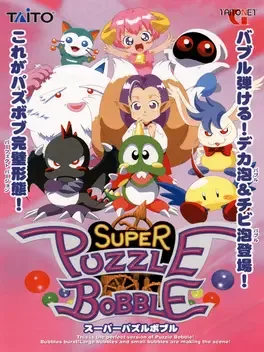
Super Puzzle Bobble (スーパーパズルボブル Sūpā Pazuru Boburu) is an arcade puzzle game in the Puzzle Bobble series developed by Taito and released in 1999. Super Puzzle Bobble's gameplay is relatively the same as previous entries. However, it introduces several new features and elements to the series. These include smaller bubbles for the player to hit small areas, big bubbles which change every bubble color in the level to itself, and blocks which can move the pointer to different areas on the board.
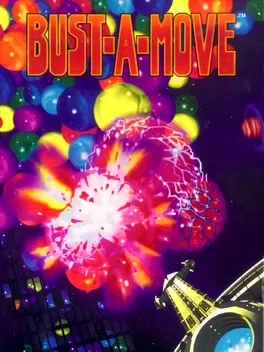
A port for Game Gear handheld devices. Controlling the dinosaurs Bub and Bob, players aim and launch colored bubbles toward the top of the screen to connect three or more of the same color, causing them to pop and drop any attached clusters before the ceiling crushes them.
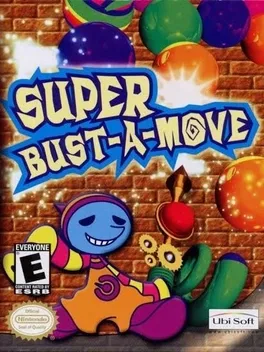
Super Bust-A-Move (also known as Super Puzzle Bobble in Japan) is a 2000 game developed by Taito and published by Acclaim.
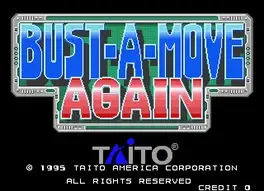
The North American port of the arcade version of Puzzle Bobble 2/Bust-A-Move Again changes many of the graphics, even removing the iconic mascot characters from Bubble Bobble.

A Port of Bust-a-Move 3 for the Sega Saturn.
Game Boy Port of "Bust-A-Move 3/Puzzle Bobble 3"