
Moonlander


Parent game
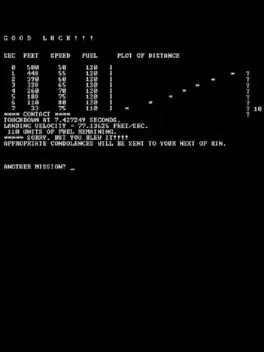
The original Lunar Lander game was a 1969 text-based game called Lunar, or alternately the Lunar Landing Game. Lunar Lander was originally written as a text-based computer game in the FOCAL programming language for the Digital Equipment Corporation (DEC) PDP-8 computer by Jim Storer while a student at Lexington High School (Massachusetts) in the autumn of 1969. Storer submitted the game to the DEC users' newsletter, which distributed the source code to readers. Other versions of the concept were written soon after: a version called Rocket was written in BASIC by Eric Peters at DEC, and a third version, LEM, was written by William Labaree II in BASIC, among others. A full game of Rocket, one of the early versions of the game type. The player has only spent fuel at the last moment, and as a result has crashed into the moon. All three text-based games require the player to control a rocket attempting to land on the moon by entering instructions to the rocket in a turn-based system in response to the textual summary of its current position and velocity relative to the ground. In the original Lunar, players controlled only the amount of vertical thrust to apply, based on their current vertical velocity and remaining fuel, with each round representing one second of travel time. Rocket added a simple text-based graphical display of the distance from the ground in each round, while LEM added horizontal velocity and the ability to apply thrust at an angle. In 1970 and 1971, DEC employee and editor of the newsletter David H. Ahl converted two early mainframe games, Lunar and Hamurabi, from the FOCAL language to BASIC, partially as a demonstration of the language on the DEC PDP-8 minicomputer. Their popularity led him to start printing BASIC games in the DEC newsletter, both his own and reader submissions.
Could be interesting
The original Lunar Lander game was a 1969 text-based game called Lunar, or alternately the Lunar Landing Game. Lunar Lander was originally written as a text-based computer game in the FOCAL programming language for the Digital Equipment Corporation (DEC) PDP-8 computer by Jim Storer while a student at Lexington High School (Massachusetts) in the autumn of 1969. Storer submitted the game to the DEC users' newsletter, which distributed the source code to readers. Other versions of the concept were written soon after: a version called Rocket was written in BASIC by Eric Peters at DEC, and a third version, LEM, was written by William Labaree II in BASIC, among others. A full game of Rocket, one of the early versions of the game type. The player has only spent fuel at the last moment, and as a result has crashed into the moon. All three text-based games require the player to control a rocket attempting to land on the moon by entering instructions to the rocket in a turn-based system in response to the textual summary of its current position and velocity relative to the ground. In the original Lunar, players controlled only the amount of vertical thrust to apply, based on their current vertical velocity and remaining fuel, with each round representing one second of travel time. Rocket added a simple text-based graphical display of the distance from the ground in each round, while LEM added horizontal velocity and the ability to apply thrust at an angle. In 1970 and 1971, DEC employee and editor of the newsletter David H. Ahl converted two early mainframe games, Lunar and Hamurabi, from the FOCAL language to BASIC, partially as a demonstration of the language on the DEC PDP-8 minicomputer. Their popularity led him to start printing BASIC games in the DEC newsletter, both his own and reader submissions.
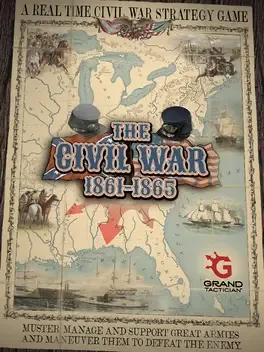
The American Civil War has erupted! On both sides, Grand Tacticians needed to take command of the opposing armies and to lead them to victory. Prepare your nation for war, plan cunning maneuvers, defeat your enemies in the field of battle, and become one of the greatest Grand Tacticians in history!

WWE 2K19 showcases a massive roster of popular WWE Superstars, Legends and Hall of Famers, as well as NXT favorites. Experience authentic WWE gameplay, extensive creation options, engaging match types, fan-favorite modes and much more!

Glory of Generals is a turn-based strategy game set during World War II. 64 campaigns between 1939 AD and 1945 AD including the Western front, the Eastern front, North Africa, and Antarctica.
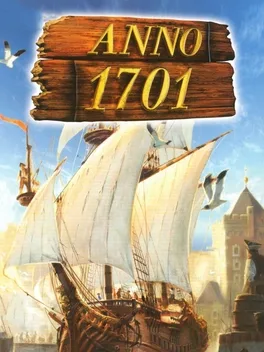
Anno is a real-time strategy video game series with business simulation and city building elements. It involves colony building and resource management on a series of small islands. It includes aspects of exploration, combat, diplomacy and trade
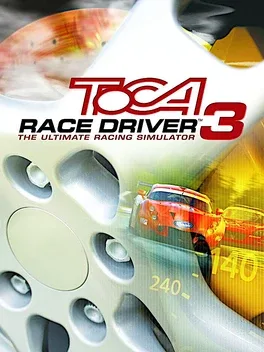
TOCA Race Driver 3 (also known as DTM Race Driver 3 in Germany and V8 Supercars 3 in Australia) is the third title of TOCA racing video game series, developed and published by Codemasters. TOCA Race Driver 3 was released in Europe and North America on February 24, 2006. The game features several fully licenced championships, including the DTM series and V8 Supercar championship. It includes 120 Championships and 35 Types of Racing through the Championship in World Tour, Pro Career, and Free Race. Also it has Bonus Championships in different disciplines. They take place largely in the UK and Germany, though many more tracks are unlocked by winning cups in Pro Career, or by setting a lap time record on a course within Pro Career mode. Open wheel, GT, Oval racing, Rallying and Off-road racing were all featured, and can be raced in either a detailed Pro Career mode or an open-ended World Tour. Online play allows 12 and 8 players on Xbox and PlayStation 2, respectively. Currently, it is the only racing simulator for PlayStation 2 with an online racing mode. It received good reviews, frequently being compared favorably to Gran Turismo 4 and Forza Motorsport, in the aspects of cars on track, damage and AI.

Richard Burns Rally (RBR) is a sim racing game developed with advice of WRC champion Richard Burns.

Pro Evolution Soccer, often abbreviated as PES and also known as World Soccer: Winning Eleven 5 in Japan and North America, is a football sports simulation video game released in 2001. It is the first instalment of Konami's Pro Evolution Soccer series. World Soccer: Winning Eleven 5 Final Evolution was also released in Japan after Pro Evolution Soccer was released in Europe.