
Rad Mobile


Buy
Could be interesting
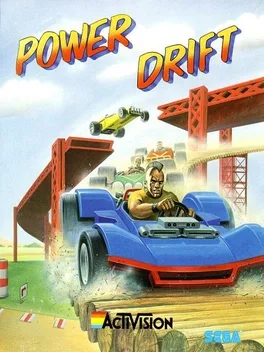
Power Drift is a kart racing game released in arcades by Sega in 1988. More technologically advanced than Sega's earlier 2.5D racing games, like Hang-On (1985) and Out Run (1986), in Power Drift the entire world and track consist of sprites. The upgraded hardware of the Sega Y Board allows individual sprites and the background to be rotated–even while being scaled–making the visuals more dynamic. Designed and directed by Yu Suzuki, the game was a critical and commercial success upon release in arcades. It was subsequently ported to various home computers in Europe by Activision in 1989, followed by a PC Engine port published in Japan by Asmik Ace in 1990. It was not released on Sega consoles until the Sega Ages release for the Sega Saturn in 1998.
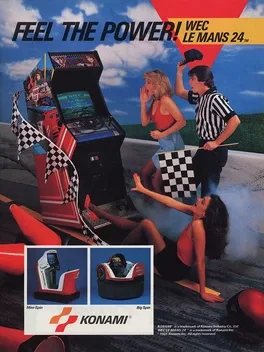
An early racing simulator based on the 24 Hours of Le Mans. It was a pioneer of realistic simulation racing, and featured a unique cabinet that rotated to simulate the feel of driving a car.

Vroom is a Formula 1 racing video game created by Daniel Macré and initially published on Sinclair QL in 1986 under the name QL Vroom. Aboard your Formula 1, speed on the available asphalt tracks. Manage pit stops, fill up with gas and change your tires in order to become the all-category champion.
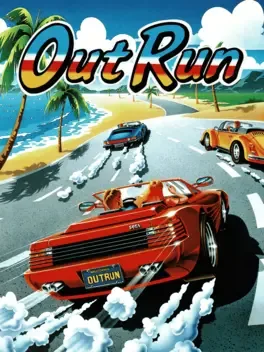
OutRun is a racing game originating in the arcades. The player can race across varied terrain in a readily available Ferrari, complete with a female passenger, over a series of short tracks. Gameplay is viewed form just above and behind the car. The roads are full of sharp bends and hazards, contact with which can cause the car to roll and lose the player's time. On each section of track there is a fork in the road, allowing the player to choose which direction he or she wishes to go in. The player has to to complete five track sections in total, out of the fifteen in the game.
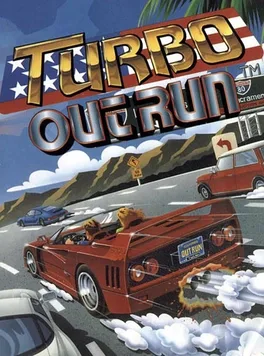
The sequel to OutRun features similar basic gameplay to the original, with the action viewed from behind the car, and the challenge being to complete each stage within the time limit. Contact can cause the car to spin, slow down or even flip; in each case you will lose time. There are 16 stages set across the US, gradually moving from east to west, all depicted differently visually. After every 4 levels, you go into a shop screen, with a choice of upgrades. As the title implies, you now have a turbo booster installed, which speeds up the car, although over-use can cause the engine to overheat, and it is not recharged until each shop section. You have 5 continues, and failure to complete the course within the time limit costs you one.

Bring the true driver’s experience to life with all the intensity and exhilaration of being behind the wheel!

A superb Formula One racing game from Sega that took sprite-scaled graphics to a whole new level. The game's single track offered a very reasonable representation of the famous Monaco Grand Prix circuit. Players could chose to race with one of three different skill/gear settings : Beginner : Automatic Gears Intermediate : 4-Speed Manual gears Professional : 7-Speed Manual Gears Before entering the Grand Prix, a qualification lap had to be completed. In the event of qualifying, the qualifying time determined the player's position on the starting grid. During the race itself, checkpoints had to be reached within a set time, or the race was over.
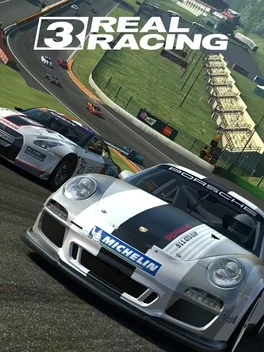
Real Racing 3 is the award-winning franchise that sets a new standard for mobile racing games – you have to play it to believe it. Real Racing 3 features officially licensed tracks with 40 circuits at 19 real-world locations, a 43-car grid and over 250 meticulously detailed cars from manufacturers.

Midtown Madness (also known as Midtown Madness: Chicago Edition) is a racing game developed for Windows by Angel Studios (now Rockstar San Diego) and published by Microsoft. The demo version was released via download on May 1, 1999 and the completed game was released toward the end of May 1999.[1] Two sequels followed, with Midtown Madness 2 released in September 2000 and Midtown Madness 3 released in June 2003 for the Xbox. The game is set in Chicago and its objective is to win street races and obtain new cars. Unlike racing games that restrict the player to a race track, Midtown Madness offers an open world recreation of Chicago. This setting was said to provide "an unprecedented degree of freedom to drive around in a virtual city".[2] Players can explore the city via one of several modes, and can determine the weather and traffic conditions for each race. The game supports multiplayer races over a local area network or the Internet. The game received generally positive reviews from gaming websites.[3]
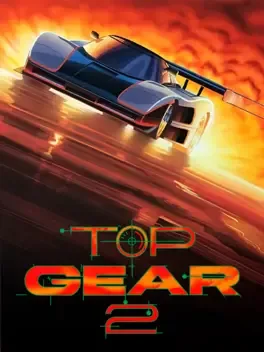
This third-person racing game resembles Gremlin's earlier Lotus series, in terms of its general look and feel, right down to the text font used in the game. Your task is to race through 16 countries, each of which features four races, with many real-world circuits recreated in incongruous locations (such as the Monza layout in Ayers Rock, and the old Hockenheim in Vancouver). These four-race blocks each represent their own mini-championship, in which you race against 19 cars, needing to finish in the top 10 to continue, and with the top 6 scoring points 10-6-4-3-2-1, and the respective amount of money in thousands. This can be spent on various upgrades, ranging from engine to tires (wet and dry) and from shocks (front, side and rear) to gearboxes. The ideal approach is to buy the more expensive versions ASAP, as you get no saving when upgrading. If you win the four-race championship, you get the next password. You get a set amount of nitro boost to use during each race, although bonus nitros, money and instant speed-up token appear on many tracks. Hazards such as puddles, barriers and ramps are also frequent.