
Space Fury


Buy
Could be interesting

You are Frald Rancer and control a space ship which must journey from your home planet to outer space to defeat enemy invaders. Once all the enemies are defeated then return home. The game moves in a forward direction where the screen objects move towards and down to the player. Approaching enemy ships are small, in the distance, and become larger and move faster as they approach the player. The player controls a fighter at the bottom of the screen, which can only move from side to side. Shots can be fired at a diagonal, as well as straight, by twisting the joystick from side to side. At certain stages, ground targets will appear and can be destroyed by using the "Burn" button. The laser disc generated backgrounds are largely non-interactive during game play. They form the backgrounds on which the game is played on. Scenes do work in with the backgrounds, however that is the extent. Some backgrounds appear as they should have elements of interactively, however, were not used in the release of the game. These include scenes where the player is going through an asteroid field and asteroids fly towards the player. Another scene is in the crystal caverns, where there are many obstacles which could have been made to be avoided. These are only two of many scenes which could have had interactive elements. The game may have been decided to have been too hard to play with these background obstacles and computer fighters to play. Hence removing the background interactively to make the game more playable. The game starts with the player in Frald Rancer's home city, then taking off into outer space via a fly-by of the city. The backgrounds are very Sci-Fi and are fantasy themed. They are very interesting, more so than the game. The music from the laser disc also complements the laser disc video very well and makes up for the sometimes annoying, computer generated sounds.
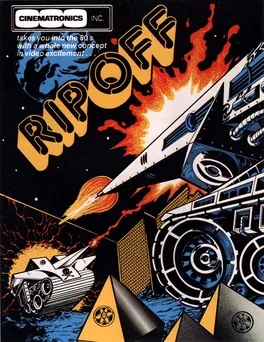
Rip-Off is a vector shoot 'em up released in arcades by Cinematronics in 1980. It is the first shoot 'em up arcade game to feature cooperative gameplay and the first game to exhibit "flocking" behavior. The objective is to prevent computer-controlled enemies from stealing eight canisters set in the center of the screen. One or two players control tank-like vehicles while game-controlled "pirate" tanks rush onto the field and attempt to drag the canisters off the edge of the screen. Enemies can be defeated by shooting or colliding with them. The game speed and difficulty increase with each successive wave until all the canisters have been taken ("ripped off").

Star Castle is a 1980 vector arcade game by Cinematronics. The game involves obliterating a series of defenses orbiting a stationary turret in the center of the screen. The game was designed by Tim Skelly and programmed by Scott Boden. Tim Skelly also created a number of other Cinematronics titles, including Starhawk, Armor Attack and Rip-Off. As with many other titles by the company, Star Castle was ported to the Vectrex video game console in 1983.
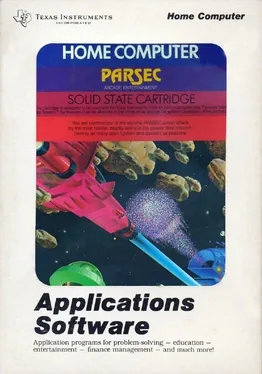
Parsec is a computer game for the Texas Instruments TI-99/4A. Perhaps the best-remembered of all TI-99/4A games, it is a side-scrolling shooter, programmed in 1982 by Jim Dramis (who also programmed the popular TI-99/4A games Car Wars and Munch Man) and Paul Urbanus. The player in Parsec pilots a spaceship through sixteen differently-colored levels of play which scroll horizontally over the screen. The objective is to avoid being shot by an enemy ship, colliding with any flying object and/or the ground, and destroy all enemy ships without overheating one's laser cannon. Three waves of fighters attack, alternating with three waves of cruisers. Enemy ships enter the screen one at a time. A ship flying off the left edge of the screen wraps around to the right side and attacks again. A new fighter can appear with others still on the screen, whereas a new cruiser will not come until the previous one is destroyed. The fighters pose only the threat of collision, while the cruisers fire on the player's ship. The fighter types are named Swoopers, LTFs (Light Triangular Fighters), and Saucers. The cruisers are called Urbites, Dramites, and Bynites. Each level ends with an asteroid belt, in which an array of asteroids advance on the ship and must be avoided or shot. At the end of each asteroid belt, any remaining asteroids are cleared away and the color of the ground is changed, then a new wave of Swoopers begins. Starting with level 4, the Swoopers are preceded by a random number of Killer Satellites, which come without the usual computer warning. The Urbites and Dramites appear to be named after the developers of the game, while the Bynites were apparently named after Don Bynum (the manager of TI's Personal Computer Division) or possibly named after the fact that they have invisibility (by night). In fact, Paul Urbanus signed Internet posts as late as 2005 as "urbite".
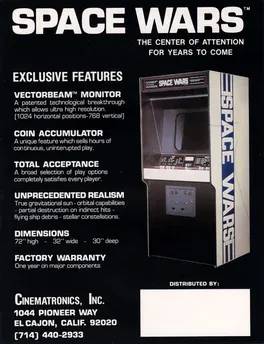
Space Wars is an early vector graphics arcade game. It is based on Spacewar!, a PDP-1 program. It was ported to the Vectrex in 1982. Space Wars was the brainchild of Larry Rosenthal, an MIT graduate who was fascinated with the original Spacewar! and developed his own custom hardware and software so that he could play the game. Cinematronics worked with Rosenthal to produce the Space Wars system. Two players controlled different ships. One button rotated the ship left, another rotated the ship right, one engaged thrust, one fired a shell, and one entered hyperspace (which causes the ship to disappear and reappear elsewhere on the playfield at random). The game offered a number of gameplay options, including the presence or absence of a star in the middle of the playfield (which exerted a positive or negative gravitational pull), whether the edges of the playfield "wrapped around" to their opposite sides, and whether shells bounced. Three other fascinating features were unique to this game. First, the game could not be played in "one player" mode; a human opponent was required. Second, the player's ship could take a glancing hit without dying, but would suffer damage; a cloud of loose ship fragments would break off and float away, after which the ship would be visibly damaged on screen and would turn and accelerate more slowly. Third and most memorable was that the duration of play for any contest was solely governed by the amount of money deposited; each quarter bought a minute and a half of play. A dollar bought six minutes, and for a ten dollar roll of quarters two players could play non-stop for an hour.
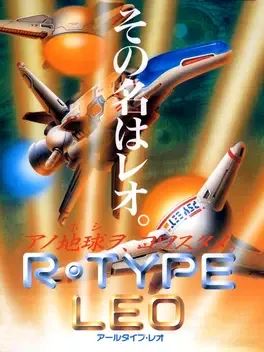
R-Type Leo is a horizontally scrolling shooter arcade game. It is a spin-off of the R-Type series and the last entry to be released in Arcades. R-Type Leo was initially an original shoot 'em up game in development by Nanao before Irem retooled it into an R-Type project instead. It is also the first R-Type game to feature simultaneous two player gameplay.
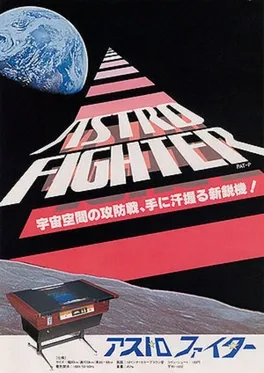
The game of Astro Fighter consists of 4 waves and a refueling stage, which are then repeated with increasingly higher difficulty. The player's task is to eliminate the four successive waves of different types of attacking craft, while avoiding being hit by missiles and bombs, and then refuel by shooting the 'GS' ship before repeating the process. The player starts with 3 lives and receives a bonus life on reaching a score of 5000. 300 bonus points are received for shooting each 6 falling bombs and for 950 for hitting the GS ship accurately on the first shot. A very large bonus of 10,000 is given for getting through 4 waves and refueling by using exactly 2 shots more than the minimum needed. As the higher levels of Astro Fighter are difficult to survive consistently, even for the best players, the highest scores have been achieved by the achieving the 10,000 bonus deliberately.

Relive the classics revamped. Take your stand against the alien horde in a pure arcade/action space shooter. Cut through hundreds of creeps to face giant monsters in unique bossfights. Collect special weapons and power-ups, upgrade your ship and save your homeworld! Write your name into the on-line leaderboard.

Gates of Zendocon is a side-scrolling shooter very similar to the original arcade shooter of this type, Scramble. Unlike Scramble, however, there are 51 game areas in total, but the player fights through a subset of them through branches, choosing the next area to visit. Some aliens will join you when shot (power-ups). Alien bases in each area allow you to repair your weapons and shield, but landing at the wrong time will cause your ship to explode and lose all power-ups.

Imagine a hunter, alone in Deep Space. You control his movements. He's armed with a "gas blaster." His prime target is the white Space Hawk. If a Hawk, deadly gas bubbles, comets or amoebas touch the hunter, he tumbles into infinity! There are just three ways to escape: move out fast under backpack rocket power, shoot away the danger, or go into HYPERSPACE! The longer the game goes on, the more exciting it becomes, so... GET THE HAWK!