
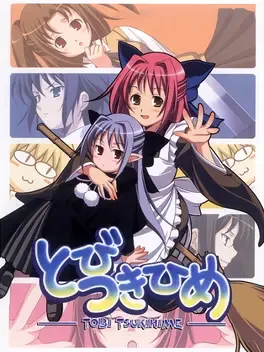
Tobi Tsukihime


Buy
Could be interesting
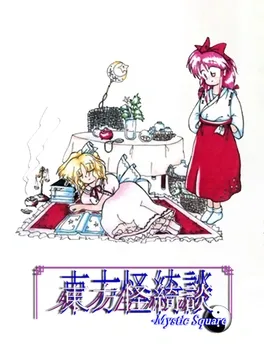
Mystic Square allows the player to select from among four unique protagonists, each hailing from one of the 2 prior danmaku shooting games in the series. Series mainstays Reimu Hakurei and Marisa Kirisame are joined by former enemies Mima and Yuuka Kazami for a journey reaching to the depths of the Makai. Mystic Square also marks the first appearance of Alice Margatroid as an opponent, who later stages a comeback in Perfect Cherry Blossom. Although limited by the PC-98 hardware, Mystic Square is the most refined of the PC-98 Touhou titles, and features gameplay quite similar to Windows Touhou games. It employs a variant of Lotus Land Story's Dream Bonus system, rewarding the player for taking risks (i.e. collecting point items from the top of the field area). Its rank system, however, is more lenient than Lotus Land Story's.
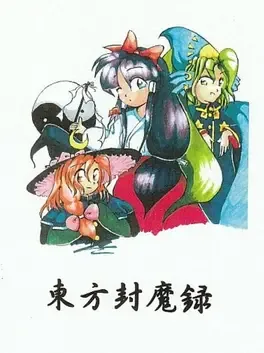
The Story of Eastern Wonderland casts the player as the Shrine Maiden Reimu Hakurei and offers three distinct attack types to choose from: a wide-range type with weak attack power, a mid-range type with moderate attack power and auto-targeting capabilities, and a narrow-range type with high attack power but lowered movement speed. The bombs also exhibit unique behavior depending on the type chosen. As the first danmaku shooting game in the Touhou Project, the Story of Eastern Wonderland introduces many features that are now hallmarks of the series as a whole: relatively small hit boxes, boss characters who are not much larger than the player character however are highly mobile, a power-up system, variable-worth point items, an unlockable Extra Stage, and a semi-complex scoring system. The game also marks the first appearance of Marisa Kirisame, who would become a major character in the series, appearing as often as Reimu Hakurei herself.
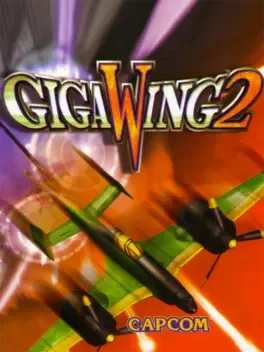
Giga Wing 2 (ギガウイング2?) is a 2000 vertical scrolling shooter arcade game developed by Takumi and published by Capcom on Sega's NAOMI arcade system board and later ported in 2001 to the Dreamcast console. The arcade version is notable both for its excessive scores (scores in the quintillions are not unheard of), and for using a horizontally aligned monitor (much like Treasure Co. Ltd's Radiant Silvergun), something that is considered rare for a vertical shooter.
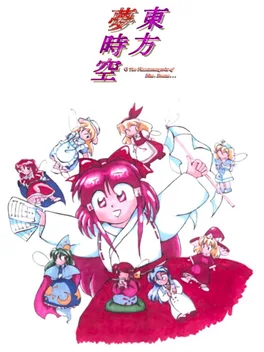
This game is a vertical danmaku shooting game, where two characters engage in danmaku gameplay within individual and separate play areas (aka. split-screen). Upon meeting certain conditions, players are able to unleash a variety of character-specific Spell Attacks upon their opponents in an attempt to whittle down their remaining health points. In Story Mode, the player will face nine opponents, each more capable than the previous. Phantasmagoria of Dim.Dream also features a Match Play Mode where the player may face off against AI opponents or compete against other players, as well as watch AI vs. AI matches.
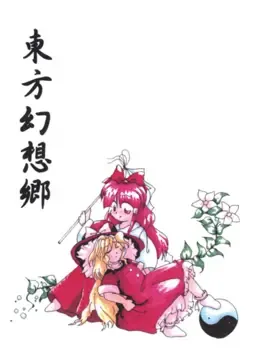
This game features two playable characters to choose from, with two different attack types each. Reimu Hakurei can pepper a wide area of the screen with weaker attacks, while Marisa Kirisame relies on her power to compensate for her narrower attack spread. The bombs also exhibit unique behavior and damage amounts depending upon the character chosen. Lotus Land Story is the first game in the Touhou Project to feature bombs that auto-collect items, graze counting, the ability to move more slowly by holding the shift key, and a non-trivial scoring system that involves the collection of special dream items that boost the player's ultimate scoring potential. The game's scoring system also marks the series' first instance of score bonuses for the elimination of bullets following the defeat of mid-bosses and bosses.
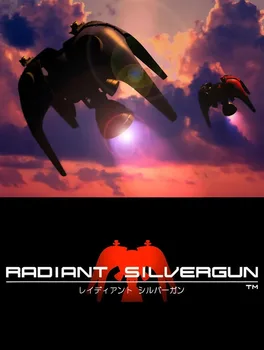
Unlike in most other shoot 'em ups, there are no power-ups. All weapons are available from the start. Weapons can 'level up', however, becoming more powerful as the player uses them to score points. There are a selection of 7 weapons that can be used at any given time: The game is designed so that there is almost always a 'right' weapon for any situation. The bosses in the game are designed so that they have multiple 'sections' which, if all destroyed before the 'core' of the boss, will award the players with point bonuses. Being able to apply the right weapons on any different boss is key to obtaining these bonuses. For example, a boss may have two sections located on either side of the screen. You could immediately go up to one and begin shooting it with a vulcan, or you could hover in the centre and hit both at the same time with the side bombs. This would increase your chance of obtaining the bonus before the time limit runs out and the boss self-destructs. The game rewards players for "chaining" enemies of just one of three colors, red, blue, or yellow. Whenever the player kills three enemies that are of the same color, who can obtain a points bonus. This also facilitates faster upgrading of weapons.
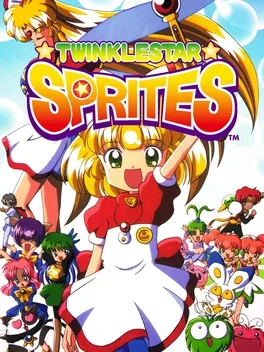
Twinkle Star Sprites is a 1996 competitive scrolling shooter arcade game originally created by ADK. It was ADK's last production for the Neo-Geo platform. The gameplay, which can be characterized as a combination of a fixed shooter and a versus puzzle game, uses combinations of shots, as well as timed power-ups to attempt to damage the opponent. These attacks also serve as counters to the opponent's attack.
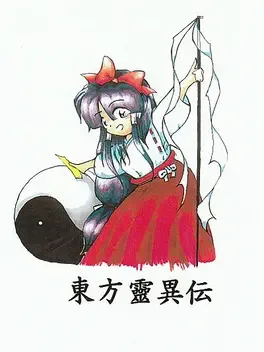
The game introduces the Shrine Maiden Reimu Hakurei, who frantically attempts to persuade a bouncing Yin-Yang Orb to hit various on-screen targets, "cards" and "bosses" alike. Reimu can knock and maneuver the Yin-Yang orb around by whacking it with her gohei, slide-tackling it, and firing shots at it. Enemies will be trying to hinder your progress by firing at you, but you can cancel out their shots with your own, or even deflect them by swinging your gohei. Only the Yin-Yang orb can damage the enemies, however, so simply firing your shots at enemies will have no effect. As a last resort, Reimu can use a "bomb", once per life, to hit all cards on the screen. There is no guarantee that any given card will be hit, and will often fail to damage a boss. The game consists of several stages of increasing difficulty, with a boss fight occurring every five stages. To complete a stage, the player should clear all cards or defeat the boss. Reimu will lose a life whenever she is hit by an enemy projectile or the yin-yang orb. There are two selectable paths in the game: the Hell path and the Makai path. Each route features unique stages, bosses, and endings.

Batsugun is a vertically scrolling shoot 'em up video game created by the now-defunct Japanese game developer Toaplan. The title translates to "exceptional" or "extraordinary". It was the final game created before Toaplan's dissolution, and has been regarded as a key title in the development of the modern manic shooter, with elements of the game such as the size of the player's hitbox, the scale of their firepower, and the complexity of enemy bullet patterns all having an influence on future titles in the sub-genre. Members of the development team also went on to work on other successful manic shooters, most notably lead artist Junya Inoue.
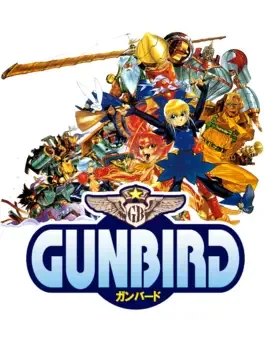
Gunbird uses anime-styled character as the player's chosen craft. A story plays out in between levels and before boss fights, telling a tale of how the protagonists are trying to collect pieces of a magic mirror to make a wish.