
Popular games for collection Buster Bros.
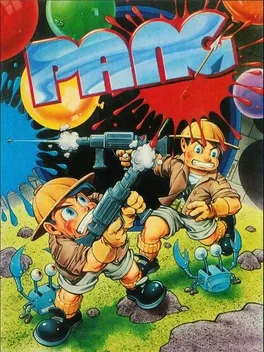
Pang, originally released in Japan as Pomping World and in North America as Buster Bros., is a 1989 arcade action game developed by Mitchell Corporation. Its core gameplay is similar to the 1983 Japanese MSX game Cannon Ball, also released that year for the ZX Spectrum as Bubble Buster. Players embark on a round-the-world quest to destroy bouncing balloons that are threatening landmarks and cities across the globe. The game features 50 stages set in 17 locations, including Mt. Fuji, Mt. Keirin, the Temple of the Emerald Buddha, Angkor Wat, Ayers Rock, the Taj Mahal, Leningrad, Paris, London, Barcelona, Athens, Egypt, Kenya, New York, Maya ruins, Antarctica, and Easter Island. Later versions added additional locations. Each stage includes a background depicting local landmarks, along with a unique arrangement of blocks, some destructible, some permanent, and some hidden with bonus items. Stages begin with balloons of various sizes; the largest balloons split into smaller ones three times before disappearing after the fourth hit. Players start with a single harpoon, though special weapons can drop when balloons are popped. At certain points, food items worth bonus points may also appear. Contact with any balloon results in the loss of a life. In two-player mode, if both players touch a balloon at the same time, only Player 1 loses a life. Similarly, when both reach a bonus or weapon simultaneously, only Player 1 collects it. Players begin with three to five lives depending on dip switch settings, with extra lives awarded upon reaching specific score thresholds. A stage is cleared when all balloons are destroyed, and the game concludes after all stages are completed, ending with the heroes driving their jeep into the sunset on an Easter Island beach.

Super Pang is an adventure for one or two players that takes the player around the world, aiming to rid the planet of a terrible foe: seemingly innocuous-looking bubbles. The main portion of the game is Tour mode, where the player visits a series of different levels representing different countries of the world. Each player's character is armed with a gun, which shoots a vertical cable. If this hits a bubble, it will cause it to split in two. Upgrades allow two cables to be shot at once, or the ability to stick a cable to the ceiling where it will cling for a few seconds, bursting any bubble that hits it. Players must clear each screen of bubbles before progressing to the next one. The largest bubbles will have 4 degrees of splitting before clearing. Many level layouts have ladders, barriers and breakable bricks in part of the screen, affecting movement of both the player and the bubbles. Faster bubbles in the shape of diamonds also bounce around the screen going any which way rather than bouncing in predictable arcs like the other bubbles. Several power-up tokens are also available, offering features such as splitting all bubbles down to their minimal size, freezing the bubbles for a few seconds, and various different weapons. Monsters also enter the screen periodically, which hit the bubbles and take them down a size, and can often be directed by the cable weapon. In addition to the main Tour mode, the game also features Panic mode, in which a succession of bubbles are thrown at at the players. As the player progresses, the amount of bubbles required to reach the next level also increases, similar to scoring on Tetris.

Your character is locked inside an art museum and has to avoid bouncing balloons of various sizes, most of which split when hit. The player has the option of "normal" play with stages or "panic" mode in which balloons will appear continuously. In normal mode, watch out for characters like birds and dogs that will paralyze your character.
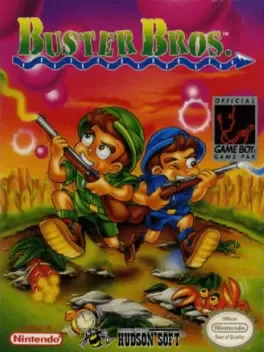
The Game Boy version of Buster Bros. (also known as Pang in some regions) is a portable adaptation of the arcade game developed by Mitchell Corporation. Released in 1990, it retains the core gameplay, where players use a harpoon gun to pop bouncing bubbles while avoiding contact. The game features multiple levels set in different world locations, but with simplified graphics and gameplay adjustments for the handheld system.

Comprising three titles, (Buster Bros., Super Buster Bros., and Buster Buddies), Buster Bros. Collection is a compilation of Capcom's "Buster" arcade series -- released over a period of six years from 1989 to 1995. Gameplay presents a blend of puzzle and action that sees players strafing from side-to-side, shooting vertically at the bubbles that bounce around the arena. Enclosed within the confines of a single, 2D arena, one or two players must utilize their rope-gun devices to destroy the deluge of bubbles that inundate the screen. When hit, the bubbles burst into multiple, smaller segments, and will continue to do so until the smallest bubble is destroyed. Only by clearing the screen can players proceed. However, coming into contact with a bubble will result in the immediate loss of a life.