
Archon


Parent game
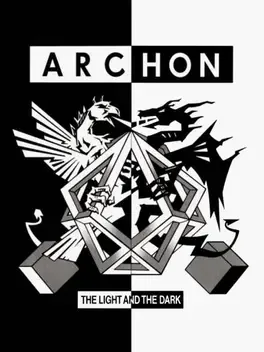
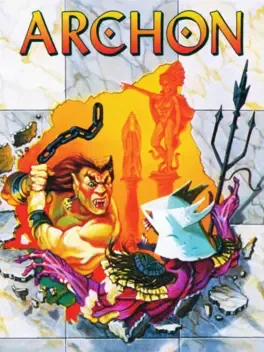
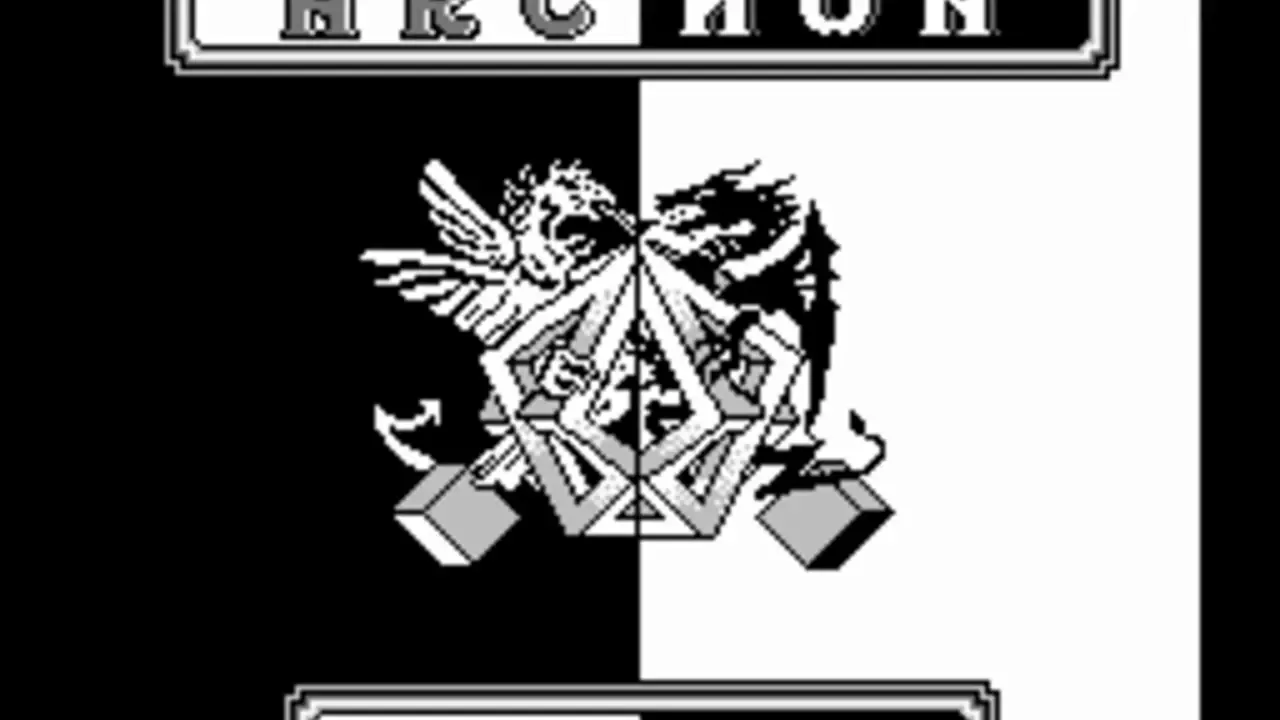
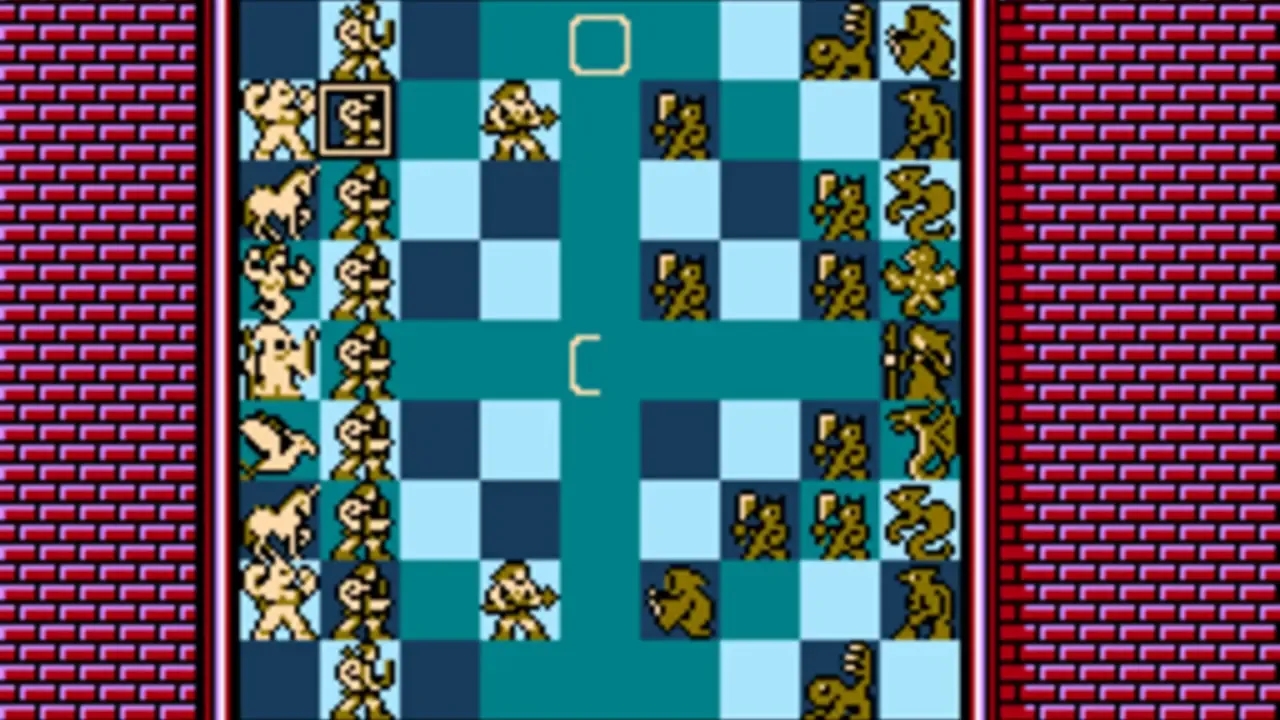
Archon: The Light and the Dark was a game developed by Free Fall Associates which loosely modeled the game of Chess, with a number of additions to the gameplay. It was programmed by Anne Westfall, and released originally for Atari 8-bit computers in 1983. It was quickly ported to a number of different systems, and was well-received.
Part of collection:
Archon
(last 3 games)
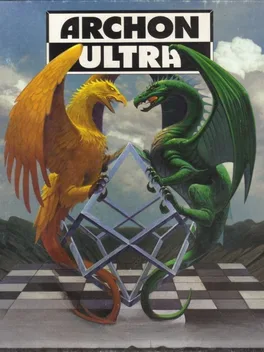
Archon Ultra is an action-strategy video game developed by Free Fall Associates and published by Strategic Simulations in 1994 for MS-DOS. It is a remake of the 1983 game Archon: The Light and the Dark. An expanded remake of the original game, it adds updated graphics and sound, but also includes additional features, most notably the units have secondary weapons and the battle sequences are shown from an isometric point of view to simulate a third dimension in the battles. It also featured a multiplayer mode via modem The goal of the game is either to take control of five power points located on the board, to eliminate all the opposing pieces, or to eliminate all but one remaining imprisoned piece of the opponent's. While the board is similar to a chessboard, and the various pieces are similarly designed to have various offsetting abilities, when one piece attempts to take another, the removal of the targeted piece is not automatic. Instead, the two pieces are placed into a full-screen 'combat arena' and must battle (action-style, with the players running the pieces) to determine who takes the square.
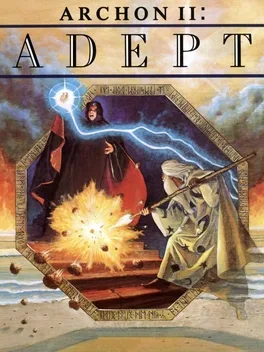
Archon 2 or also Adept is the successor of the successful Electronic Arts classic Archon. As already seen in Archon, an apocalyptic fight takes place in a fantasy surrounding, now not between "light" and "dark" but between "order" and "chaos". It all happens in a game area which is divided into 4 elemental layers. In the center is the earth layer, it is surrounded by the water layer and this is surrounded by the air layer. The outer layer is made of fire. Opposite to its forerunner the players start in Adept only with one magician ("Adept") per layer. All the other creatures have to be conjured in the course of the game. Evocations and other spells cost energy, which is renewed by occupying energy points on the game area with your own creatures. The more points you occupy, the more energy you get. Every side possesses 4 own elemental beings, which have a special force when they are on their corresponding layer. Moreover 4 different demons can be conjured from both sides, which can fight independently from the chosen element. Many of these creatures can use a shooting attack, but they have also lots of special attacks. When two figures meet on a field, here also the screen is zoomed and a fight for life and death starts. The winner claims the hard-fought field. Dependent on the layer you are fighting on, the battlefield has different obstacles such as slowing-down lakes, shoot destracting swirls, flame walls or simply walls ready. The only exception are the two void fields, here no terrain is used
Could be interesting
Phase 10 in the newest rummy inspired game from the creators of the UNO! And Phase 10 is based on a variant of Rummy that has brought friends and families together for over 40 years. Now with online multiplayer for Solitaire, Rummy, Skip Cards, Uno, any card or card party games lover!
Now it's time to play Rummikub free online against real players or AI. The basic goal of the tile-matching game is to create melds of number tiles in your hand. You get 14 tiles at the game start, and have to create groups or runs on your turn. A group is a combination of three or four tiles with the same face value, but of different color, such as blue 8 + red 8 + back 8. A run is a sequence of numbers of the same color, e.g. red 2, 3, 4 and 5. On your turn, you get a tile and have to create melts using the tiles on the table, and the initial has to score at least 30 points. This online board game requires matching and strategy skills, and is fun for kids and adults to play.
Welcome to the Cards Against Humanity Lab! This solo version of the game helps us figure out which cards are fan-favorites and which cards are real stinkers when we update the game and release new expansions every year.
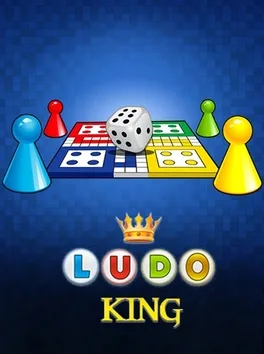
Ludo King is a cross platform multiplayer game that supports Desktop, Android, iOS and Windows mobile platform at same time. This game also support offline mode, where player can play with Computer or, Local multiplayer (pass and play mode).
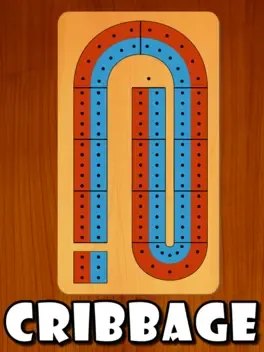
The classic card game Cribbage Online also known as Crib, Cribble, and Noddy. A multiplayer card game traditionally for two players, that involves playing and grouping cards in combinations which gain points. Cribbage has several distinctive features: the cribbage board used for score keeping, the crib, box, or kitty, a separate hand counting for the dealer, two distinct scoring stages (the play and the show), aces low, and a unique scoring system including points for groups of cards that total fifteen. Cribbage is a Trump style Card game.
Play UNO! in a whole new way! The classic card game comes to your mobile device with new rules, tournaments, modes of play, and much more! Whether you’re at home, on the go, an UNO veteran or completely new, UNO! has something for everyone in the family!
Advanced version of the popular Canasta card game also known as Argentine Rummy. Use of joker cards makes the game unpredictable and very challenging. You play as a team with computer opponent against computer team. Pick up cards and fit them into groups (melds). Group of seven cards called canasta and allows team to finish the round. Points go for the melds, the first team scoring 5000 points wins. This version includes following features: - Three levels of difficulty. - 1 or 2 drawing cads from deck. - Enhanced game statistics.
Spider Solitaire, also known as Microsoft Spider Solitaire (Spider in the About box in some versions), is a solitaire card game that is included in Microsoft Windows. It is a version of Spider. As of 2005, it was the most played game on Windows PCs, surpassing the shorter and less challenging Klondike-based Windows Solitaire. The game was first included as part of Windows 98's Microsoft Plus! package and has been since featured on most subsequent versions of Windows. Spider Solitaire was not included in Windows 2000, but was added to Windows ME and later on Windows XP; the game gained popularity subsequent to its inclusion in the latter. Windows Vista again saw a new version, which was mainly unchanged in Windows 7. Finally, Windows 8 has another updated version available in the Windows Store as part of Microsoft Solitaire Collection but not bundled with the operating system.
