
Darius Alpha


Buy
Parent game
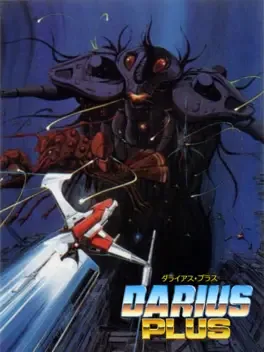
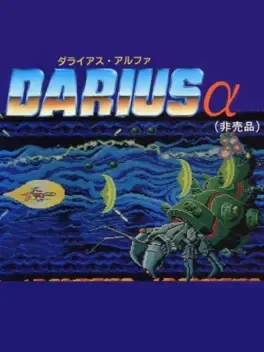
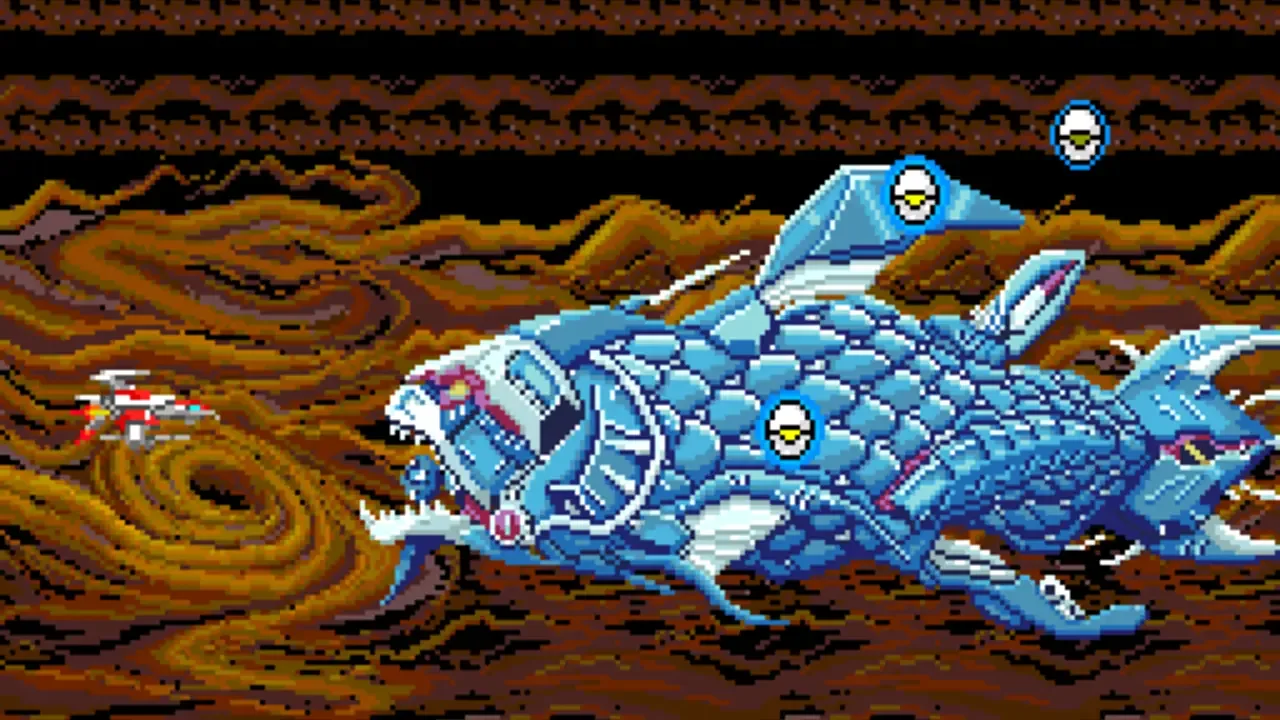
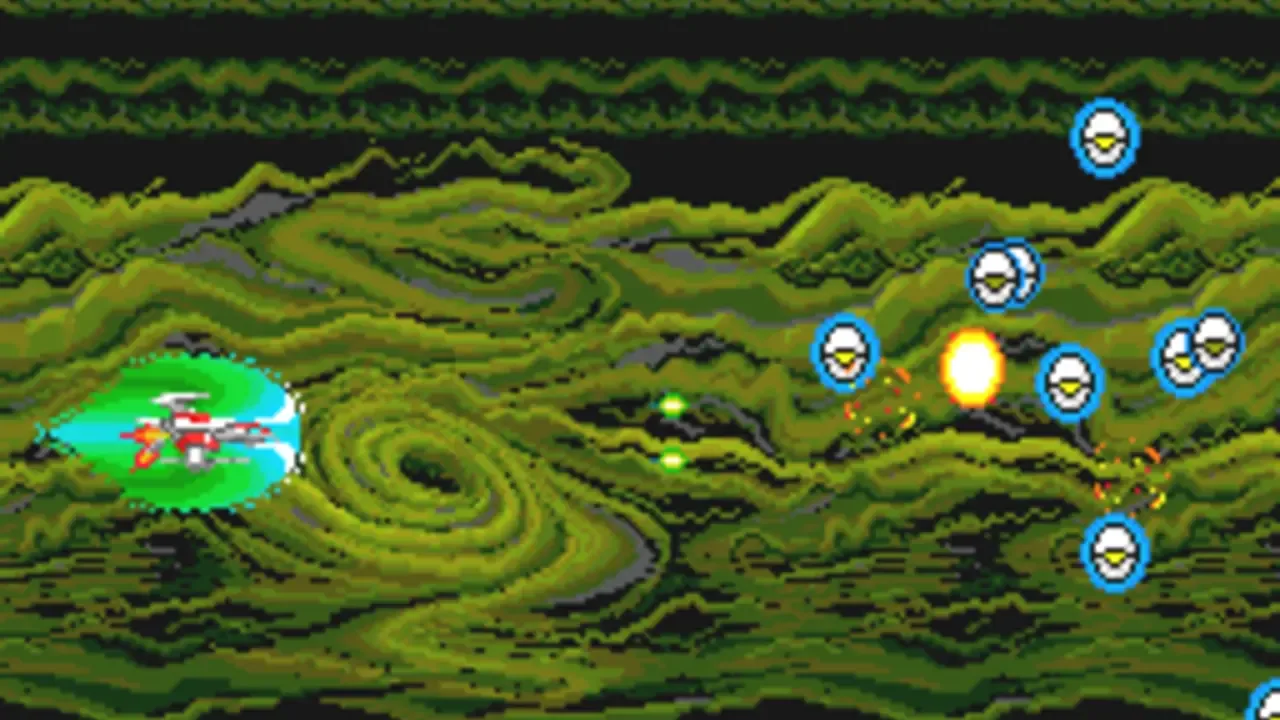
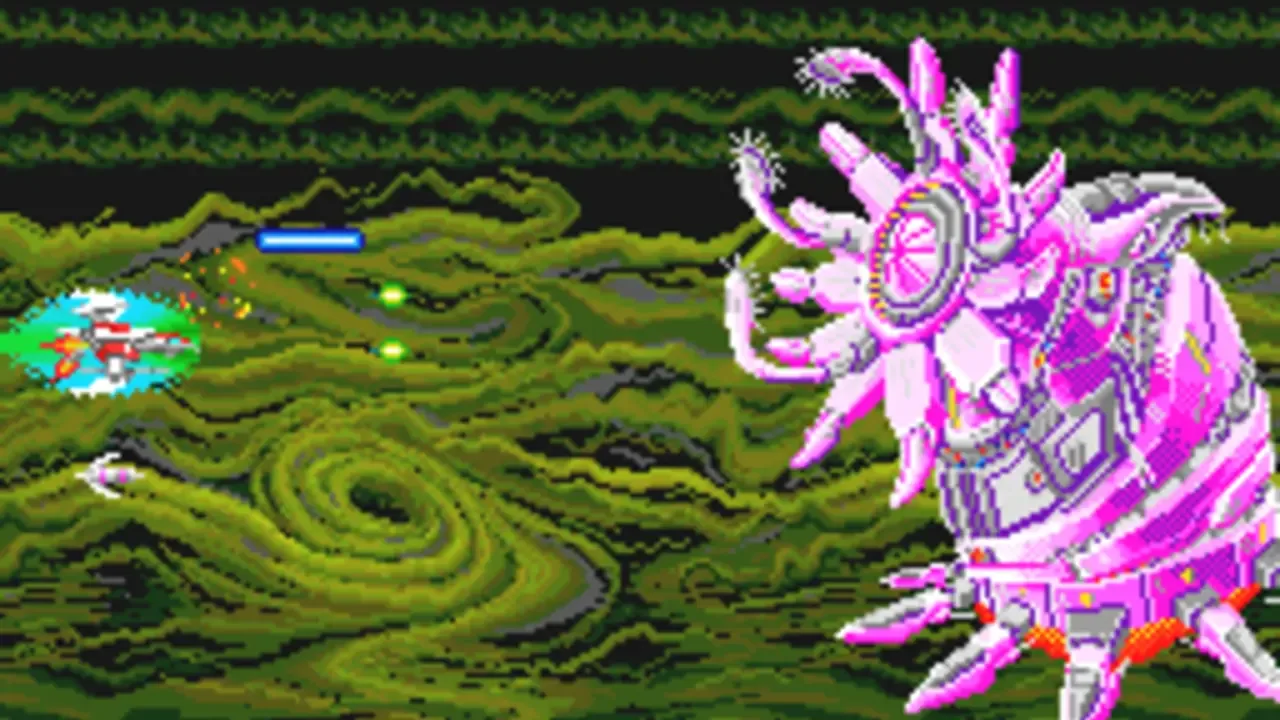
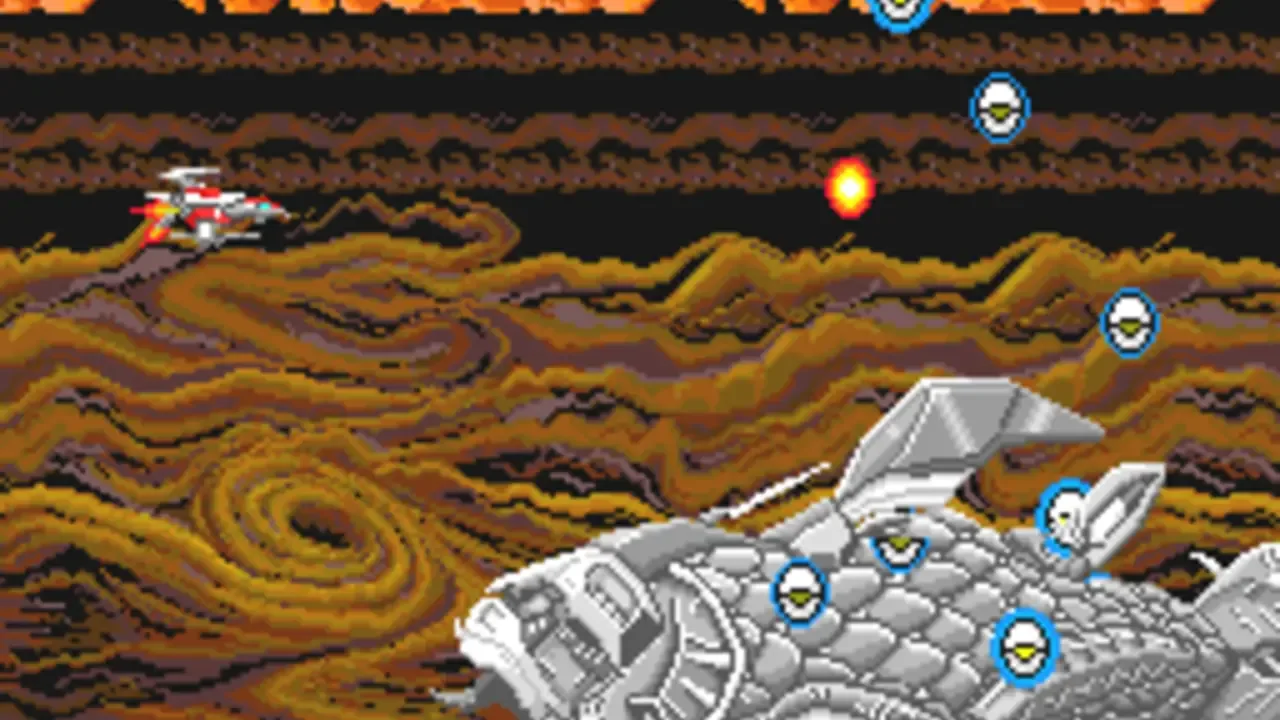
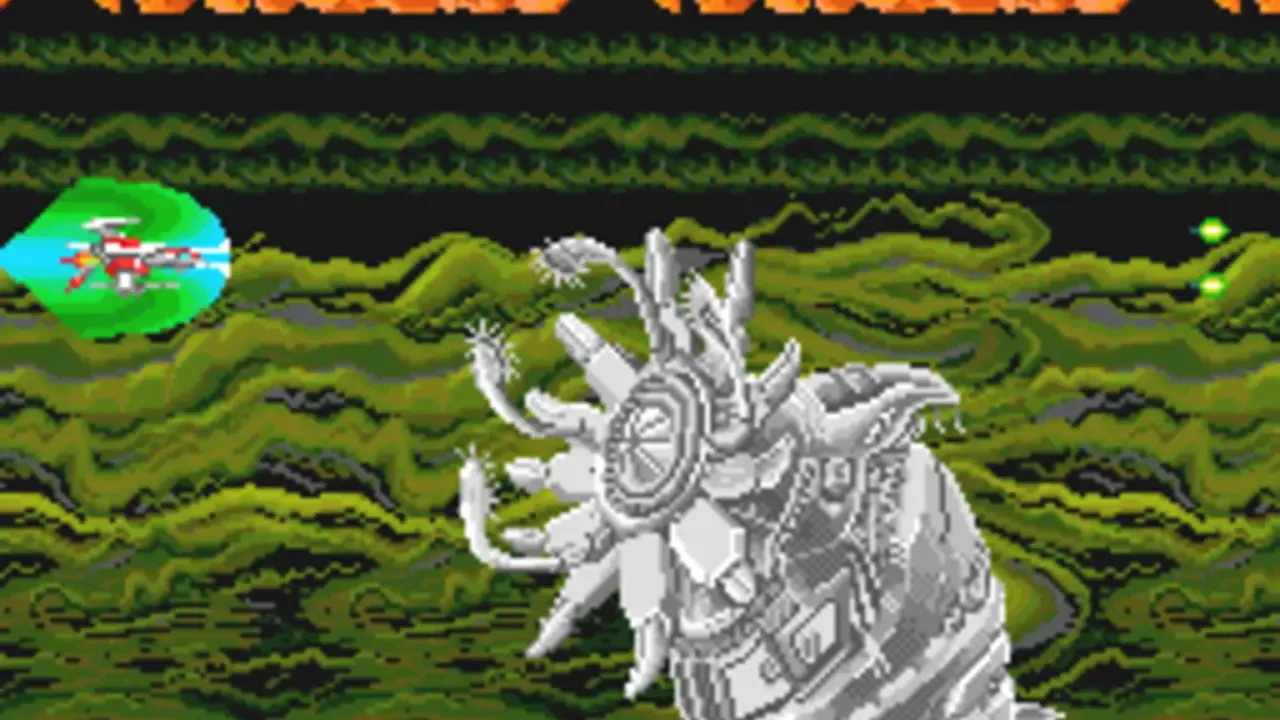
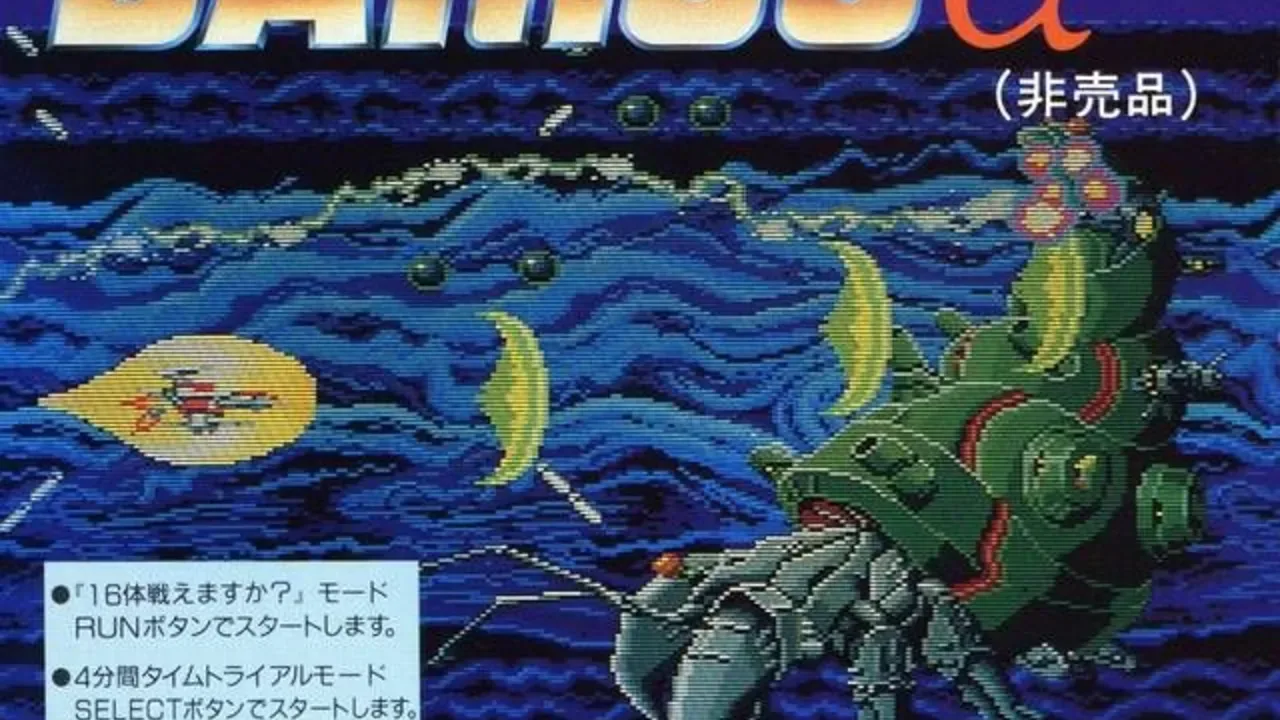
NOTE: "Darius Plus" is the TurboGrafx-16 PC-Engine port of the original Darius produced by Bits Laboratory and NEC Avenue. This is a different port than the title "Darius+", which was published by The Edge and developed by Softek for the Amiga, Atart ST, and ZX Spectrum. Amidst the clutter of arcade shooters in the late 1980s, companies needed to make their games stand out in some way. Simply flying a ship into outer space simply wasn't going to cut it anymore. Taito had an idea. Yes, there was still a spaceship. And yeah, that "outer space" part was still there too. But instead of the usual aliens, you fought fish. Yes, fish. Not even regular, aquatic fish, but robotic fish with lasers equipped to their fins, giant metal teeth and missiles firing from their gills. And not just fish either. There are squid, snails, and other undersea variations out for your blood as well. The requisite plot is about the people of the planet Darius, who are being terrorized by said intergalatic fish. Only the heroic pilots Proco Jr and Tiat Young can save the day. The constant star of the Darius series is the Silver Hawk. Much like Gradius, it has a primary, forward firing weapon, along with bombs that can be used to attack vertically, and the usual shield. The arcade game Darius games also used a unique system that attached three monitors together to create one massive horizontal playing field (also used in Taito's Ninja Warriors.) Naturally, this couldn't quite be replicated on the console system, so that nifty little gimmick is lost, but emulators can still replicate the dimensions of the screen, even if you end up looking at a tiny picture. Looking to further set itself apart from the crowd, every Darius game has multiple levels, with several branching paths throughout the game. It adds tremendously to the replay value, especially since there are usual multiple endings, depending on which final zone you end up at. Darius is a two-dimensional horizontally scrolling shoot 'em up set in a fictional future. Uniquely among shoot 'em ups, the game's screen was three times wider than conventional size, and the arcade cabinet used an arrangement of three screens to accommodate it. The player controls an ornate fighter spacecraft, named the Silver Hawk, and must navigate through scrolling terrain while battling a variety of fighter craft, ground vehicles, turrets, and other obstacles throughout the game's stages (referred to as zones in the game). The ship's arsenal consists of forward-firing missiles, aerial bombs and a protective force field, all of which can be upgraded by power-ups (in the form of large, colored orbs) that are dropped by specially-colored enemies throughout the game's zones. When the player reaches the end of a zone, a boss appears, which must be defeated to proceed. Once the boss of a zone is destroyed, the player is given a choice of which zone to play next via a branching path. While there are 28 zones in total, only seven can be played in a single run. When various ports of it were made for different consoles, Taito (and others) were forced to shrink the playfield to fit on one screen. The PC Engine saw three releases: - Darius Alpha (1990): A very rare beta release. This is one of the rarest Hu-Cards ever published. You could only get a copy of this hardcore shoot-em-up by buying Darius Plus and Super Darius and then mailing coupons to the publisher. 800 copies were made available, and names were drawn from those who mailed their info in. Some copies of the game were also given away as prizes by PC Engine Gekken and Marakatsu magazines. - Darius Plus (1990): The full game itself, again a PC Engine HuCard. The bosses that were removed in Alpha do not return here. Both Alpha and Plus were actually written for the PC Engine SuperGrafx and playing them on that console results in slightly improved graphics (less flicker and slowdown). - Super Darius (1990): A conversion of Darius for the PC Engine's Super CD-ROM, very close to the original arcade version other than being single-screen. Features new bosses, as well as a "boss rush" mode.
Part of collection:
Darius
(last 3 games)
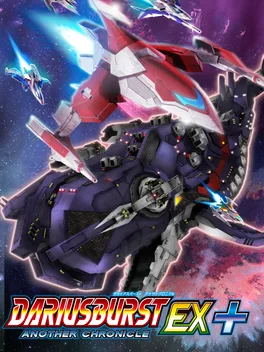
Taito's Darius series began with the titular arcade game, Darius, in 1986 and comprises numerous side-scrolling shooting games released in arcades, many of which were later ported to game consoles. This game is a port of the 2010 arcade game, DariusBurst Another Chronicle EX, including the final update and exclusive new features for this version. It adds the previously omitted Event Mode, with brand new events too, and also includes the Murakumo ship, playable across all modes.
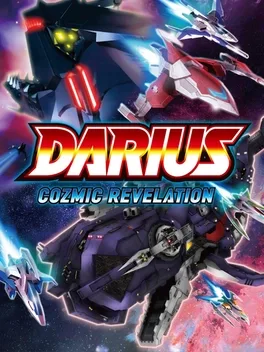
A sequel to the Cozmic Collection, Darius Cozmic Revelation was released for PlayStation 4 and Nintendo Switch on February 25, 2021 in Japan, containing the games G-Darius HD and Dariusburst: Another Chronicle EX+. The western release will contain the Game Boy version of Sagaia as a bonus on the cartridge. A future update also adds G-Darius Ver. 2 to the compilation.
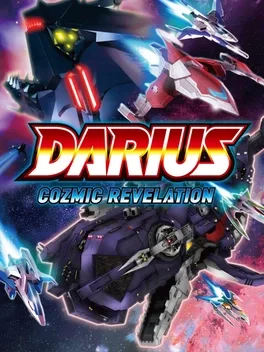
A sequel to the Cozmic Collection, Darius Cozmic Revelation was released for PlayStation 4 and Nintendo Switch on February 25, 2021 in Japan, containing the games G-Darius HD and Dariusburst: Another Chronicle EX+. The western release will contain the Game Boy version of Sagaia as a bonus on the cartridge. A future update also adds G-Darius Ver. 2 to the compilation. Included with the Famistu DX Pack of Cozmic Revelations - Special Edition is a packaged copy of Darius: Extra Version, released for the Sega Mega Drive in 2020. The Collector's Edition contains: - Darius Cozmic Revelation Game for Nintendo Switch - Collector’s box with magnetic latch - Darius PCB Box - DARIUSBURST ANOTHER CHRONICLE Live in O-EAST -revolt- Blu-ray with Zuntata bonus feature by Audi Sorlie and John Linneman. - Arcade Papercraft - Hardcover Artbook (localised in English) - 4 Acrylic Art Cards - PVC Standee - DARIUS THE OMNIBUS III Arrange CD - Darius Revelation Pin
Could be interesting
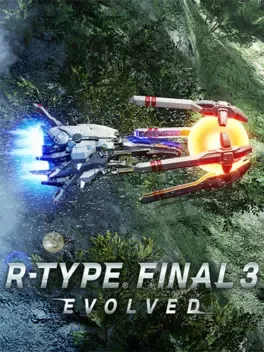
R-Type Final 3 Evolved serves simultaneously as a sequel to R-Type Final 2, offering a whole new 7-stage campaign made in the engine of Final 2, whilst also serving as a compilation of most of content released for R-Type Final 2. Additional features such as R-Park, an online area where one can interact with other players.
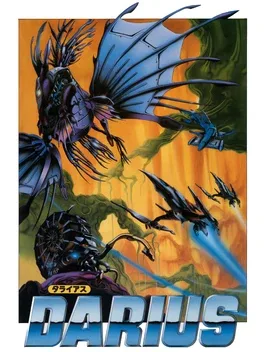
Darius is a two-dimensional horizontally scrolling shoot 'em up set in a fictional future. Uniquely among shoot 'em ups, the game's screen is three times wider than conventional size, and the arcade cabinet uses an arrangement of three screens to accommodate it. The player controls an ornate fighter spacecraft, named the Silver Hawk, and must navigate through scrolling terrain while battling a variety of fighter craft, ground vehicles, turrets, and other obstacles throughout the game's stages (referred to as zones in the game). The ship's arsenal consists of forward-firing missiles, aerial bombs and a protective force field, all of which can be upgraded by power-ups (in the form of large, colored orbs) that are dropped by specially-colored enemies throughout the game's zones. When the player reaches the end of a zone, a boss appears, which must be defeated to proceed. Once the boss of a zone is destroyed, the player is given a choice of which zone to play next via a branching path. While there are 28 zones in total, only seven can be played in a single run. A Sega Mega Drive port was produced in 2019 that is pre-installed in the Mega Drive Mini as a bonus game.
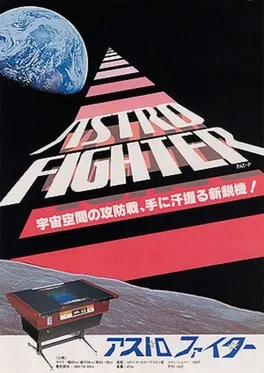
The game of Astro Fighter consists of 4 waves and a refueling stage, which are then repeated with increasingly higher difficulty. The player's task is to eliminate the four successive waves of different types of attacking craft, while avoiding being hit by missiles and bombs, and then refuel by shooting the 'GS' ship before repeating the process. The player starts with 3 lives and receives a bonus life on reaching a score of 5000. 300 bonus points are received for shooting each 6 falling bombs and for 950 for hitting the GS ship accurately on the first shot. A very large bonus of 10,000 is given for getting through 4 waves and refueling by using exactly 2 shots more than the minimum needed. As the higher levels of Astro Fighter are difficult to survive consistently, even for the best players, the highest scores have been achieved by the achieving the 10,000 bonus deliberately.
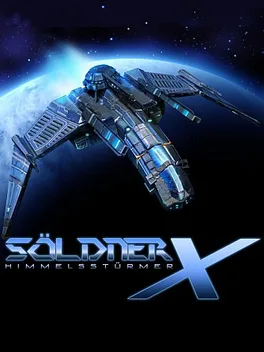
The celestial planet Conceyta orbits with its moon in a dust- and gas-covered solar system. Within lurks an evil unknown to man that bears a danger so much greater than any threat yet witnessed. A dark, mysterious power has manifested itself in the depths of the gas giant, absorbing life and technology, and assimilating all in its wake. Spacecraft, pilots, androids, and computers: Nothing is safe. No one can escape the virus that infects all life forms, turning once brave heroes and peaceful colonists alike into ravaging, chaotic forces, fighting each other and infecting more in the process. Soulless technology and hate-driven humanoids are all that's left of Earth's once-proud fleet. The galaxy as we know it is threatening to fall apart. War, death, and bedlam have taken hold of civilisation. Humankind is at the brink of extinction. Those who aren't yet infected--the resistance, a band of mercenaries, soldiers and civilians--are Earth's final hope, and they have one goal in common: To stop the deadly infection and destroy the core of all evil, hidden in the depths of Conceyta. Scouts have undertaken a merciless mission to bring detailed plans and data on the location of the power and its defence line in a last attempt to save humankind. So it has come to be that the last remaining pilot, a mercenary and bounty hunter, is the only chance of survival, ironically driven by the desire for wealth and fame. Left with little choice, the resistance has developed a star fighter capable of intercepting the evil force, equipped with a deadly weapon system and of utmost agility. With no time to lose, the 10th and final prototype of the ship is handed to the pilot. Its name: "Sldner-X". Should the pilot succeed, his name shall live on in the memories of man forever to come. And so the battle begins.
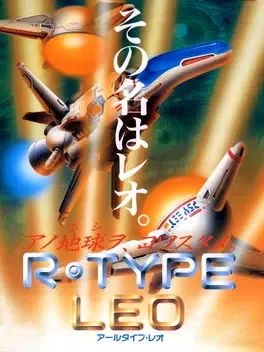
R-Type Leo is a horizontally scrolling shooter arcade game. It is a spin-off of the R-Type series and the last entry to be released in Arcades. R-Type Leo was initially an original shoot 'em up game in development by Nanao before Irem retooled it into an R-Type project instead. It is also the first R-Type game to feature simultaneous two player gameplay.
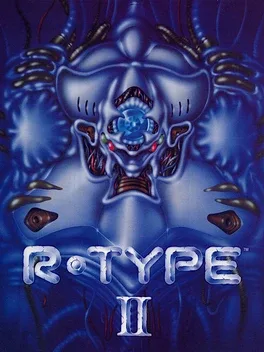
The game is the sequel to R-Type, which was first released as an arcade game in 1987 and profoundly influenced later shooting games with its charge shots, unique weaponry, and grotesque enemies. Hudson Soft ported the later 4 levels of the original R-Type to the PC Engine with the title R-Type II, but the Hudson release is unrelated to the game described in this article. The player controls a ship called the R-9C (or R-9 Custom), which is an improved version of its predecessor game's ship; the R-9. The ship's design was changed slightly, and the wave cannon was given homing capabilities. Two new types of weapons (the Search Laser and Shotgun Laser) were added, bringing the total number of weapon types up to five. A new anti-ground unit bomb was also added to the missile inventory. Though the number of levels was decreased from the prequel, the number of enemies, their durability, and the number of bullets they shoot were greatly increased. Enemy movements and terrain were also made trickier, bringing the game's difficulty up considerably. The same revival system is used as in the prequel, where the player is brought back to a checkpoint whenever their ship is destroyed. The controls are mostly unchanged from R-Type, where the 8-way joystick controls the ship's movement, and the shot button fires the ship's main beam. The other button is used to equip or unequip Force; the series' most unusual innovation. Pressing down the shot button causes the blue beam gauge to fill up, and releasing the button causes a wave beam to travel a certain distance depending on the length of time the button was pressed down. If the button is pressed down until the blue gauge is fully charged, a red gauge appears and fills up quickly. Filling up the red gauge causes it to flash blue and red, releasing the shot button at this point shoots an even more powerful beam. Unlike the normal beam that only travels in a straight line, the newly added Shotgun Laser beam explodes in multiple directions after traveling a short distance. This shot causes heavy damage if the player can target a single enemy with it. However, holding the button down after the gauge is flashing causes the beam to return to the normal transverse beam (the gauge alternates between flashing and returning to the normal state while the button is held down), so the player must release the button at the right timing in order to successfully target enemies. The other newly added beam, the Search Laser, is semi-homing, and can bend at angles up to 45°.
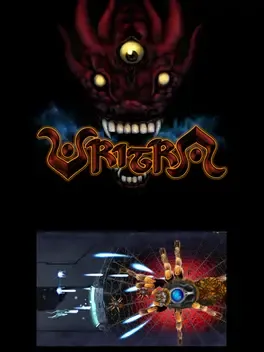
Throw down a challenge to all the 80s and 90s gamers. Get back the enthusiasm you had once! Control the dragon and the vajras, and destroy the evil Dragon Emperor "VRITRA"! Awesome graphics, powerful sound effects and amazing controls. This ultimate 2D shooter is a step forward in the history of the shooting games!
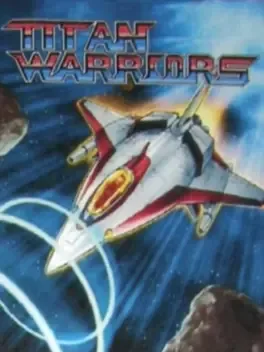
Titan Warriors is a cancelled shoot-'em-up that was developed by Capcom for the NES / Famicom, in 1988. The game was meant to be a sequel of Vulgus, an arcade shooter developed and published by Capcom in Japan in 1984.
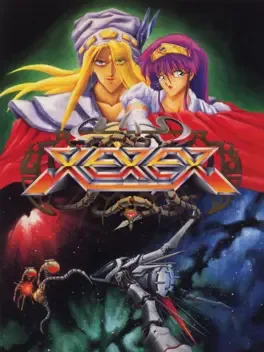
Xexex is a 1991 side-scrolling shoot 'em up arcade game by Konami released in Japan. It draws on Irem's R-Type and Konami's other shoot 'em up Gradius, while adding the tentacle mechanics of Irem's other shoot 'em up XMultiply. In the game, players pilot a ship called the Flintlock in order to save a blue haired princess named Irene of the planet E-Square from an evil lord named Klaus. Each stage is punctuated with a cutscene of the princess crying for help as she is tortured. In the ending, the Flintlock sends the orb back through the atmosphere of the planet, where it morphs into a naked fairy. There are different gameplay mechanics between the original Japanese release and the overseas releases.
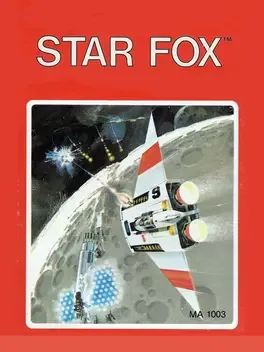
Star Fox is a video game for the Atari 2600 console, developed and published by Mythicon in 1983. Although the front cover of the game states "Game 1 in Star Fox Series," no sequels were ever made, which is most likely because it received negative reception