
Dune Dynasty

Parent game
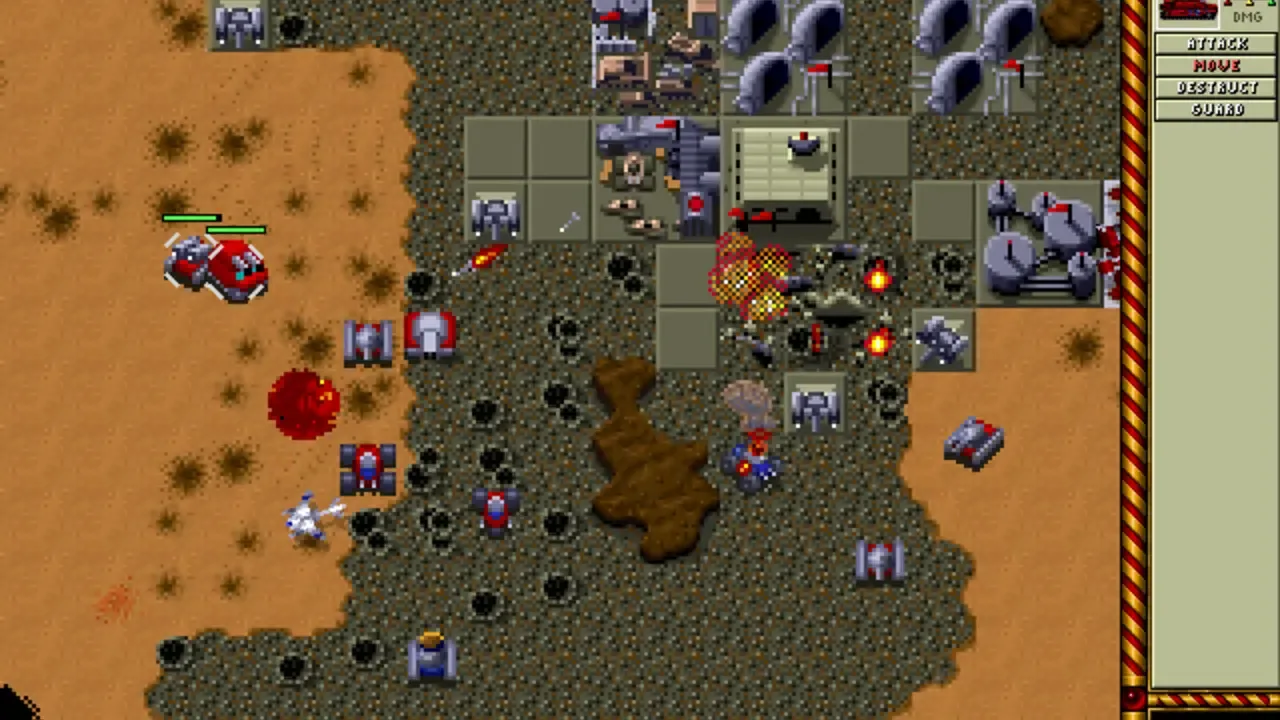
Dune II is often considered the first mainstream modern real-time strategy game and established many conventions of the genre. Even though set in Frank Herbert's famous Dune universe, the game is only loosely connected to the plot of any of the books or the films based from them. Controlling either of the three Houses, the player must fight a number of battles against the other Houses. In the early levels, the goal is simply to earn a certain number of credits, while in the later missions, all enemies must be destroyed. The single resource in the game is the Spice, which must be collected by harvesters. The spice is converted to credits in a refinery, which are then spent to construct additional buildings and units. There are two terrain types: buildings can only be constructed on stone, while the Spice is only found on sand. However, units moving on sand attract the large sandworms of Dune, who are virtually indestructible and can swallow even large units whole. As levels progress, new and more advanced buildings and units are made available, including structures like a radar station, a repair facility or defense turrets and, for units, various ground troops, light vehicles and tanks. Each House can construct one unique special unit, and, after building a palace improvement, can unleash a unique palace effect.
Could be interesting
Dune Legacy is an effort by a handful of developers to revitalize the first-ever real-time strategy game. It tries to be as similar as possible to the original gameplay but to integrate user interface features most modern realtime-strategy games have like selecting multiple units
Dark Reign narrowly beat Total Annihilation as the first RTS to incorporate 3D movement and positioning. This increases the strategic advantage of hills and mountains. Each mission puts you in the role of commander of either the Imperial army or the Freedom fighters in a campaign to undermine and eventually destroy the opposing force. This game has many unusual features for the RTS genre. AI patterns you to simply give a unit the order "Search and Destroy" and it would drive off towards the enemy's last known location, in search for something to kill. There is also "explore" mode which let your units do all the map exploring for you. A mission/campaign editor is also provided.

The second title in the Galaxy Online series by IGG.
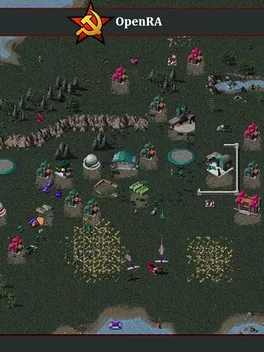
A free and open-source RTS bringing back the classic Command & Conquer, Red Alert, and Dune series by Westwood Studios, with updated user interface, superb multiplayer mode and balance tweaks.
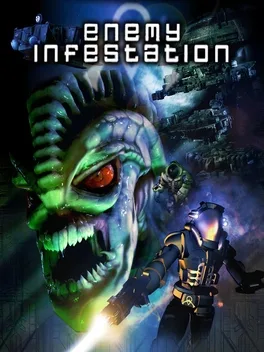
Set in the 24th century, a group of unsuspecting colonies are attacked by a swarm of aliens who want to preserve their race. Now it's up to you to save the colonists and stop the aliens from taking over the planet. Enemy Infestation is a squad-based RTS similar to games like Gender Wars and Commandos. The game is seen from an isometric view similar to Diablo and Crusader. Game missions range from killing off all the aliens, saving colonists and alot more. Players will have the ability to modify their squads weapons, which range from lasers to missile launchers. The game supports multiplayer up to 4 players on LAN and Internet. It even supports single player co-op.
I of the Enemy (IOE) is a unique experience of sci-fi wargaming and innovative gameplay for single player offline or up to 8 opponents battling over the internet or a LAN.
Militarism, also known as "Generals of War" in Germany", is a science fiction real time strategy game. The Malkari, an alien race, have conquered and destroyed earth. Fight in two campaigns as the humans or the aliens with modern weapon systems like tanks or planes and even orbital cannons. Multiplayer is possible via LAN and internet.

A real-time steampunk strategy game were you are a potat. Potat destruction 4 styles, Plant, Mental, Energy, Insect. Gather resources, improve, defend your lab, use inventions like random gravity check, whos frying now. Place inventions in the town, for potat mayhem!
Overlord is a real-time strategic warfare game where the player must manage large standing armies, economic capital, and political stability throughout a number of extra-dimensional star systems. As the dictatorial ruler of the Epsilon Galaxy, the player has obtained complete, indisputable authority. However, during a scientific experiment in hyperdrive technology, Epsilon scientists discovered four "buffer" dimensions, each containing a number of barren planets that exist between the Epsilon Galaxy and another alien dimension. Unfortunately, the most powerful empires from these alternate dimensions have also just discovered these zones through their own experiments. The player must battle these alien species for control of these buffer worlds, to ensure that their rule in the Epsilon Galaxy remains intact. To make the new planets useful in the player's campaign, they can purchase terraforming equipment which can transform them into tropical Gaian-esque worlds which are ideal for agriculture, mineral-rich and heavily volcanic worlds, desert planets capable of producing vast amounts of energy, or ecologically balanced planets that can support large cities which are readily able to generate significant income through taxation. In addition, the player can mine for resources and tax their citizens to raise money, construct spaceship-buildings to feed the populace, enlist soldiers and equip them, buy battle cruisers or other craft to move from planet to planet, and so on. The player can fight battles, colonize planets, and even spy on alien races. The end goal is to ensure that the other alien races do not gain the upper hand by conquering these four new dimensions before the player can. The player cannot retreat from battle, as the only way to shut down the hyperspace link from their universe to Epsilon would be by vaporizing the player's homeworld, which is where the hyperspace generator is located. Politically (at the very least), this is not an option. Blood will have to be shed for supremacy of the hyperspace planets, and for the player to become Overlord of these four new dimensions plus their own.