
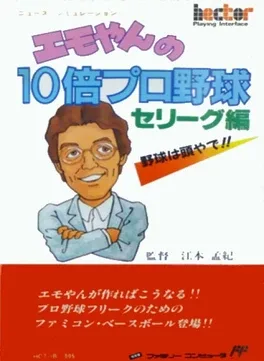
Emoyan no 10-bai Pro Yakyuu
Buy
Could be interesting

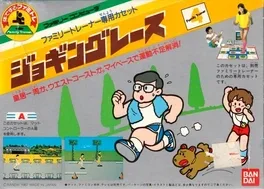
An exercise game created for the Family Trainer (the Japanese name for the NES Power Pad) developed by Human and published by Bandai. Jogging Race is the fourth game created by Bandai for the Family Trainer (US: Power Pad) accessory for Famicom systems. It was one of the many games that used the peripheral that did not see a release outside of Japan. As with other Family Trainer games, the emphasis was on receiving a work out using the Famicom, a conceit that would later find greater success with the Nintendo Wii and the Wii Fit games. Specifically, Jogging Race is about jogging through areas of a simulated Tokyo using the pad to simulate the exercise. The background scrolls by slowly, accurately matching the scale of the distances found in the real location, and will occasionally include additional details like other joggers. There is also a second mode named Marathon, in which the player competes in a long distance race with other CPU runners.

Sanrio Cup: Pon-pon Volley is a Sports game, published by Character Soft, which was released in Japan in 1992.

Buster Ball is an Action game, published by Riverhillsoft, which was released in Japan in 1992.
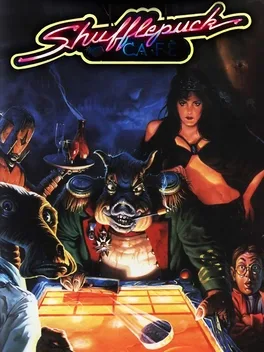
Shufflepuck Café is a computer air hockey game developed by Christopher Gross, Gene Portwood and Lauren Elliott for Brøderbund. There are two game modes. The player can compete in a tournament, playing against opponents who visit the Café, or can practice against each opponent to find out his/her/its weakness in a single-player match. There is a general storyline behind the Amiga version of the game in which the player is an inter-galactic salesman whose spaceship has broken down. He needs to find a telephone to call the breakdown service and get the spaceship fixed. Shufflepuck Café is the nearest place for miles, so he goes in to use their telephone. The main eight Shufflepuck players are standing in his way and will not let him get to the phone until he has beaten them all. Once all are defeated, the player gets in his spaceship and flies off into the distance.

Namco's baseball simulator for 1990.
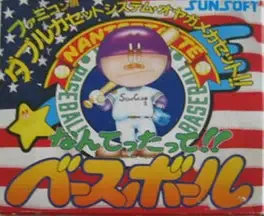
A baseball game by Sunsoft released on the Family Computer in 1991. Nantettatte!! Baseball is a baseball game with the innovative feature of being able to update team rosters without needing to buy a brand new full price game. This is done by inserting a mini-cartridge that updates the roster into the main game.
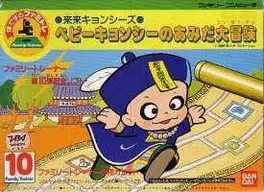
The tenth and final Bandai game to use the Family Trainer/Power Pad accesssory for the NES. The player helps a baby kyonshi (jiang shi) find its parents. Family Trainer: Rairai Kyonshizu is the final game in Bandai's series of Family Trainer games, intended for use with the peripheral of the same name (called the Power Pad overseas). It is based on a TV show about a young Kyonshi - better known as the Jiang Shi Chinese hopping vampire outside of Japan. The player, as the Kyonshi, must complete various mini-game challenges in order to help it reach its parents. The subtitle for this game is "Baby Kyonshii no Amida Daibouken" or "Baby Kyonshi's Ladder Adventure" - the ladder randomly determines the next mini-game.
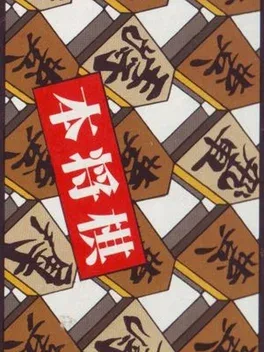
A video game biased off of the board game Shogi (Japanese Chess). It was developed and published by SETA Corporation to be released August 10, 1985, exclusively in Japan for the Nintendo Entertainment System. The game is named for Naito Kunio Kudan, a famous Shoji player from Japan. Born November 15, 1939, Naito has been a professional Shoji player since he was 18 years old. In addition to helping with this video game, Naito Kudan is a published author, having 13 books written about Shoji and running a column in the sports section of the newspaper. He is also a published singer but mostly does it as a hobby. In 2010 Naito was honored with the Order of the Rising Sun, twin Mitsuaki, the fifth highest honor a citizen can receive in Japan. Honshogi: Naitou Kudan Shogi Hiden, follows the standard rules of Shoji (Japanese Chess). There is no ability to change the difficulty or handicap. Most of the screen is the Shoji board, but there is also a representation of the player and computer playing Shoji in a Japanese setting, which moves as the game moves. The player always starts first, with the fastest possible way to beat the computer set at 15 hands/turns. Honshogi: Naitou Kudan Shogi Hiden was entered into the first annual World Computer Shoji Championship in 1990. It was the only NES entrant out of the six entrant, software versus software competition. The game finished in forth place, with a record of two wins and three losses.

Kawa no Nushi Tsuri is a fishing role playing game, developed by Yuu Yuu and published by Pack-In-Video. It is the first game in the "Legend of the River King" series. But it was never released outside of Japan. The game is unique in that it combines fishing with traditional JRPG elements with those of Fishing games.