
Famicom Mukashibanashi: Yuuyuuki - Kouhen


Buy
Parent game
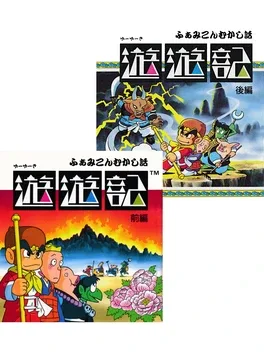
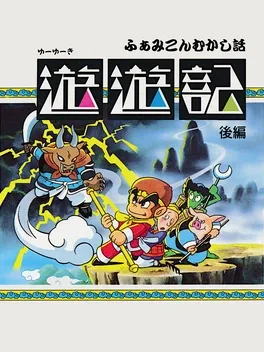
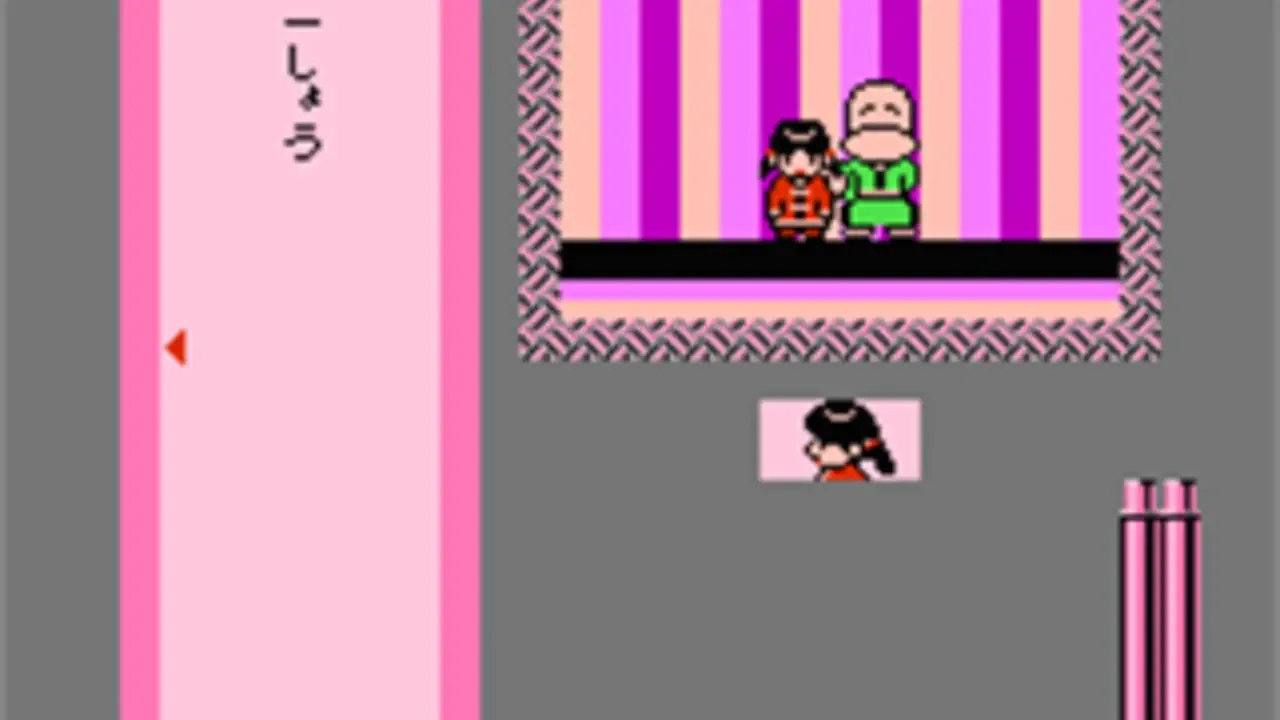
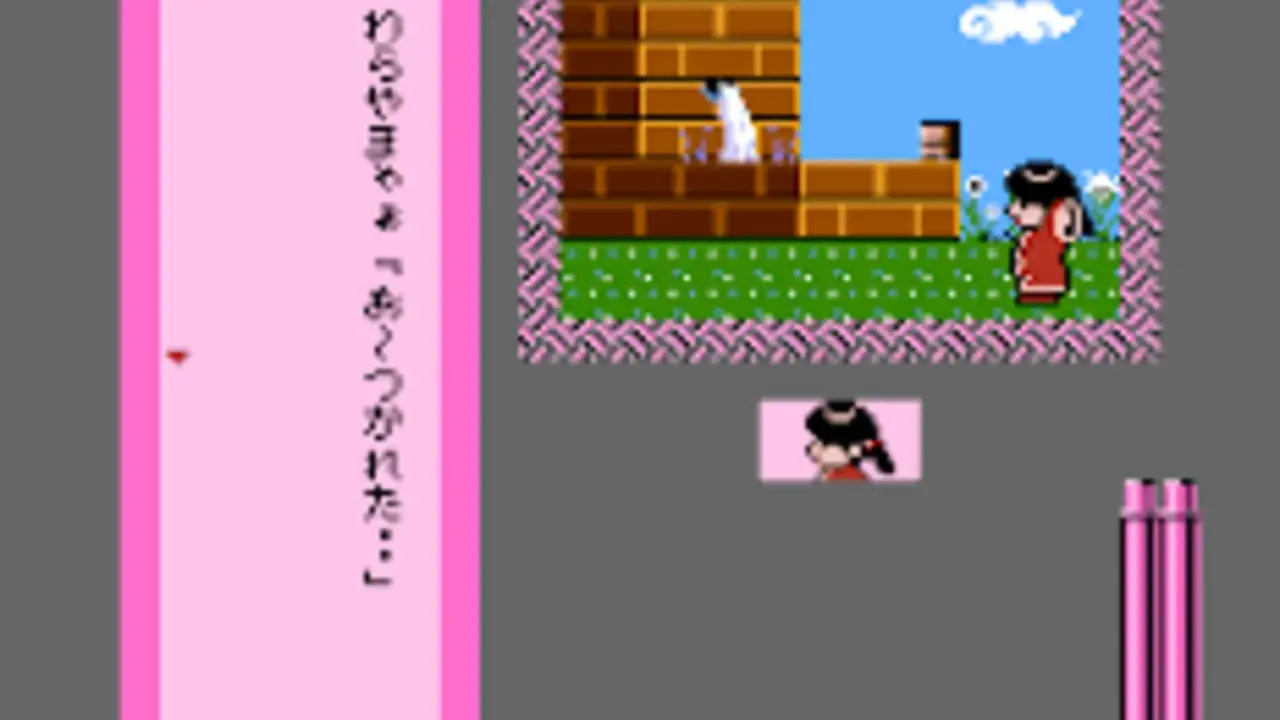
Famicom Mukashibanashi: Yuuyuuki is a 2-part Famicom Disk System game. Yuuyuki is an adventure game played by choosing from several text commands shown on screen. It resembles its predecessor, Shin Onigashima, in its implementation of the "Change Character" command, usage of traditional Japanese fairytales, and general screen layout and appearance. The story-line is a parody of the Chinese novel Journey to the West, where two main characters, Goku and Chao, embark upon separate journeys to find one another. In Yuuyuki, the "Change Character" command can switch between a maximum of five different characters. However, there are very few points in the game where it can actually be used to such extent. Its main use is to switch between Goku and the others accompanying him. Like Shin Onigashima, the character in use can greatly affect the descriptive text shown on screen, and the significant increase in number of characters allowed for more variety in each scene. It is possible to enjoy the game by viewing the reactions towards choosing completely unrelated characters or commands in certain situations. While Shin Onigashima demanded rather complex puzzle-solving abilities, Yuuyuki mainly focuses on having the player carefully read and understand the story-line. Puzzles are solved easily in this game, and very few choices actually lead to a "game over" screen. Easy trivia questions and simple action gameplay emerge at certain points, and players may find themselves searching for the obvious answer on screen more often than thinking hard to solve the puzzle at hand. Main changes in gameplay from Shin Onigashima include the implementation of the "Ittaisan" command, which saves progress at any point during the game, and faster animation of game text. The shortening in load time after choosing commands, and an overall decrease in difficulty allowed Yuuyuki to run at a much quicker tempo than its predecessor.
Part of collection:
Famicom Mukashibanashi
(last 3 games)
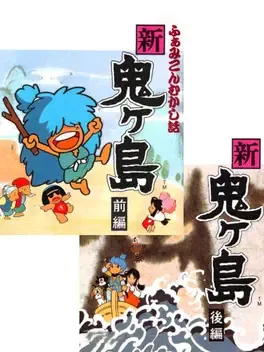
Famicom Mukashi Banashi: Shin Onigashima - Zengohen (Famicom Fairytales: New Island of Ogres - Part 1+2) is a game that ports both Part 1 (Zenpen) and Part 2 (Kouhen) games from the original Famicom Disk System releases to be played as a complete game. This version was first released on the Wii Virtual Console, but the first time that both parts were ported together was in the Famicom Mini Series for the Game Boy Advance.
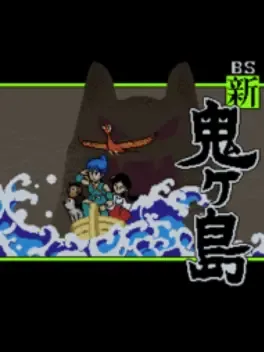
The fourth and final episode of BS Shin Onigashima. BS Shin Onigashima is a Downloadable 4-part Soundlink game for the Satellaview that was broadcast in at least 2 distinct runs between September 29, 1996 and January 31, 1996. The game was popular and won its December 1997 rebroadcast through the votes of players in the Third Player's Choice competition. The game came in second (in terms of votes) to BS SimCity: Machi Tsukuri Taikai and so it was broadcast second as a 4-day broadcast. BS Shin Onigashima was a remake sequel to the earlier Shin Onigashima, a game that was released for the Famicom Disk System in September of 1987. The major difference between the two games relate to the SoundLink elements that were introduced for the Satellaview broadcasts. BS Shin Onigashima was later re-made in December 1997 as the commercial release, Heisei Shin Onigashima, for the Nintendo Power system. This was later followed-up by the May 1998 Super Famicom cartridge release of the same name.
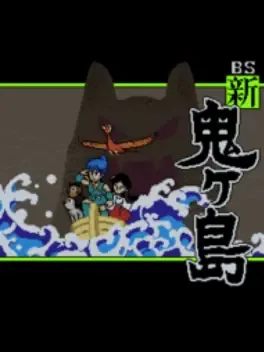
The third episode of BS Shin Onigashima. BS Shin Onigashima is a Downloadable 4-part Soundlink game for the Satellaview that was broadcast in at least 2 distinct runs between September 29, 1996 and January 31, 1996. The game was popular and won its December 1997 rebroadcast through the votes of players in the Third Player's Choice competition. The game came in second (in terms of votes) to BS SimCity: Machi Tsukuri Taikai and so it was broadcast second as a 4-day broadcast. BS Shin Onigashima was a remake sequel to the earlier Shin Onigashima, a game that was released for the Famicom Disk System in September of 1987. The major difference between the two games relate to the SoundLink elements that were introduced for the Satellaview broadcasts. BS Shin Onigashima was later re-made in December 1997 as the commercial release, Heisei Shin Onigashima, for the Nintendo Power system. This was later followed-up by the May 1998 Super Famicom cartridge release of the same name.
Could be interesting
Famicom Mukashibanashi: Yuuyuuki is a 2-part Famicom Disk System game. Yuuyuki is an adventure game played by choosing from several text commands shown on screen. It resembles its predecessor, Shin Onigashima, in its implementation of the "Change Character" command, usage of traditional Japanese fairytales, and general screen layout and appearance. The story-line is a parody of the Chinese novel Journey to the West, where two main characters, Goku and Chao, embark upon separate journeys to find one another. In Yuuyuki, the "Change Character" command can switch between a maximum of five different characters. However, there are very few points in the game where it can actually be used to such extent. Its main use is to switch between Goku and the others accompanying him. Like Shin Onigashima, the character in use can greatly affect the descriptive text shown on screen, and the significant increase in number of characters allowed for more variety in each scene. It is possible to enjoy the game by viewing the reactions towards choosing completely unrelated characters or commands in certain situations. While Shin Onigashima demanded rather complex puzzle-solving abilities, Yuuyuki mainly focuses on having the player carefully read and understand the story-line. Puzzles are solved easily in this game, and very few choices actually lead to a "game over" screen. Easy trivia questions and simple action gameplay emerge at certain points, and players may find themselves searching for the obvious answer on screen more often than thinking hard to solve the puzzle at hand. Main changes in gameplay from Shin Onigashima include the implementation of the "Ittaisan" command, which saves progress at any point during the game, and faster animation of game text. The shortening in load time after choosing commands, and an overall decrease in difficulty allowed Yuuyuki to run at a much quicker tempo than its predecessor.
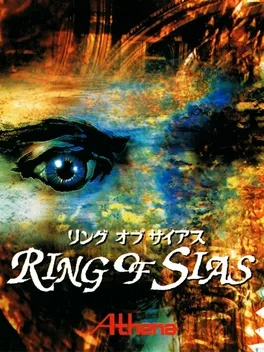
Ring of Sias is a sound novel adventure that features different endings depending of the player choices during the game.
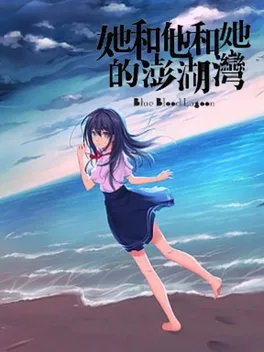
In 1949, The Chinese Civil War rages on. To escape the war, students from Shandong led by their teachers began making their way to the islands of Penghu, a distant and unfamiliar land our in the sea. The hero of the story, Yin Hsiao-Feng, came from an insular and traditional family, so he has always kept his feelings tightly locked away. He is now all alone after becoming separated from his family and joining the refugees fleeing the Civil War. During the flight to safety however, Hsiao-Feng meet the two most important people in his life: Teng Lin, a charming and innocent young girl who believes that the Civic War would soon end in peace, no matter who the winner is. Sun Yi-Fang, a cheerful and forthright beauty, who still believes that the tide of war will soon be turned, and triumph will eventually arrive. His everyday school life with the two girls gradually heals Hsiao-Feng’s wounded soul and a story of youthful romance unfolds between the three of them.
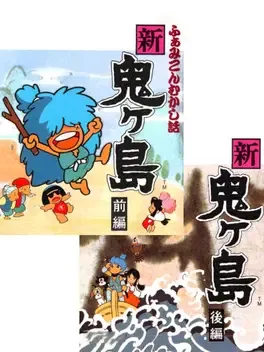
Famicom Mukashibanashi: Shin Onigashima is a Famicom Disk System text adventure game. The plot revolves around an elderly couple with no children who adopt an infant boy and girl. When the children turn six, a dragon appears in the country, and starts turning people into Oni who steal the souls of others. The Oni arrive at their home and steal the elderly couple's souls. The children decide to save their adoptive parents. The game is controlled by selecting commands such as the "Change Character" command, which allows you to switch between controlling Donbe (the boy) and Hikari (the girl). The game progress is shown by changes in the in-game graphics. The Famicom Disk System version comes on two disks released on different dates. Disk 2 cannot be played without completing Disk 1, and is switched while the system is still powered on. All later releases are switch-free.
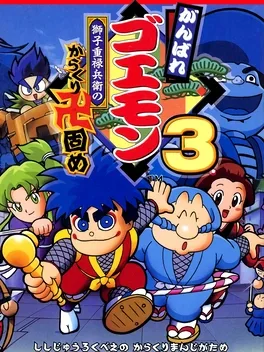
Third title in the Ganbare Goemon series of platform/adventure games which cast you as the heroic Goemon as he attempts to save feudal Japan from all sorts of wacky evildoers. This time around, a time-travelling machine threatens all of Japan and thus Goemon and co. must jump into the future to stop the machine. The game alternates between a top-down world map view in which your characters explore the gameworld and side-scrolling stages in which the main action lies. As in most games of the series there are also loads of mini-games and unique gameplay sequences such as maneuvering Goemon's giant mecha. The game continues the tradition of bizarre humor unique to the series, you can play as either Goemon or any of his 3 companions, Ebisumaru, Sasuke or Yae with each sporting unique weapons and abilities and also with their own dialogue options and cutscenes, which feature sitcom-like pre-recorded laughs for added wackiness.
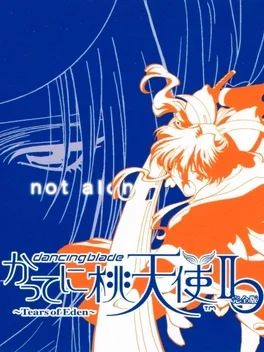
The sequel to "Dancing Blade Katteni Momotenshi!"
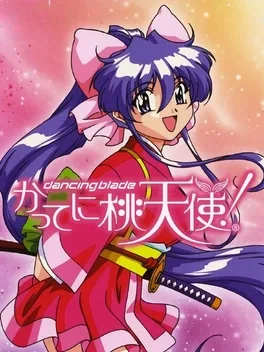
Dancing Blade is an anime FMV game. The player simply watches each scene as it proceeds; the only interaction is occasionally selecting dialogue choices when prompted. Depending on the player's choices, they will reach one of four different endings. Once an ending is reached, the scenario leading to that ending can later be replayed without interruption. Any scene already viewed can also be freely revisited.
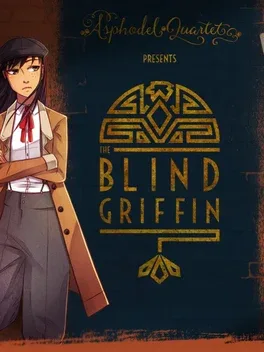
The Blind Griffin is an otome game developed by Asphodel Quartet for NaNoRenO 2015.
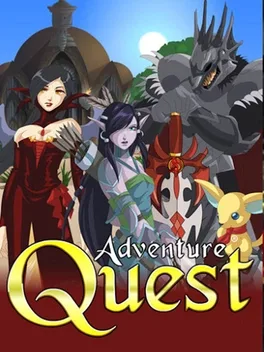
AdventureQuest is a fully animated RPG that you can play when you are on your lunchbreak, when the big game servers go down, or even for hours every day! You fight against hordes of monsters and enemies so that you can grow stronger and obtain ancient weapons of unimaginable power. Explore an entire world, filled with over 700 monsters, hundreds of items, magical powers to gain, and many classes to master! Become a Fighter, Wizard, Ninja, Vampire Slayer, Rogue, Knight, Mage, Paladin, Dragonslayer, and more.
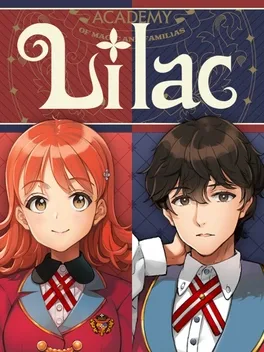
A fantasy visual novel adaptation of the stage play by Project Ricoro, about an interspecies academy story between mages and humans that depicts the “ordinary” within the “extraordinary.”