
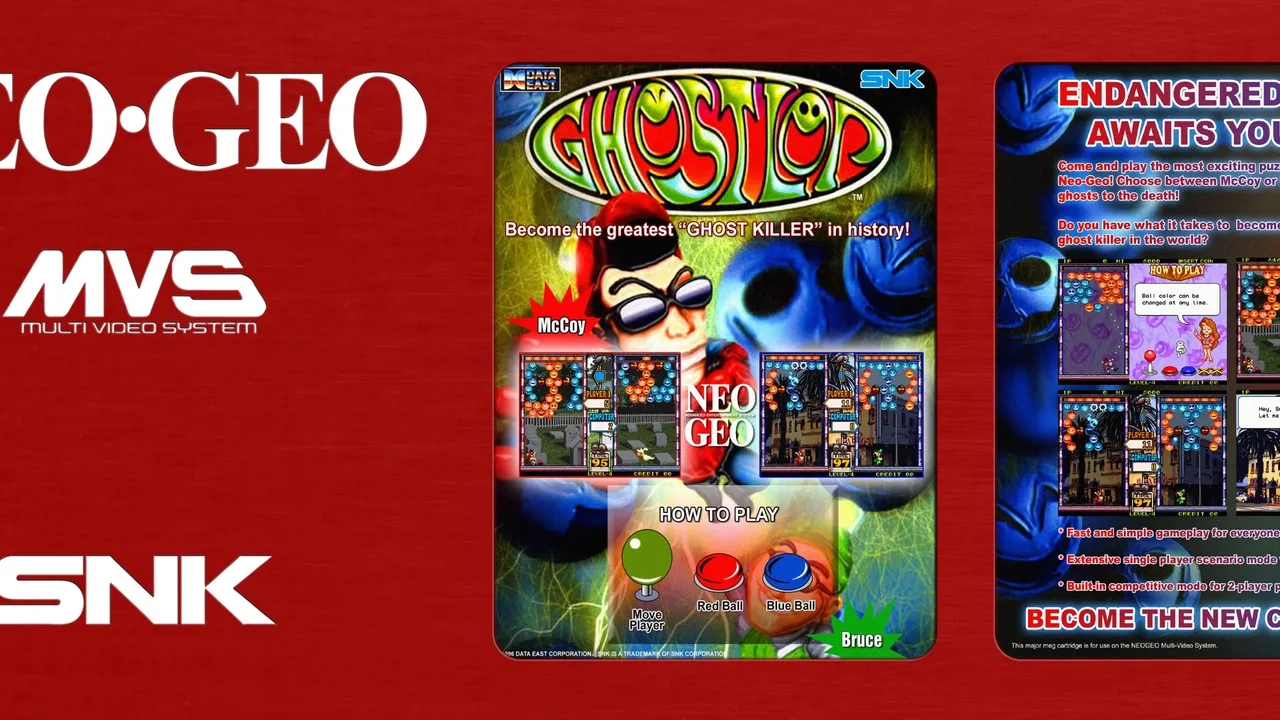
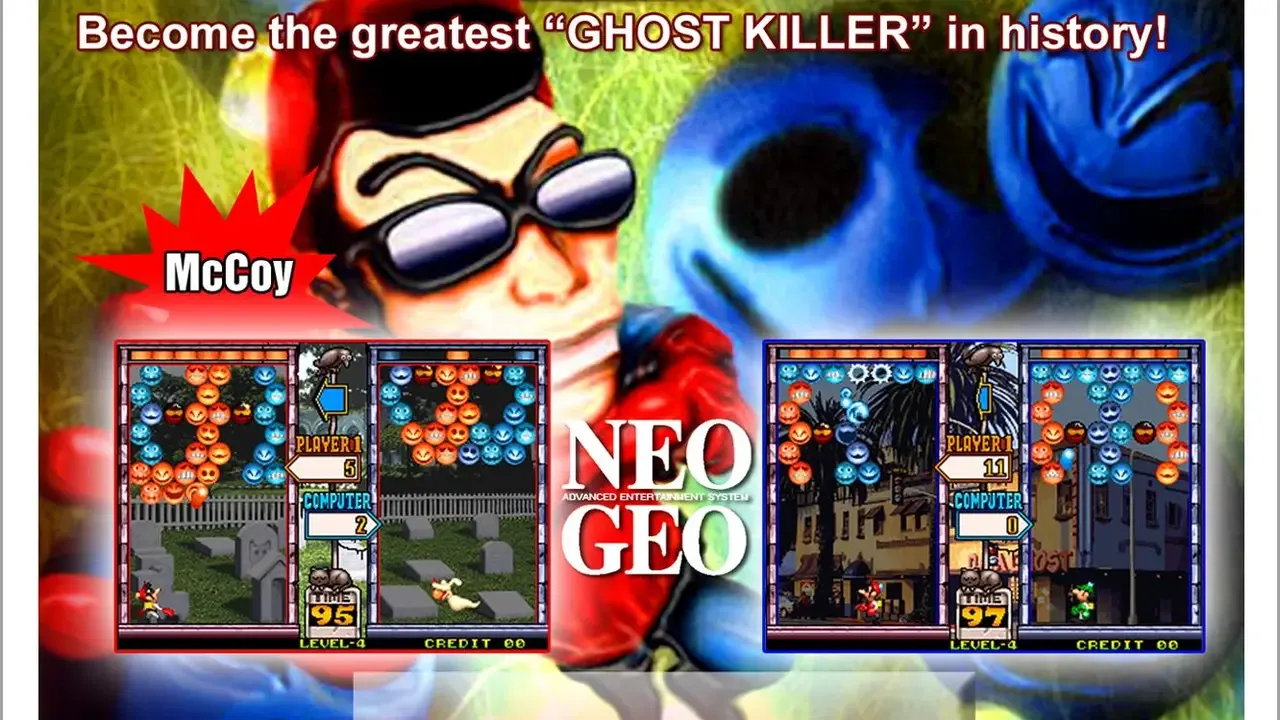
Ghostlop



Buy
Could be interesting
The original version of the latest puzzle game classic! "Tetris" is proud to number more than 50 million sales worldwide, is a popular puzzle game. This work "The Tetris" So scores continue to compete off the block "1PLAYER" mode, you can play with man against man "2PLAYER" We offer a mode. "1PLAYER" mode is a type of game scores compete. Eliminate one level up every 10 columns, change the background image is available 140 sheets at a time. The faster the blocks fall in the level rises will slow once every five levels, maintains the integrity of the tension and sense of relief on continuing the game. The difficulty levels from 0 to 30 can be selected at intervals of 5 levels. When you reach a level higher than 35 games go, the more you can choose from one level in the next play. "2PLAYER" mode is a type of game play against each other to do two users. Depending on the column player disappeared, garbage is fed to the other blocks. Saseta side wins piled up above the opponent's block.
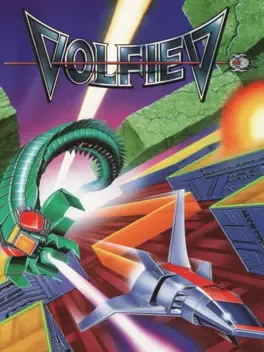
Once in the game, using the arrow keys you can move the 'Scanner' ship around the 'Shield Line' at the parameter of the playing area. While moving around this edge the ship is protected from the aliens by a shield indicated by a glowing circle around the ship. This shield is not infinite and care should be taken to complete each level as quickly as possible. A counter indicates the level of shield that you have: when it reaches zero then any contact with an alien is deadly whether you are on the 'Shield Line' or not. The idea of the game is to cut areas out of the screen without touching any of the aliens. This is done by pressing the SPACE key which initiates the 'Laser Cutter' and moving off the 'Shield Line' and rejoining it somewhere else. While you are in the process of drawing a line, your shield is inactive and touching an alien is fatal. Similarly, if one of the aliens touches the line then it will send a charge down the line towards you and you must quickly return to the safety of the edge before it reaches you. When you rejoin the 'Shield Line' the area that does not contain the 'Boss' alien will be filled (points are gained by trapping the other aliens) and the 'Shield Line' will be adjusted to surround the area that is left. The level is completed when a certain percentage of the total area has been filled in. This percentage starts at 80% but may increase in the later levels.
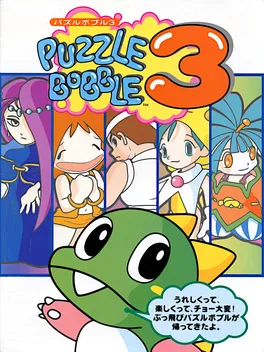
The second sequel to Puzzle Bobble. It was released into arcades in September 1996 and later ported to the Sega Saturn, Sony PlayStation, Game Boy, Nintendo 64 and Microsoft Windows. It would be the final appearance of Puzzle Bobble on the Sega Saturn. Like its predecessors, the player is tasked with shooting balls at groups of balls, creating groups of 3 or more, which are then removed from play. A European remake is entitled Bust-a-Move 3 DX. released in America as Bust-a-Move '99.
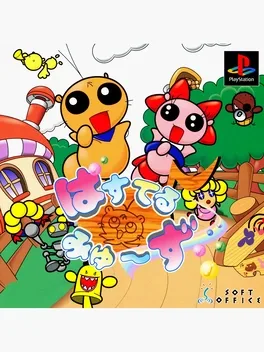
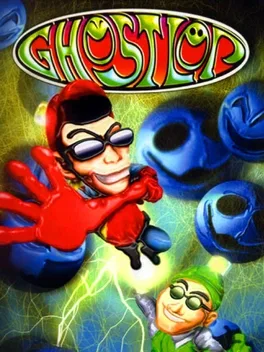
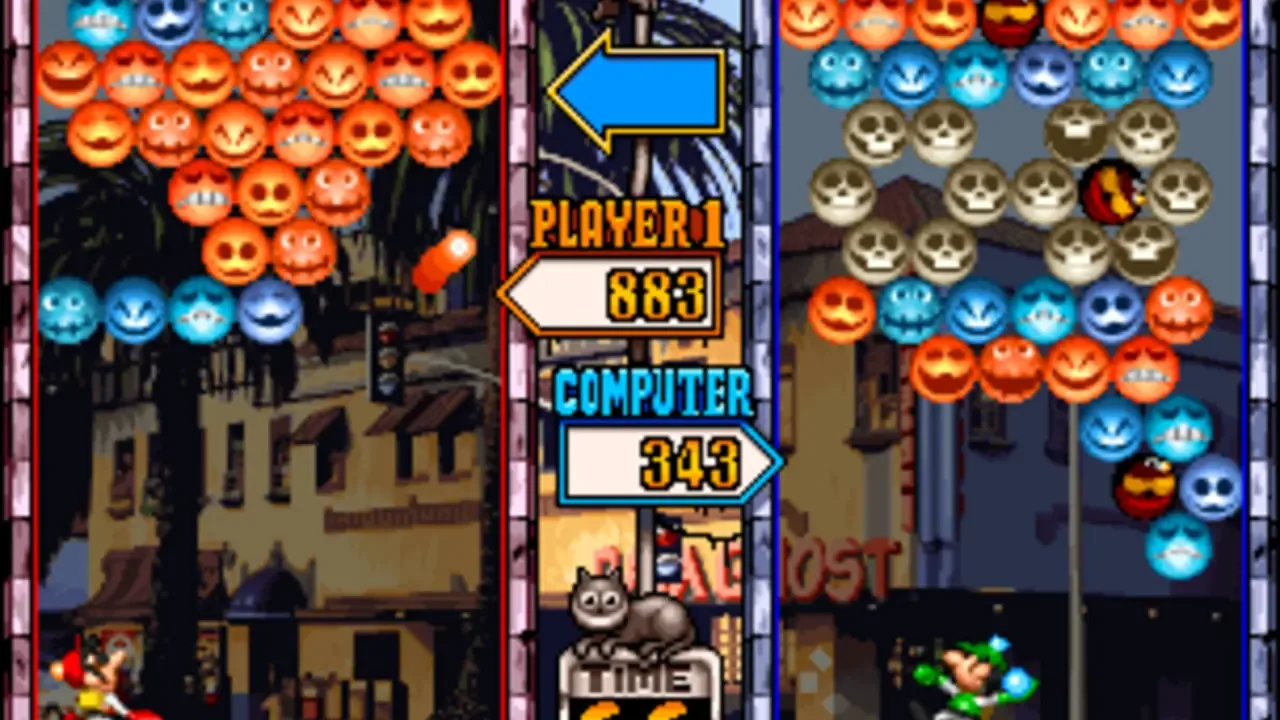
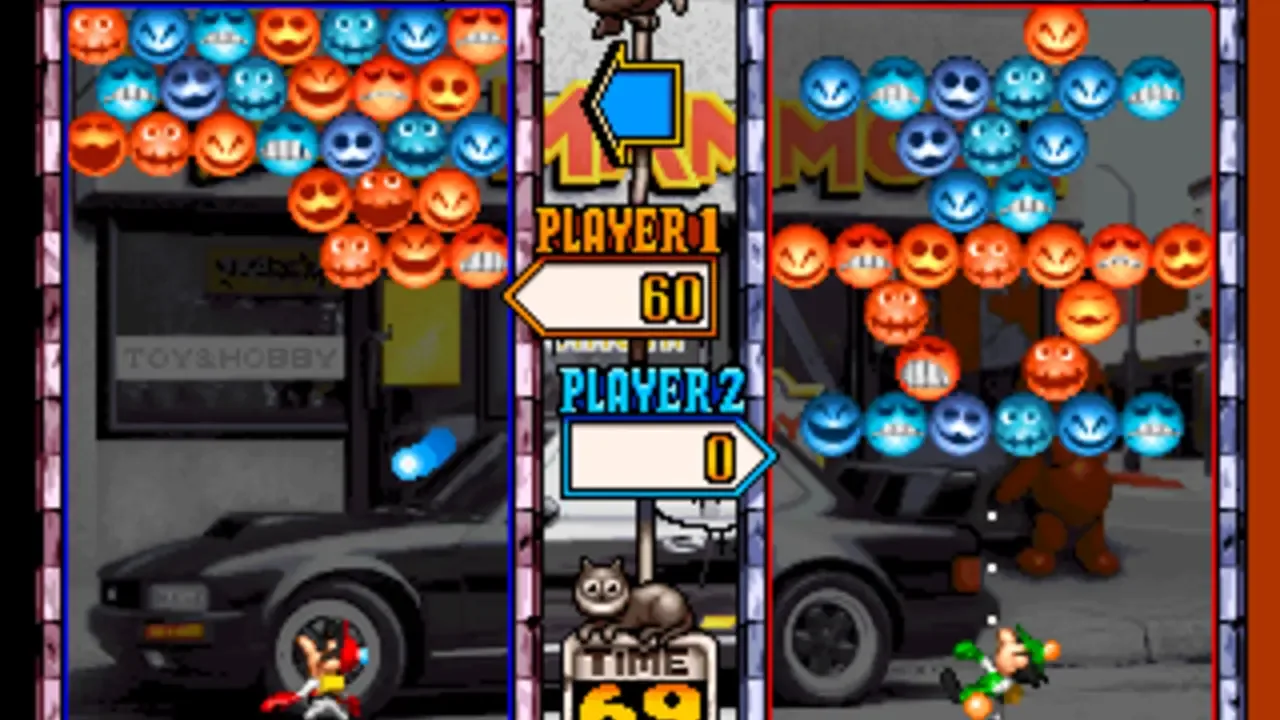
A colored ball matching style puzzle game released exclusively in Japan.
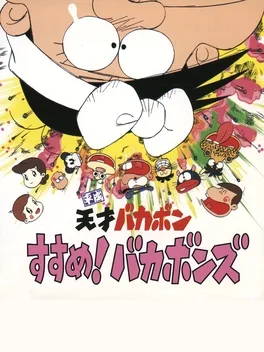
Heisei Tensai Bakabon: Susume! Bakabons is a competitive falling-block puzzle game based on the 1990 animated series Heisei Tensai Bakabon. Pairs of blocks in four colors drop from the top of the screen, and the goal is to line up two or more blocks of the same color, with another pair of a different matching color at either end. Any blocks on top of the ones cleared will fall into the open space, potentially comboing together into chains. Clearing multiple sets of blocks in a combo or chain will send garbage blocks to the opponent's playfield, and also charge up a super move that triggers automatically at a certain threshold which can clear a large number of blocks from the playfield. The game has a single-player story mode in which Bakabon's dad, refusing to wake up in the morning, gets sucked up by his wife's vacuum cleaner and sent to a strange puzzle world where he must defeat the other characters from the show in puzzle battles. There is also a two-player versus mode with nine playable characters.
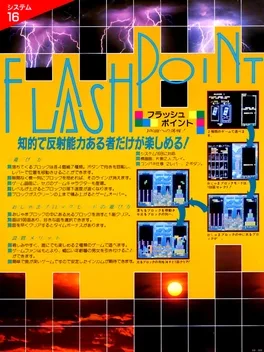
Flash Point is a variant of Tetris, with the various shapes of the tetrominos and their rotation are identical to Sega's Tetris . What makes the game different from a standard Tetris clone is its objective; each stage already contains a pattern of blocks, usually arranged as symbols, characters, or other images. Among these blocks are several bombs. The goal is to make these bombs detonate by clearing out the rows they are in. Once all the bombs have been detonated, the stage "explodes", and the player advances to the next one.
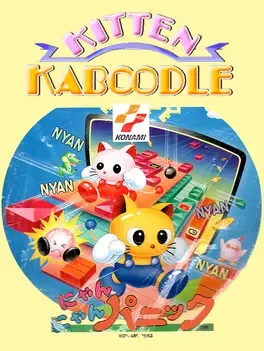
Kitten Kaboodle was produced by Konami in 1988. The game lets the player control a cat as it searches each stage trying to find four hidden keys. The stages are filled with enemies that can be defeated by pushing blocks into them. Blocks can also be jumped over if they get in the way. There are also special blocks that when three of the same kind are lined up it will cause an effect to happen such as clearing the screen of every enemy on it or giving the player temporary invulnerability. Enemies can drop valuables which increase the players points and in turn these points can be spent at a shop which sells various items like running shoes and bombs.
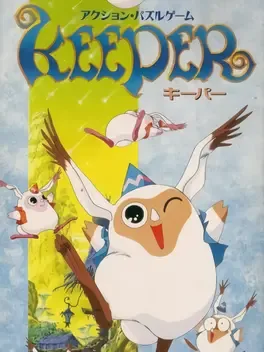
Keeper is an action/puzzle game developed by Fupac and published by Bullet-Proof Software, and released only in Japan for the Super Famicom.
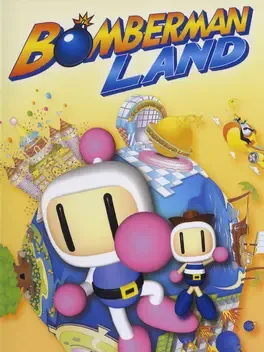
Bomberman Land is a theme park filled with people and different attractions. As in top-down RPG games, the player controls a character who can interact with the NPCs and objects on the map. Various spots give access to the attractions, in the form of mini-games. In some games, the player must pick-up sheep and lock them out of the field, complete jigsaw puzzles, look at equations and answer if they are true or false, etc. Completing various tasks will reward the player with numbered coupons that give access to new areas of the theme park. In addition to the solo play, some games can be played in up to four players battles, or in a tandem cooperative mode.
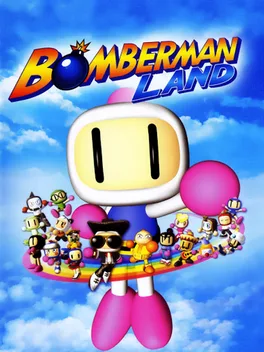
Bombermand Land is a revamped continuation of the Bomberman series. There is a single-player Story Mode where the player travels through the Bomberman universe in order to bring peace to it once again by solving puzzles, defeating enemies and collecting power-ups and weapons to defeat them. There are 40 different single-player minigames and 5 multiplayer games to choose from, ranging from skiing, skateboarding, laser ball, archery among many others. There is also the classic Bomberman which can also allow up to four human opponents in six different battle modes to compete in: Normal, Points, Stars, Crown, All-Out and Wii (which uses the Wii Remote to throw bombs, an exclusive mode for the Wii)