
Knockout Kings 2001
Buy
Part of collection:
Knockout Kings
(last 3 games)
Knockout Kings is a series of boxing video games that were produced by EA Sports for the PlayStation, Nintendo 64, PlayStation 2, Xbox, Game Boy Color and GameCube yearly between 1998 and 2003. Before releasing the first Knockout Kings, Electronic Arts released its first 3D boxing game, Foes of Ali, for the 3DO in 1995. While there are a few similarities between the two games, Foes of Ali was developed by a different team, Gray Matter and as such, is not regarded as a true prequel. The Knockout Kings game series gives the user a chance to compete against numerous real fighters, such as Muhammad Ali, Eric Esch, Marvin Hagler, Sugar Ray Leonard, Oscar De La Hoya, Larry Holmes, Jake LaMotta, Roberto Durán, Alexis Argüello, and Ray Mancini. The duration of a round can be adjusted to either 90 seconds or 3 minutes. In the game's "slugfest" mode, fighters can knock each other out at any given moment of the fight, or suffer 6 or 7 knockdowns and still last for the whole fight. There are several differences between Knockout Kings, Knockout Kings 2000, and Knockout Kings 2001 in particular, the most notable being the graphics. In Knockout Kings, the boxer sprites, although distinctive, are not facially representative of their real-life counterparts. Championship bouts can last only up to 10 rounds and not for 12 as in real life or 15 as in the past. In between rounds, all that is seen is a ring-card girl. In Career Mode, a fighter is made to retire right after winning the title and defending it for only the first time. A created boxer can fight in Career Mode and Slugfest Mode, but not in Exhibition mode. Although there is a training mode within Career Mode, it is extremely basic. However, 2 aspects that Knockout Kings has which the sequels lack is that the referee does a mandatory eight-count when a fighter is knocked down whereas in the sequels the referee stops the count immediately after a fighter gets up from a knockdown, and, in Career Mode, the result of a fight is afterwards seen on the screen as front-page newspaper headlines. In Knockout Kings 2000 for the PS1, the boxer sprites are for the first time facially representative of their real-life counterparts. Championship bouts can last up to 15 rounds. Sound and Music volume can also be adjusted in Option Mode. In between rounds, you may see either a ring-card girl, a replay of a part of the previous round, or your boxer sitting at his corner together with the statistics so far of the bout. Injury to the face of boxers can also be recognized, as well as his mouth-piece flying out if he is hit by a hard punch. A created boxer in Career Mode can now fight in all Modes. The training mode within Career Mode is more specific. You can now control your boxer while he is training and, in the PS1 version, you can also choose the location of your gym. Each boxer in the PS1 version can also be seen entering into the ring just before the bout takes place. There is also a new Mode where the player can see the statistics and biography of all the real-life boxers in the game, and another Mode in which the player can re-live famous classic bouts. The user-interface and intro-theme of the PS1 version is different to the N64 version and there are also more boxers, while the graphics on each version are similar. Knockout Kings 2001 contains the same improvements as Knockout Kings 2000 and adds more. Whereas fighters in KO Kings and KO Kings 2000 are either "boxer" or "slugger" style fighters, the styles of fighters in KO Kings 2001 are either "boxer", "slugger", "freestyle", or "crab", and these differences of style are very noticeable during bouts. Commentary in KO Kings 2001 is also far more vocal than its predecessors. During Career Mode, your trainer will occasionally talk and give you advice in between rounds as you progress through the bout. A fighter in Career Mode is made to retire after winning the title and defending it for several times. KO Kings 2001 is also the first game of the series to introduce CPU vs CPU bouts and "fantasy match-ups" between famous boxers of different eras, and the first to introduce women's boxing, which is accessible in Exhibition Mode. The PS1 and PS2 versions of Knockout Kings 2001 are virtually identical. Knockout Kings 2002 changes many concepts of its predecessors, e.g. you have to progress through a number of bouts in order to unlock new fighters. After Knockout Kings 2003, the name of the series was replaced by Fight Night (EA video game series).
In Knockout Kings 2002, you get to stare down your opponent as the ref runs down the rules, smack your gloves with his, wait for the bell...and let your fists fly. The speed, pain and adrenaline of professional boxing has come to your fingertips. Now it's time to show the world who's the champ! Intense, head-to-head action takes it to the mat with the superior technology of PS2.
All the egomaniacal, violent splendor of heavyweight boxing comes to the PlayStation 2 in Knockout Kings 2001 by EA Sports. This title employs EA's new CyberScan technology, which allows the boxers faces to be accurately reproduced in full polygonal glory. In addition to the graphical overhaul, the game features new modes of play and simplified control. Choose your champion from a stable of boxing's greatest, including Muhammad Ali, Joe Louis, Rocky Marciano, and Lennox Lewis. A new career mode allows you to play through several weight classes and to box at famous arenas all around the world.
Could be interesting
Knockout Kings was EA's flagship boxing title prior to Fight Night.
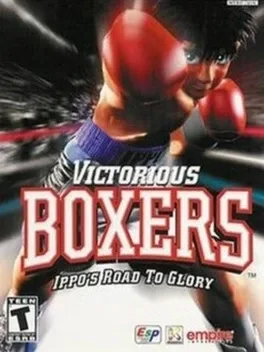
Tape up your hands, pull on your gloves and get ready to go toe-to-toe with some of the most accomplished boxers you're ever likely to meet. Victorious Boxers places you directly in the ring as Ippo Makunouchi on his quest to become the champion. But first you must prove to the coach that you're worth training!
In Knockout Kings 2002, you get to stare down your opponent as the ref runs down the rules, smack your gloves with his, wait for the bell...and let your fists fly. The speed, pain and adrenaline of professional boxing has come to your fingertips. Now it's time to show the world who's the champ! Intense, head-to-head action takes it to the mat with the superior technology of PS2.
Knockout Kings is a series of boxing video games that were produced by EA Sports for the PlayStation, Nintendo 64, PlayStation 2, Xbox, Game Boy Color and GameCube yearly between 1998 and 2003. Before releasing the first Knockout Kings, Electronic Arts released its first 3D boxing game, Foes of Ali, for the 3DO in 1995. While there are a few similarities between the two games, Foes of Ali was developed by a different team, Gray Matter and as such, is not regarded as a true prequel. The Knockout Kings game series gives the user a chance to compete against numerous real fighters, such as Muhammad Ali, Eric Esch, Marvin Hagler, Sugar Ray Leonard, Oscar De La Hoya, Larry Holmes, Jake LaMotta, Roberto Durán, Alexis Argüello, and Ray Mancini. The duration of a round can be adjusted to either 90 seconds or 3 minutes. In the game's "slugfest" mode, fighters can knock each other out at any given moment of the fight, or suffer 6 or 7 knockdowns and still last for the whole fight. There are several differences between Knockout Kings, Knockout Kings 2000, and Knockout Kings 2001 in particular, the most notable being the graphics. In Knockout Kings, the boxer sprites, although distinctive, are not facially representative of their real-life counterparts. Championship bouts can last only up to 10 rounds and not for 12 as in real life or 15 as in the past. In between rounds, all that is seen is a ring-card girl. In Career Mode, a fighter is made to retire right after winning the title and defending it for only the first time. A created boxer can fight in Career Mode and Slugfest Mode, but not in Exhibition mode. Although there is a training mode within Career Mode, it is extremely basic. However, 2 aspects that Knockout Kings has which the sequels lack is that the referee does a mandatory eight-count when a fighter is knocked down whereas in the sequels the referee stops the count immediately after a fighter gets up from a knockdown, and, in Career Mode, the result of a fight is afterwards seen on the screen as front-page newspaper headlines. In Knockout Kings 2000 for the PS1, the boxer sprites are for the first time facially representative of their real-life counterparts. Championship bouts can last up to 15 rounds. Sound and Music volume can also be adjusted in Option Mode. In between rounds, you may see either a ring-card girl, a replay of a part of the previous round, or your boxer sitting at his corner together with the statistics so far of the bout. Injury to the face of boxers can also be recognized, as well as his mouth-piece flying out if he is hit by a hard punch. A created boxer in Career Mode can now fight in all Modes. The training mode within Career Mode is more specific. You can now control your boxer while he is training and, in the PS1 version, you can also choose the location of your gym. Each boxer in the PS1 version can also be seen entering into the ring just before the bout takes place. There is also a new Mode where the player can see the statistics and biography of all the real-life boxers in the game, and another Mode in which the player can re-live famous classic bouts. The user-interface and intro-theme of the PS1 version is different to the N64 version and there are also more boxers, while the graphics on each version are similar. Knockout Kings 2001 contains the same improvements as Knockout Kings 2000 and adds more. Whereas fighters in KO Kings and KO Kings 2000 are either "boxer" or "slugger" style fighters, the styles of fighters in KO Kings 2001 are either "boxer", "slugger", "freestyle", or "crab", and these differences of style are very noticeable during bouts. Commentary in KO Kings 2001 is also far more vocal than its predecessors. During Career Mode, your trainer will occasionally talk and give you advice in between rounds as you progress through the bout. A fighter in Career Mode is made to retire after winning the title and defending it for several times. KO Kings 2001 is also the first game of the series to introduce CPU vs CPU bouts and "fantasy match-ups" between famous boxers of different eras, and the first to introduce women's boxing, which is accessible in Exhibition Mode. The PS1 and PS2 versions of Knockout Kings 2001 are virtually identical. Knockout Kings 2002 changes many concepts of its predecessors, e.g. you have to progress through a number of bouts in order to unlock new fighters. After Knockout Kings 2003, the name of the series was replaced by Fight Night (EA video game series).
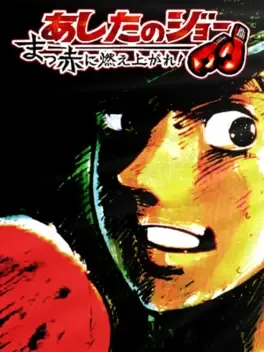
Ashita no Joe: Masseki ni Moe Agare! is a Sports game, developed and published by Konami, which was released in Japan in 2003.
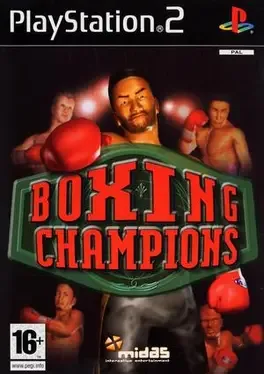
Go 12 rounds against the toughest fighters with Boxing Champions. Now you can hook, jab and uppercut with the very best in this great new 3D slugfest! Choose one of nine characters across three fighting weights, take on the fearsome Tournament mode, or try to knockdown all-comers in the Survival mode.

A boxing game featuring a Championship mode and a 1 or 2 player exhibition match mode. In the Championship mode, players choose from 1 of the 8 available boxers, and then compete against the other 7 boxers on the road to try becoming the World Champ. Players go toe to toe with their opponents in the boxing ring in 3 minute rounds. The boxers can throw hooks and jabs at each other with the sole intention to knock their opponent down to the canvas by draining all their energy by landing those punches. Each punch thrown costs the boxer some stamina which is indicated by boxing glove icons. If all the boxers stamina is drained, they can no longer throw punches for a little while until they gain some of their stamina back. After each fight is over, players go to the gym to train in various different exercises like skipping rope and bench pressing weights. These exercises increase the players boxer in various areas like speed and power. Options include setting the number of rounds (from 1 to 10) and setting the difficulty level (novice, advanced, and expert).
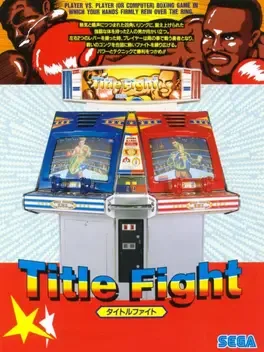
Title Fight is a behind-the-back boxing game developed by Sega-AM3 and released by Sega for arcades (using Sega System 32 hardware) in 1993. A spiritual successor to Sega's 1987 game Heavyweight Champ, Title Fight features a similar twin-joystick control setup that corresponds each oversized joystick (or "glove handle") with each of their boxer's arms, giving the illusion of throwing actual punches and guarding or dodging their opponent. The game follows one of several boxers in their journey to winning the championship belt. Title Fight takes full advantage of the hardware's sprite-scaling effects not only for the large character sprites, but also for the ring itself (which now rotates in a 3D space, allowing for 3D side-stepping). It also features linked multiplayer, one of the few boxing games of its type to do so.
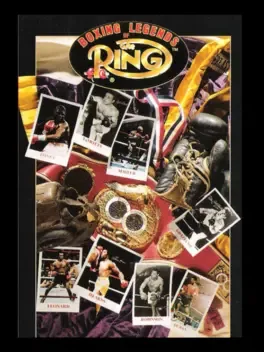
Boxing Legends of the Ring is a boxing game, developed by Sculptured Software and published by Electro Brain. During fights, it is possible to keep track of the participating boxers' wellbeing by observing the small portraits of the fighters' faces at the top of the screen. As the fighters receive punishment, these portraits show injuries such as cuts and bruises, the severity of which indicate the fighter's health (or lack of). There is also a boxing glove shaped meter at the top of the screen, that indicates how much power a boxer has left in his punches (as in a real fight, the more punches boxers throw, the more tired they become, resulting in weaker punches). The fighters movement about the ring is limited to side-stepping left or right; it is impossible to step back or forward. A variety of punches can be thrown; left jabs, crosses to the head, hooks to the body, and uppercuts to the head (all punches except jabs can be thrown with either hand). It is also possible to throw a limited number of so-called 'super punches', that are essentially either a right cross or a right uppercut, but with extra power. At the start of each round, each boxer is capable of throwing one super-punch at any time, although it becomes possible to throw one more with each knockdown they score against their opponent. Defensive techniques consist of blocking, dodging, and clinching. Each boxer has three attributes: 'power', 'stamina', and 'chin'. A special version was released in Mexico and the American Southwest called Chavez II; the game exchanged the English language words for Spanish and omitted some vocals.
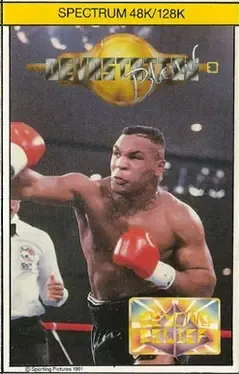
Devastating Blow, the first game from Beyond Belief, is a two-dimensional boxing game. An up-and-coming boxer must fight his way up to the top, eventually facing Mike Tyson himself.