
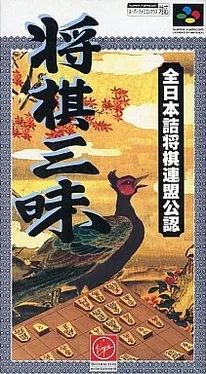
Shogi Zanmai
Buy
Could be interesting

Shogi-Meikan '93 is a Miscellaneous game, developed and published by Hect, which was released in Japan in 1992.
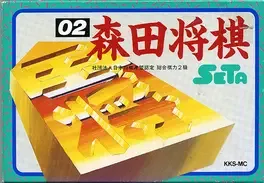
A Famicom Shogi game developed by Random House and published by Seta. Morita Kazuo no Shogi ("Kazuo Morita's Shogi") is a Shogi game from Random House. The game's namesake, Kazuo Morita, is a famous Japanese Shogi player that had previously been attached to several Shogi games prior to this one. Furthermore, Random House (not to be confused with the famous book publisher) is his development company. As well as playing regular Shogi against an AI opponent, the player has a few options regarding the set-up of the pieces. There is a mode where they place all the tiles on the board themselves, in case they wish to continue an existing game or maybe replay a famous match at its turning point.
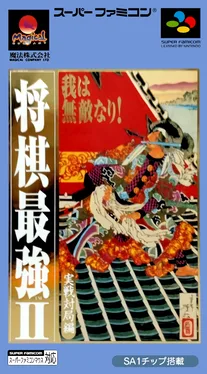
Shogi Saikyou II: Jissen Taikyoku-hen is a Miscellaneous game, published by Magical Company (Mahou), which was released in Japan in 1996.
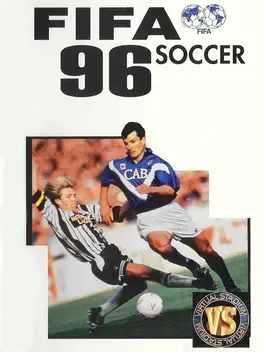
FIFA Soccer 96 is an entry to the FIFA series of video games, and was developed by Extended Play Productions and published by Electronic Arts. Though it was not the first FIFA game (both FIFA Soccer '95 and FIFA International Soccer had come before it), FIFA 96 is often considered the first truly successful FIFA game, and opened the doors to annual sequels that continue to this day. It was released for the Sega Mega Drive, Sega 32X and Sega Game Gear, with a different version of the game being released on the Sega Saturn.
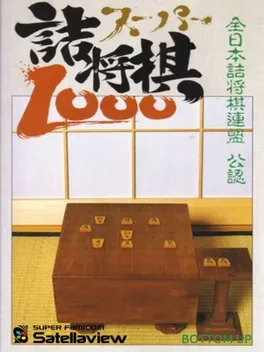
Super Tsume Shogi 1000 is a Miscellaneous game, published by Bottom Up, which was released in Japan in 1994. It was also a a view-limited downloadable game for the Satellaview that was broadcast in at least 3 runs between November 30, 1997 and Nov. 28, 1998.
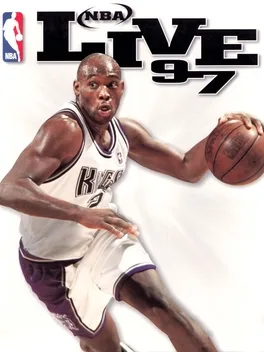
NBA Live 97 is a basketball game with an emphasis on realism. You can choose from all of the NBA teams, create a team with players you create yourself, or choose a team formed by the All-Star players of the east or West coasts. When you create a player yourself you can customize the player to a high degree. There are over 60 offensive and 10 defensive set-ups. Match options include an exhibition match, a whole season or the playoffs.
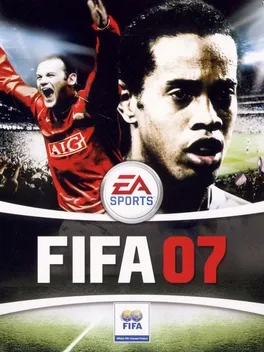
FIFA 07 (also known as FIFA Football 07 and FIFA 07 Soccer) is the 2006 edition of EA Sports' series of football simulator video games. Developed by EA Canada, it is published by Electronic Arts. It was the last game in the FIFA series to be released for the GameCube, Xbox, and Game Boy Advance, and the first to be released for the Xbox 360. The next-generation graphics and physics engine used in the Xbox 360 version will be exclusive to the console for a period of 12 months. It was also released for PC, Nintendo DS, PlayStation Portable, and PlayStation 2. There are seven different covers of FIFA 07, each with a different player, depending on which region the game is sold in. Ronaldinho (FC Barcelona) graced the cover of all the games and was joined by Landon Donovan (Los Angeles Galaxy) and Francisco Fonseca (UANL Tigres) in North America; Wayne Rooney (Manchester United) in the United Kingdom, Australia, and the Benelux; Lukas Podolski (Bayern Munich) in Germany; David Villa (Valencia) in Spain; Kaká (Milan) in Italy; Juninho (Lyon) in France; Tranquillo Barnetta (Bayer Leverkusen) in Switzerland; and Kim Nam-Il (Suwon Samsung Bluewings) in South Korea. FIFA 07 sponsored Accrington Stanley for the 2007–08 season, with the FIFA 07 logo displayed on the back of the team's shirts
Morita Shogi Advance is a Japan-only shogi game for the Game Boy Advance. Developed by Yuki Enterprise and published by Hudson Soft, it reproduces the traditional rules of shogi, including the ability to reuse captured pieces.
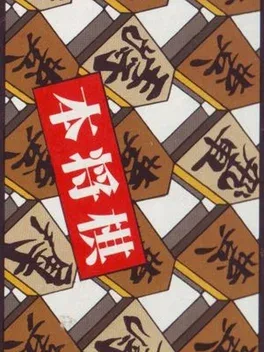
A video game biased off of the board game Shogi (Japanese Chess). It was developed and published by SETA Corporation to be released August 10, 1985, exclusively in Japan for the Nintendo Entertainment System. The game is named for Naito Kunio Kudan, a famous Shoji player from Japan. Born November 15, 1939, Naito has been a professional Shoji player since he was 18 years old. In addition to helping with this video game, Naito Kudan is a published author, having 13 books written about Shoji and running a column in the sports section of the newspaper. He is also a published singer but mostly does it as a hobby. In 2010 Naito was honored with the Order of the Rising Sun, twin Mitsuaki, the fifth highest honor a citizen can receive in Japan. Honshogi: Naitou Kudan Shogi Hiden, follows the standard rules of Shoji (Japanese Chess). There is no ability to change the difficulty or handicap. Most of the screen is the Shoji board, but there is also a representation of the player and computer playing Shoji in a Japanese setting, which moves as the game moves. The player always starts first, with the fastest possible way to beat the computer set at 15 hands/turns. Honshogi: Naitou Kudan Shogi Hiden was entered into the first annual World Computer Shoji Championship in 1990. It was the only NES entrant out of the six entrant, software versus software competition. The game finished in forth place, with a record of two wins and three losses.
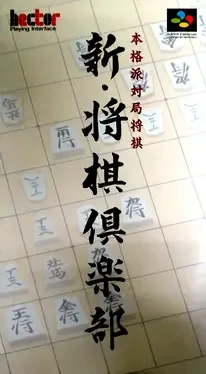
Shin Shogi Club is a Puzzle game, developed by Natsu System and published by Hector, which was released in Japan in 1995.