


Buy
Parent game
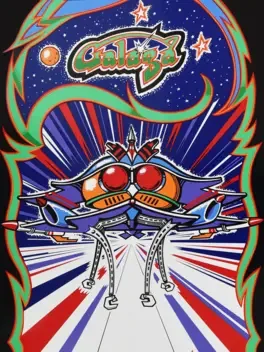
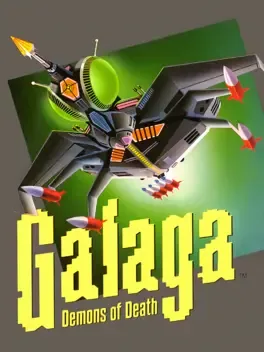
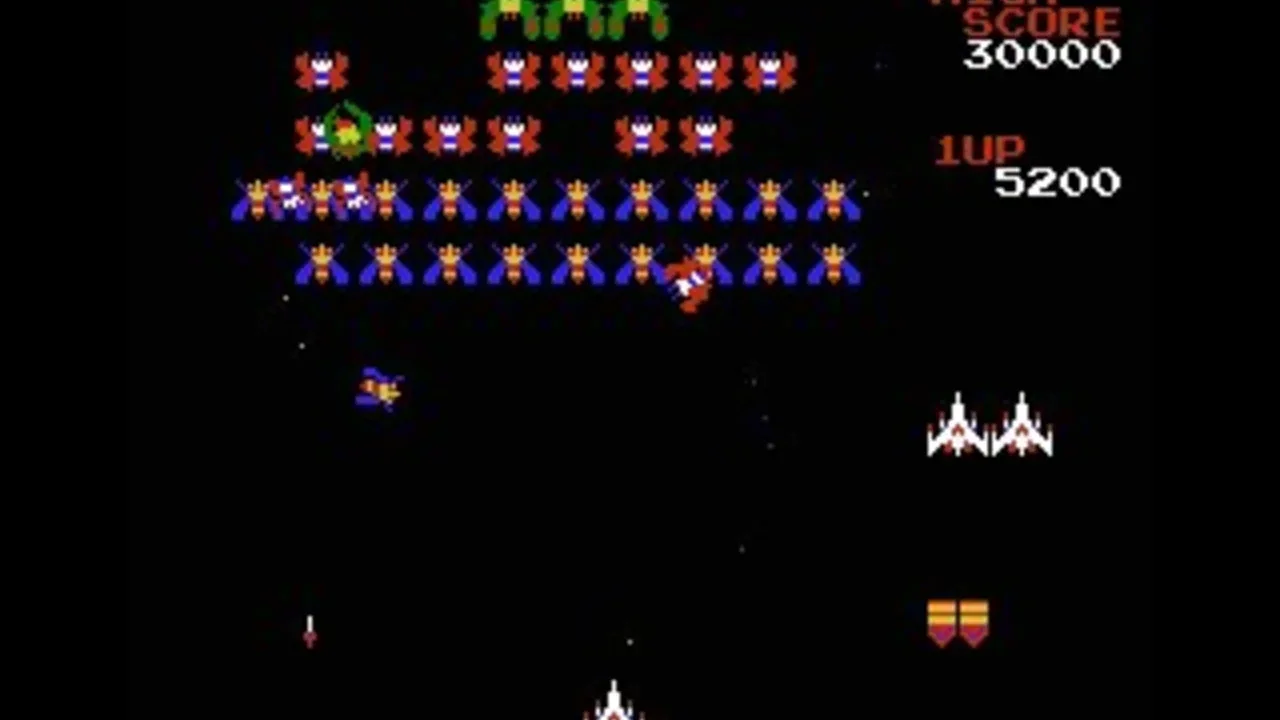
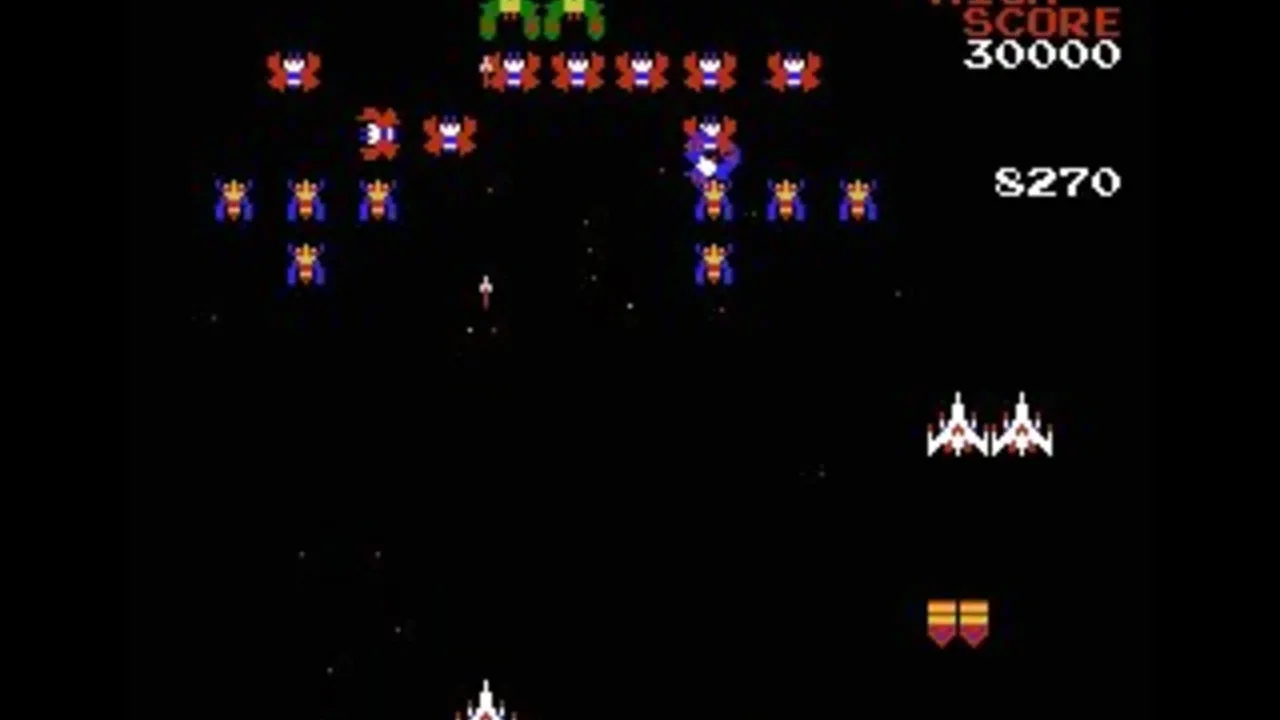
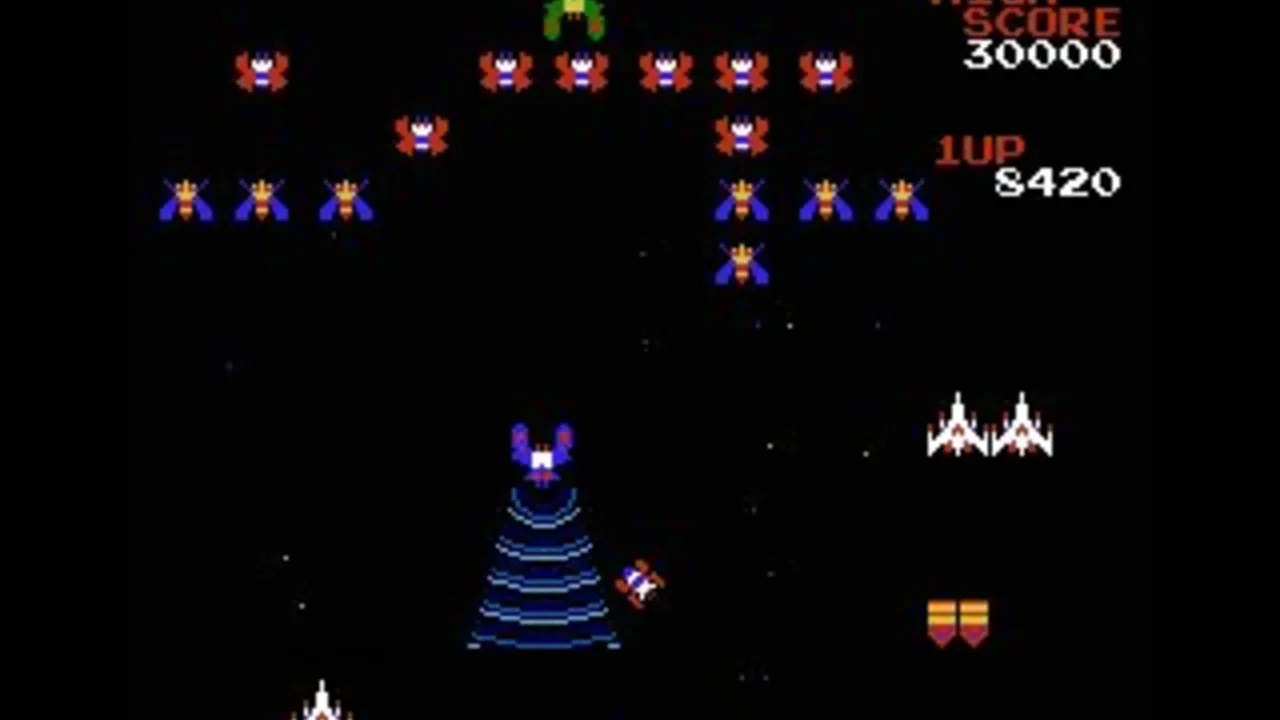
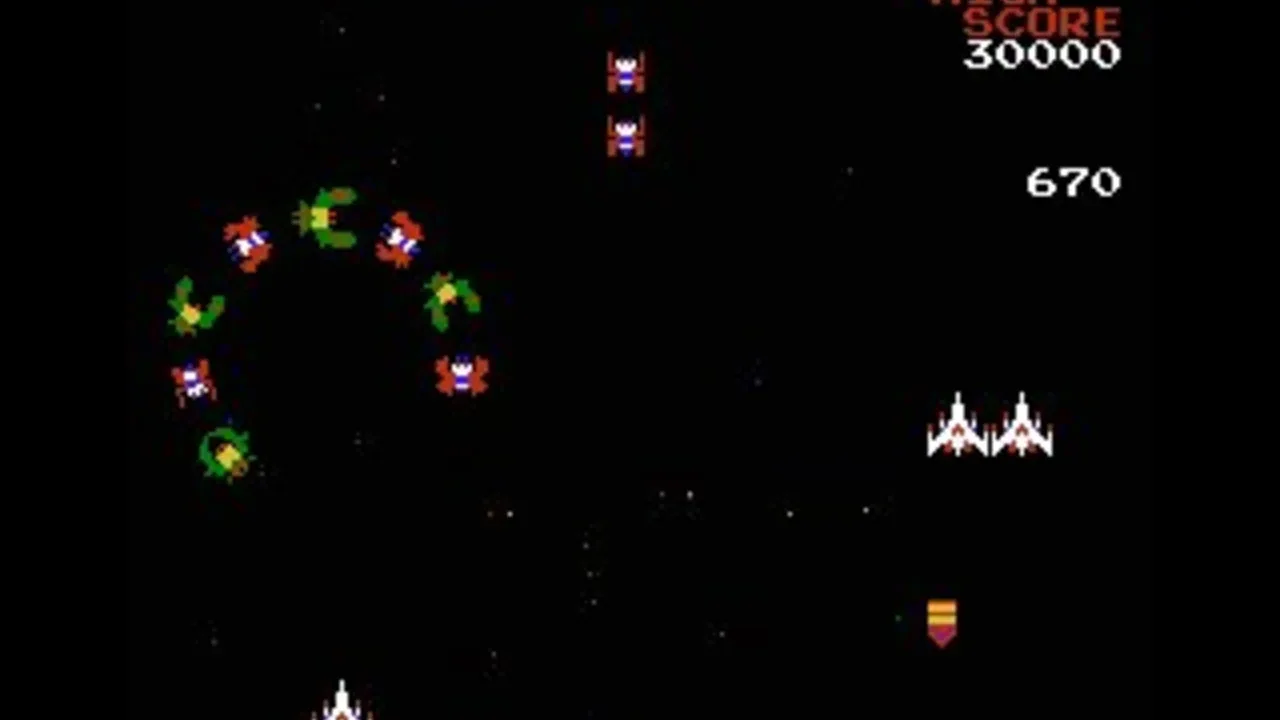
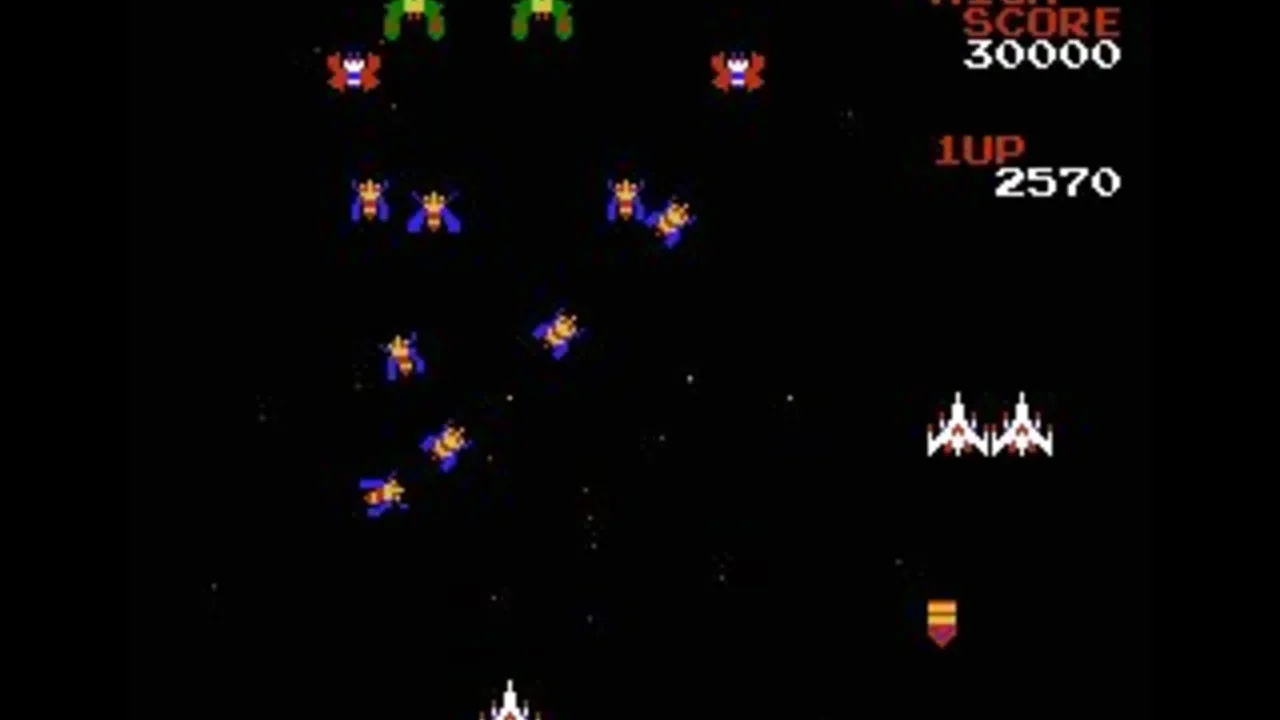
The objective of Galaga is to score as many points as possible by destroying insect-like enemies. The player controls a starfighter that can move left and right along the bottom of the playfield. Enemies swarm in groups in a formation near the top of the screen, and then begin flying down toward the player, firing bombs at the fighter. The game ends when the player's last fighter is lost, either by colliding with an enemy or one of its bullets, or by being captured. Galaga introduces a number of new features over its predecessor, Galaxian. Among these is the ability to fire more than one bullet at a time, a count of the player's "hit/miss ratio" at the end of the game, and a bonus "Challenging Stage" that occurs every few levels, in which a series of enemies fly onto and out of the screen in set patterns without firing at the player's ship or trying to crash into it. These stages award a large point bonus if the player manages to destroy every enemy. Another gameplay feature new to Galaga is the ability for enemies to capture the player's fighter. While the player is in control of just one fighter, a "boss Galaga" (which takes two shots to kill) periodically attempts to capture the fighter using a tractor beam. If successful, the fighter joins the enemy formation. If the player has more lives remaining, play resumes with a new fighter. The captured fighter flies down with the enemy that captured it, firing upon the player just like normal enemies, and can be shot and destroyed. The player can free the fighter by destroying the boss Galaga while in flight, causing the captured fighter to link up with the player's current fighter, doubling his or her firepower but also making a target twice as large. Galaga has an exploitable bug that can cause the attackers to stop firing bullets at the player, due to a coding error. In addition, similar to the famous "Split-Screen bug" in Pac-Man, a bug exists in Galaga in which the game "rolls over" from Level 255 to Level 0. Depending on the difficulty setting of the machine, this can cause the game to stall, requiring that the machine be reset or power-cycled in order to start a new game.
Part of collection:
Galaga
(last 3 games)
This is a special edition of Galaga Wars exclusively for Apple Arcade. It has no ads, and the microtransactions have been removed.

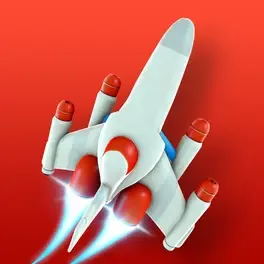
The galaxy is calling for you, it needs to be saved from waves of aliens. Jump in your ship and head to space. The survival of the universe is once more at stake. They have an alien mothership of immense proportions, endless waves of ships bristling with high-tech weaponry and of course the sheer power of the boss Galaga... You are the hero that will make it through those waves as if they were mere bricks. You are the breaker of this cycle and the savior of the galaxy Galaga Wars is a classic retro shooter that has been seen times and times in your favorite arcades. From pixel ships to more refined ones, have the feel of a casual runner mixed with the adrenaline of destroying enemies in the vast ocean of stars ATTACK through endless waves of original enemies, including the Bee, Butterfly, Scorpion and many more deadly ones. ENHANCE your weapons by upgrading and leveling up your craft. BLAST alien waves with 4 unique abilities per ship including laser, explosive shot, space mines, ghost shield...
Part of franchise:
Galaxian
(last 3 games)
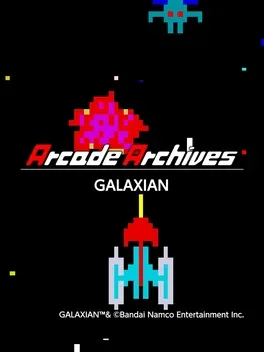
"Galaxian" is a shooting game released by Namco in 1979. You control a Galaxip and shoot aliens that approach you in eerie curves. Aliens during the assault double your score, and the flagship (Galboss) can be shot at in turn, starting with the escort (red alien), for a higher score. Deftly dodge enemy aliens and destroy the large formation.
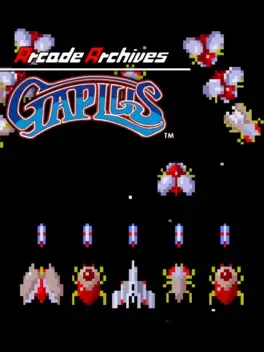
Strike back with powerful Blaster Head weapons!
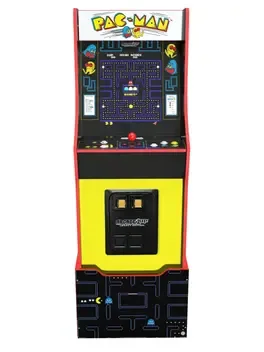
Pac-Man 12-in-1 Legacy Series is an arcade machine bundle by Arcade1Up that features various arcade games from Namco.
Could be interesting
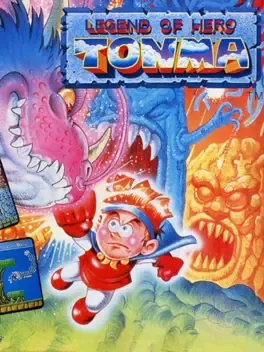
Legend of Hero Tonma is a side scrolling platform game released by Irem to arcades in 1989.
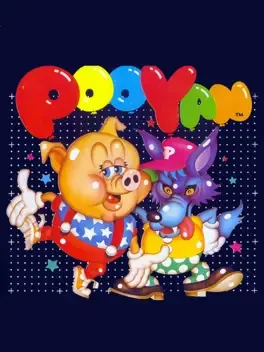
Pooyan is a classic arcade game manufactured by Stern Electronics under license from Konami in 1982. In it, the player controls "Mama", a pig whose babies have been kidnapped by a group of wolves.
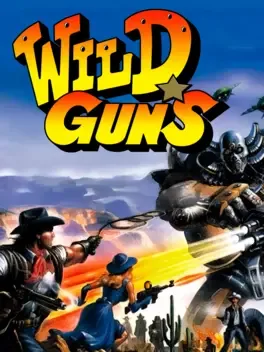
Released in 1994, Wild Guns is a shooting gallery video game for the Super Nintendo Entertainment System, developed by Natsume. Its setting is a unique blend of the Wild West, steampunk, and science fiction. The narrative revolves around Annie and Clint, a bounty hunter duo on a quest for vengeance after Annie's family is killed. Players can choose to control either Annie or Clint, navigating through the foreground, avoiding enemy fire, and taking down hostile robots in the background. This gameplay combines elements from third-person shooters and light gun games.
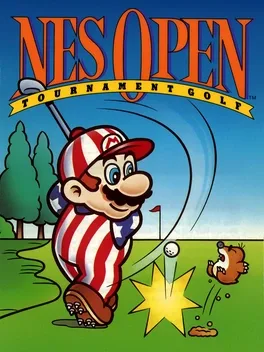
NES Open Tournament Golf is an NES game featuring Mario characters. As the name of the game implies, it is a golf game and was one of the first golfing games in the Mario series. You can play a round of golf on one of three different courses. One or two players can play in the U.S., Japan, or the U.K. and choose a stroke or match play game. Gameplay is from two point of views, starting with an overhead view allowing you to set up the shot and choose a club, then switching to a 3-D point of view. Hitting the ball uses the common power meter where tapping the button starts the meter, tap the button a second time to select the amount of power in the shot, then tap the button a third time to select the amount of slice or hook.
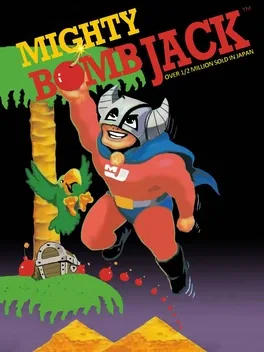
A platform game where the main character travels throughout various levels collecting bombs. The hero of the game, Jack, must make his way through 16 levels of a pyramid in order to defeat the demon Belzebut and rescue the royal Pamera family.Each level is split into two parts an action zone and a Royal Palace room. The mechanics and level designs of the Royal Palace rooms are directly lifted from the games prequel, Bomb Jack. Action zones can be split up into several portions, and contain power-ups usually hidden in treasure chests such as money bags, Mighty Coins and Mighty Drinks. Mighty Coins allow Jack to change colors blue allows Jack to open orange treasure chests, orange allows him to open any treasure chest by simply touching it from the side, and green transforms all enemies on the screen into coins for 5 seconds. Mighty Drinks add 10 seconds to the games timer. Secret passages can also be found in the action zones, activated by finding a Sphinx in a visible or hidden treasure chest.To prevent the player from becoming too greedy, the game automatically sends the player to a Torture Room if they obtain more than 9 Mighty Coins or 99 seconds on the games timer. The only way to escape a Torture Room without losing a life is to complete a number of jumps, which are counted down on the screen. Once the player exits the torture room, Jack automatically loses all Mighty Coins, the timer is reset to 60 seconds, and the game recommences from the beginning of the current level.A Royal Palace room NES version.A Vs. Series version of the game was released in 1986 for the Japanese market not to be confused with the original dedicated arcade version. Differences between the original and vs. series versions include adding a two-player mode, changing the locations of some secret passages and removing a warp trick in the Royal Palace rooms. In the NES version, Jack could warp forward to the next Royal Palace room if he touched the first lit bomb in the current room after the other 23 bombs were collected however, if Jack died in the warping process, he would be sent back to the beginning of the level from which the trick commenced.Mighty Bomb Jack also had a guest appearance on Tecmo Super Bowl, during the halftime show in the Super Bowl
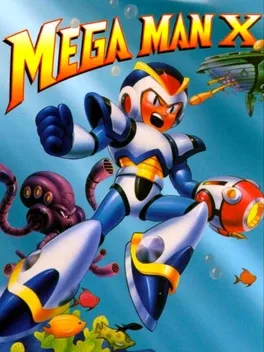
Mega Man X, known as Rockman X in Japan, is the first game of the Mega Man X series. It was the first spin-off of the classic Mega Man series and made its debut on the Super Famicom/SNES, initially released in 1993. It was ported to the PC in 1995, and to Android and iOS devices in 2011. It was re-released as part of Mega Man X Collection in January 2006, then later re-released in Mega Man X Legacy Collection in July 2018. The game takes place in the year 21XX (early 22nd century), a century after the conclusion of the classic Mega Man series, and stars a new main character named X.
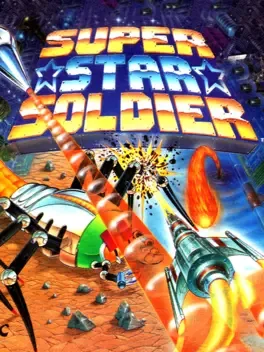
Move fast and blast! It's a nonstop explosion of fire power and you're streaking through space, right in the middle of it! The Brains Cult you once defeated is back, badder than ever. But your finger's on the trigger of an incredible new techno-attack! Scorch the Scorpion with a nuclear a sting. Fire your heat-seeking sidewinders. Then power-up to launch your doomsday Super Bomb! Blow those Brains out and save the galaxy. Then challenge your friends with a special competition time mode to prove who the Super Star really is!
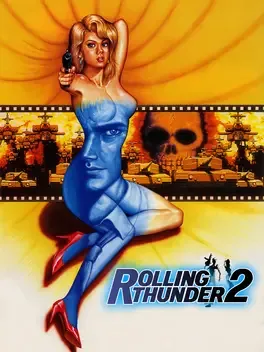
A terrorist group has taken out the world information flow and, as either a guy named Albert Ross or a woman named Leila, you must stop them. You can also get cool weapons that pack more of a punch than your ordinary hand gun. Also RT2 is a password supported game, so in other words you get a password at the end of each round so if you loss all your lives, you can continue from the end of that round, very handy.
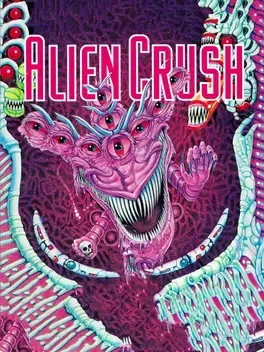
Fight against the aliens with your pinball skills! Imagine a living pinball machine...with aliens and outlandish worlds to throw at you. And turbo-charged, speed-of-light pinball action. You control the flippers and ball speed to defeat the Slime, the Tentacloid and Scorpion. Go for the eyes! This is full-tilt, out-of-this-world action! Surrealistic graphics plus true-to-life, earsplitting arcade pinball sound. Achieve the maximum possible score of 10 less than 1 billion and the game ends with the destruction of the table and a congratulatory message. The game is the first installment in the Crush Pinball series. It was followed by three sequels, Devil's Crush, Jaki Crush, and Alien Crush Returns.
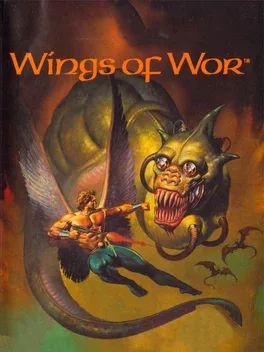
Gynoug, known in North America as Wings of Wor, is a 1991 scrolling shooter video game developed by Masaya and published by NCS Corporation for the Sega Genesis. The game was released in North America and Europe in 1991 and in Japan on January 25, 1991, and re-released on the Wii Virtual Console exclusively in Japan on May 20, 2008.