
Kururin Squash!

Buy
Part of collection:
Kururin
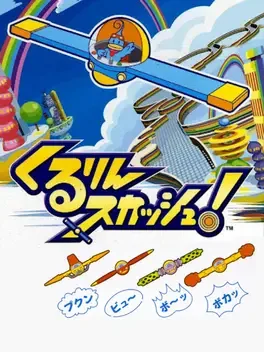
Kururin Squash! is an action-puzzle video game developed by Eighting and published by Nintendo. It was released only in Japan on October 14, 2004. The game is the successor to Kururin Paradise and is the only title of the Kururin series with 3D computer graphics.
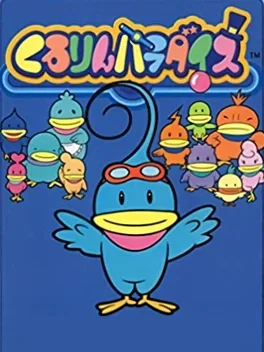
Kururin Paradise revolves around avoiding collisions as the player maneuver a robot through levels. The robot is shaped like a stick, and constantly spins. The second in the Kururin franchise, Paradise involves navigating complex levels with a constantly-rotating robot. Spring objects within levels change the direction of rotation when collided with, and an unlockable ability allows for increasing the speed of rotation. The player has three hit points. After three collisions with objects in the level (discounting the aforementioned springs), the level is re-started. Some levels have intermediate points that replenish health fully. However, they do not save progress. If the player loses all of his or her hit points, they still restart the level from the beginning. Almost all of the game is in Japanese.
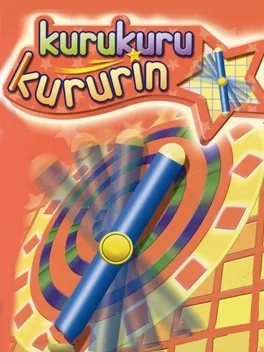
The story begins when Kururin’s brothers and sisters go missing, and it is up to him to find them. Kururin is initially unsure that he is up to the task because he has never left his home world before. Being the adventurous and helpful fellow he is, Kururin agrees to rescue his lost family. Teacher Hare trains Kururin in the art of controlling the Helirin, a stick-shaped helicopter that has a slow-spinning propeller. Piloting the Helirin through the different worlds will be a difficult task, but using Teacher Hare's valuable lessons, Kururin bravely sets out on his adventure to rescue his lost family.
Could be interesting

Live A Live's story is split across seven seemingly unrelated chapters that can be played in any order, based on popular genres such as Western, science fiction, and mecha. Each chapter has its own plot, setting, and characters. Although the basic gameplay is the same throughout the game, each chapter adds a new factor to the basic formula, such as the stealth elements in the ninja chapter. After the first seven chapters are completed, two final chapters take place to establish the connection between the seven previous and resolve the story.
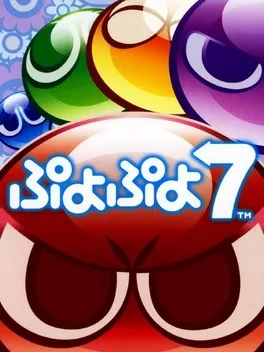
This is the 7th game in the main Puyo Puyo series, which is denoted by the 7. A break from the previous Fever series games, the game is set in a world similar to the real world instead of Primp Town. In this game, a new game mode known as Transformation was added as the default mode. Five new characters were introduced, and a few characters from past games in the series were reintroduced, either as playable characters or cameos.
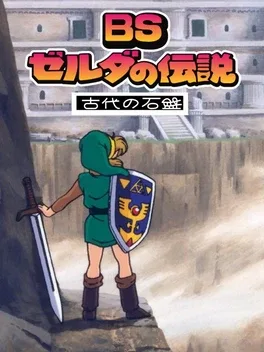
Ancient Stone Tablets was a Japan-Only release for the Legend of Zelda: A Link to the Past. It was an add on made for Satellaview, a system that takes radio broadcasts and processes them into games live. The game came in four weekly broadcasts and made new additions to the original, such as weather, many new dungeons, and a new story. The game was much like a Second Quest or Master Quest of A Link to the Past, sharing a very similar overworld with slight changes and entirely new dungeons. Unlike a Second Quest however, it has an entirely new story. Various actions earned the player points, and these points could later be traded in to Nintendo for different prizes. Ancient Stone Tablets is different from most other Zelda games as the game's central heroes are actually the avatars of the player's ID for the BS-X Broadcasting System (Super Famicon), drawn into Hyrule, which is also true for BS The Legend of Zelda. The difference being that this time the player does not take the place of Link, but takes part in a new tale set after the events of A Link to the Past. The male character wears a green tunic (though others are later available) and a backwards baseball cap. The female character has long red hair and is otherwise almost exactly the same as the male.
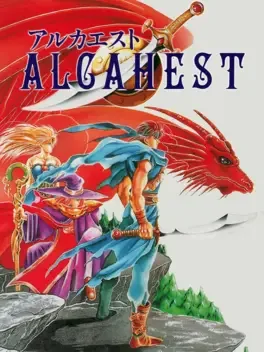
Alcahest is an action role-playing game with a top-down perspective that plays similar to The Legend of Zelda. It is divided into 8 stages that are progressed by finding items that aid the protagonist Alen on his quest, and end with a boss battle. After specific boss fights, the player will gain the abilities of one of the four elemental Guardians. Alen will also find five allies that will join him at predetermined points of some levels. They are the young wizard Garstein, the princess Elikshil, the knight Sirius, the android Magna and the shape-shifter dragon goddess Nevis. Though they cannot be controlled directly, allies will attack and use special moves when the corresponding button is pressed.
Ready. Set. Blitz! Collect and play with hundreds of Disney, Pixar and Star Wars emojis like never before in an exciting matching game! Play fast paced rounds of match-3 to earn prizes, complete missions, and discover new emojis. Collect Disney, Pixar and Star Wars emoji characters and items from The Little Mermaid, The Lion King, Cinderella, Zootopia, The Muppets, Disney|Pixar's Toy Story, Monsters, Inc., Finding Dory and more!
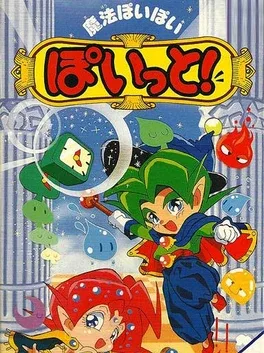
Match-3 Super Famicom puzzle game published by Takara in 1994. Features a story mode where the player has to wear down the health bars of various monsters by creating combos.

Lufia II: Rise of the Sinistrals serves as a prequel to Lufia & the Fortress of Doom, unfolding its events ninety-nine years before. The narrative delves into the origins of the series' antagonists, the Sinistrals, a group of super-humans. Players take on the role of the ancestor of Maxim, the protagonist from the first game, as he embarks on a quest after encountering Iris, a mysterious woman. Maxim seeks other heroes to join forces in preventing the Sinistrals from wreaking havoc and destroying the world. Like its predecessor, Rise of the Sinistrals follows the Japanese-style turn-based RPG format with an infusion of puzzle elements. The game incorporates intricate puzzles into its dungeon designs, requiring players to use various items and accessories for solving. Additionally, it introduces the "Capsule Monsters" system, allowing summoned monsters to participate in battles. These creatures evolve through the consumption of weapons, armour, or special fruits. Unlike the first game, dungeons in Rise of the Sinistrals lack random battles, with enemies visibly moving on-screen.
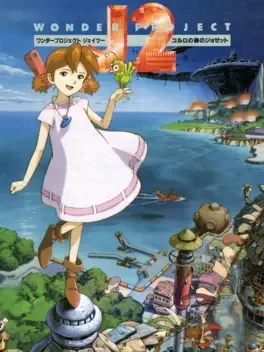
Wonder Project J2 takes place 15 years after the events of the first Wonder Project J game and focuses on a gijin (robot) girl named Josette. The game begins with Josette leaving her home on Corlo Island and traveling to Blueland, where she must learn to behave like a human and ultimately stop an empire from destroying the world.
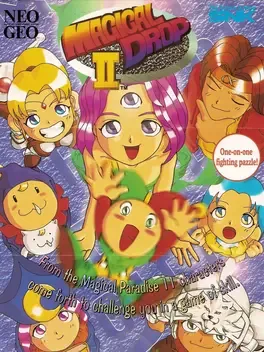
Magical Drop is played in a style and gameplay similar to Compile's (now Sega's) Puyo Puyo and Taito's Puzzle Bobble franchises; a "stack" of random colored bubbles descend from the top, and a player is defeated when a bubble hits the bottom. Bubbles can be picked up and dropped by the player's "clown" at the bottom, and are destroyed when three or more of the same color are put together on a single column. "Chains" are formed either when a single drop caused a chain reaction, or when more than one group of bubbles is destroyed in quick succession. The game is normally played with two players (one may be a computer opponent), and chains cause the opponent's stack to descend faster. There are 24 characters, all but the Black Pierrot being named after a tarot card (although the Strength card has been represented by two characters throughout the series). Different characters have different attack patterns. The columns of the opponent's stack will descend at different rates relative to each other depending on the character chosen. This causes a disjunction of colors that may make it more difficult for the other player to clear their stack. For example, with the character Devil, all the columns will descend at the same rate, whereas with Sun, the middle columns will descend faster than the others.
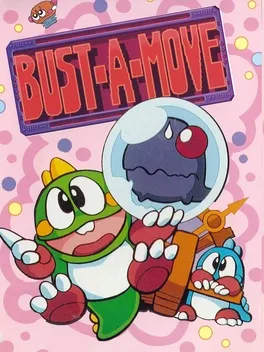
Bust-A-Move (also known as Puzzle Bobble) is a real-time puzzle game in which the player controls a device called "pointer" at the bottom of the screen, aiming and releasing randomly colored bubbles upwards. Depending on the aiming, the bubbles may float up directly or bounce off the walls, changing their trajectory. The goal is to aim the bubbles in such a way that they will touch identically colored ones. When such bubbles form a group of three or more, they pop and disappear from the screen. If the ceiling of the area is covered by too many bubbles, it will gradually descend; the game is over when it nearly reaches the player-controlled pointer. Should the player fail to release the bubbles within a specific time limit, they will be released automatically, unaffected by the pointer's aiming.