
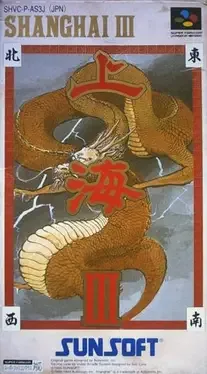
Shanghai III
Buy
Part of collection:
Shanghai
(last 3 games)
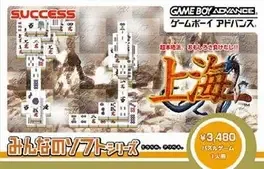
Minna no Soft Series: Shanghai is a Miscellaneous game, published by Success, which was released in Japan in 2003.
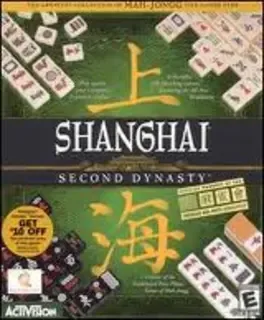
Shanghai: Second Dynasty includes several modes: Classic Shanghai, Dynasty, Pandamonium, as well as Windstorm and new "beat-the-clock" arcade modes. An official American Mah-Jongg association product, Second Dynasty now includes four authentic versions of Mah-jongg. Fifty-four tilesets are now included, with optional "power tiles" useful for the multiplayer mode. Players can create their own tiles by importing custom images. The game also includes an online mode where players can compete against each other.
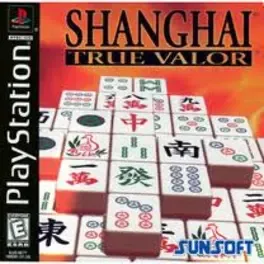
Shanghai: True Valor is a 3D puzzler based on the classic Oriental games Mah Jong and Shanghai. Each game starts off with a stack of tiles arranged in a pyramid shape. In order to win, the player is required to match up tiles by finding "free" tiles of the same type. For instance, some tiles have numbers and some have pictures; the object is to find a tile not restricted, blocked, or under another tile. Once a player matches up two tiles of the same type, they are removed and the pyramid is reduced. By removing tiles, previously restricted tiles may be opened up. Gameplay flows in this fashion until there are no more tiles or a stalemate. Stalemates are very common and occur when there are no possible matches or moves remaining.
Could be interesting
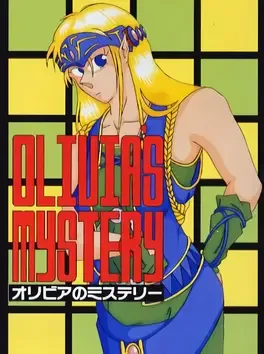
Olivia's Mystery is a Puzzle game, published by Altron, which was released in Japan in 1994.

Flight Rising is a social web-based activity site featuring dragon breeding, adventuring, combat, and collecting. It puts you in control of your own clan of dragons, allowing you to control their mating habits, specialize their abilities and traits, and adorn them thousands of different ways with a variety of apparel.
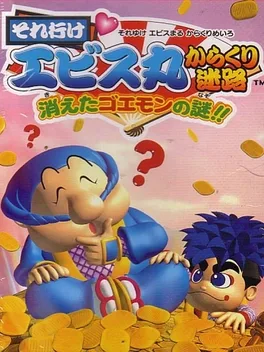
A spin-off game of Ganbare Goemon series. It is a puzzle game starring the titular fat ninja. Viewed from an overhead angled perspective, you are given a small level and must guide Ebisumaru to the end.
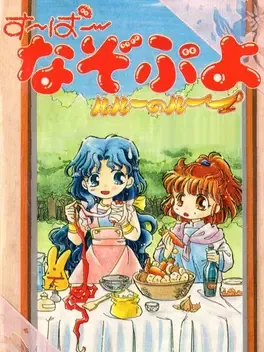
Super Nazo Puyo: Rulue no Roux is the sequel to Nazo Puyo: Arle no Roux. It was succeeded by Super Nazo Puyo Tsu: Rulue no Tetsuwan Hanjouki. A Nuisance Puyo variation known as Iron Puyo was introduced in this game. Super Nazo Puyo: Rulue no Roux uses the basic rules of Puyo Puyo. The game controls like a normal Puyo Puyo game with all five colors available and the ability to roate clockwise and counter clockwise, except the ability to double rotate and climb is not possible. Each puzzle gives the player different objectives to clear. The objectives range from clearing all of a specific color of Puyo, clearing all Nuisance Puyo, creating a specific chain length, clearing a certain amount of Puyo simultaneously, or simply clear the whole board. Every time the player fails to complete a puzzle, the player's health will deplete, as indicated by Arle or Rulue's expression gradually getting more distressed. If the player's health depletes completely, they'll receive a Game Over and can either choose to continue from the last save or quit back to the title. The player can recover completely if the gauges on the right side of the screen fills completely and rank up, with each cleared puzzle filling it gradually. On the pause menu, the player has the option to skip a puzzle at the cost of health. There are five game modes: Arle's Roux, Rulue's Roux, Road to Chains, Endless Puyo, and Editor. In the first three modes, the player must solve the presented tasks with a set of available Puyo. Arle's Roux focuses on a scenario with Arle, acting as the normal course with her puzzles only involving standard Puyo. Rulue's Roux is the mode that focuses on Rulue and acts as the expert mode, with her puzzles including Iron Puyo and Blocks. In both modes, the objective is to clear puzzle sets from varies characters within an area, with one character acting as a boss that cannot be challenged until the others are beaten. Once the boss of a given area is beaten, the player will progress to the next area. Road to Chains acts as a challenge mode where the player is given a series of puzzles to solve at a gradually increasing difficulty, with the player being unable to restore health. The Endless Puyo mode is a regular endless mode except that 6 next Puyo are shown instead of 1 next Puyo, and that nuisance Puyo will fall in the higher levels of difficulty. The Editor mode allows you to place Puyo freely in a manner similar to Practice Notebook in Puyo Puyo 7. You can also set a list of next Puyo and the task to be solved.

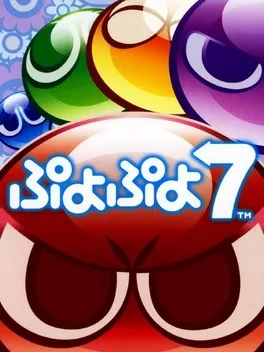
This is the 7th game in the main Puyo Puyo series, which is denoted by the 7. A break from the previous Fever series games, the game is set in a world similar to the real world instead of Primp Town. In this game, a new game mode known as Transformation was added as the default mode. Five new characters were introduced, and a few characters from past games in the series were reintroduced, either as playable characters or cameos.

Bust-A-Move (also known as Puzzle Bobble) is a real-time puzzle game in which the player controls a device called "pointer" at the bottom of the screen, aiming and releasing randomly colored bubbles upwards. Depending on the aiming, the bubbles may float up directly or bounce off the walls, changing their trajectory. The goal is to aim the bubbles in such a way that they will touch identically colored ones. When such bubbles form a group of three or more, they pop and disappear from the screen.
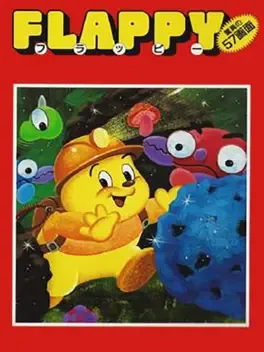
Flappy is a puzzle game by in the same vein as the Eggerland series and Sokoban that is obscure outside Japan. It features Flappy, a somewhat mole-like character who must complete each level by pushing a blue stone from its starting place to the blue tile destination.
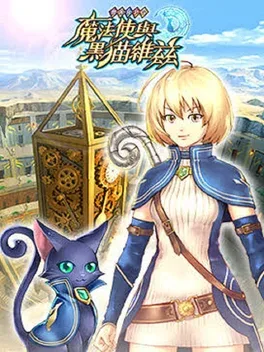
An RPG released on iOS and Android devices, the game is in fantasy theme with role playing puzzle genre.

The first game to be produced as a coverdisk for Japanese Famicom magazine Famimaga, Hong Kong is a points-based variant of Mahjong Solitaire (a.k.a. Shanghai) that also plays a little bit like Jenga. Hong Kong, or Famimaga Disk Vol. 1 Hong Kong, is a Shanghai variant in which players must remove specified tiles from a pattern. The player can select which pattern (from pyramids and hourglasses to more complex designs) from which to draw tiles as well as inputting a three letter code which offers several thousand possible combinations of the tiles within that pattern. Rather than removing tiles in pairs on the edge of the pattern in order to access buried tiles, as is the norm in Shanghai, the player can select any tile on the board as long as it corresponds to the tile the game requests. However, points are scored based on how many other tiles surround the selected tile: A maximum of 320 points are awarded for tiles completely surrounded on all six sides by other tiles. Any tiles that aren't "standing" on at least one other tile will fall off the board causing a premature game over: players need to balance earning points by removing entrenched tiles while ensuring that no tile will fall off the table as a result of the removal. Because the game is not a true version of Shanghai it is named after another Chinese city - Hong Kong - instead.