
Jetpac

Buy
Part of collection:
Jetman
(last 3 games)
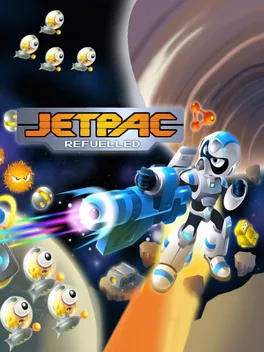
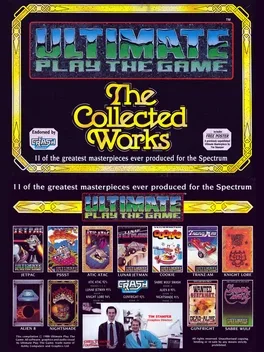
Jetpac Refuelled is the Xbox Live Arcade reworking of the classic 8 bit title Jetpac. The game was developed by Rare, who were responsible for the original game under their previous guise 'Ultimate - Play the Game'.
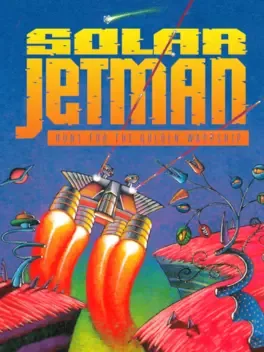
Blasting off through the cosmos and into hostile alien terrain, Jetman has returned in his most ambitious adventure yet! After the most powerful spacecraft in the known Universe, the Golden Warpship, is disassembled by a band of ruthless Space Pirates and scattered throughout the galaxy, Solar Jetman is tasked with rebuilding the ship to its former glory. Aided only by the gargantuan Federation Mothership for refuelling, Jetman will have to explore twelve labyrinthine planets solo in his Jetpod, where opposition is hidden inside every cavern and beyond every crater. With survival running as thin as his fuel, Solar Jetman will need to ward off every potential invasion and escape with the Golden Warpship intact – only then can he face off against his largest interstellar foe yet! Solar Jetman was re-released as part of the Rare Replay Collection on Xbox One.
Could be interesting
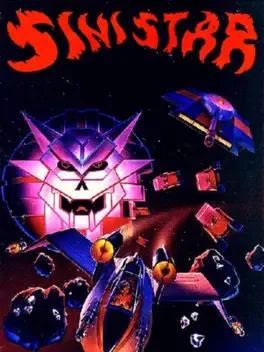
The player pilots a lone spacecraft, and must create "Sinibombs" by shooting at drifting planetoids and catching the crystals that are thereby released. Sinibombs are needed to defeat the game boss, Sinistar, an animated spacecraft with a demonic skull face. Sinistar does not exist at the start of the game, and is continuously under construction by enemy worker ships. Though time is crucial, attempting to mine too quickly will destroy a planetoid without releasing any crystals. Enemy worker ships are also gathering crystals (often stealing them from the player) which they use to construct the Sinistar. Enemy warrior ships can directly attack the player's ship. The player is given a head-start before the enemy ships have enough crystals to begin construction. Game ends when the player's ships are all destroyed. Once the Sinistar is completely formed, a digitized voice makes various threatening pronouncements, including "Beware, I live!," "I hunger, coward!," "I am Sinistar!," "Run! Run! Run!," "Beware, coward!", "I hunger!," "Run, coward!," and a loud roaring sound. The Sinistar has no weapon attacks, but if it contacts the player's ship while it darts about the playfield, the player's ship will be "eaten" and destroyed. A total of 13 Sinibombs are required to destroy a fully built Sinistar, although an incomplete Sinistar can be damaged to slow construction. Each short-range Sinibomb automatically targets the Sinistar when fired, but can be intercepted by a collision with an enemy ship, enemy fire, or a planetoid. The player moves from one zone to the next each time he defeats the Sinistar. A sequence of four zones repeats continuously after the first zone. Each is named for the most numerous feature of that zone: Worker Zone, Warrior Zone, Planetoid Zone, and Void Zone (the Void Zone is especially difficult because it has very few planetoids). Beginning with the first Worker Zone, a completed but damaged Sinistar can be repaired/rebuilt by the enemy ships by gathering more crystals, extending its "lifespan" if the player is unable to kill it quickly.

Soda Crisis is a fast-paced side-scrolling shooter game. You play a mysterious character of unknown origin, equipped with advanced high-tech gears and fierce combating skills - definitely the chosen one for this rescue mission!
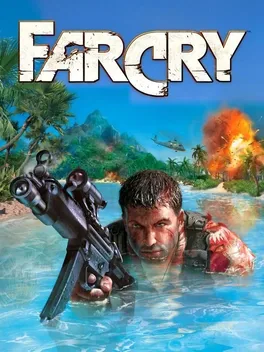
A tropical paradise seethes with hidden evil in Far Cry, a cunningly detailed action shooter that pushed the boundaries of combat to shocking new levels.Freelance mariner Jack Carver is cursing the day he ever came to this island. A week ago, a brash female reporter named Valerie had offered him an incredible sum of cash to take her to this unspoiled paradise. Shortly after docking, however, Jack's boat was greeted by artillery fire from a mysterious militia group swarming about the island. With his boat destroyed, his money gone, and the gorgeous Valerie suddenly missing, Jack now finds himself facing an army of mercenaries amidst the wilds of the island, with nothing but a gun and his wits to survive. But the further he pushes into the lush jungle canopy, the stranger things become. Jack encounters an insider within the militia group who reveals the horrific details of the mercenaries' true intentions. He presents Jack with an unsettling choice: battle the deadliest mercenaries, or condemn the human race to a maniac's insidious agenda.
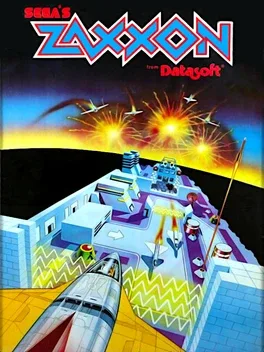
Zaxxon is a 1982 isometric shooter arcade game developed and released by Sega. The game gives the player the experience of flying a fighter craft through a fortress while shooting at enemy entities (missiles, enemy gunfire, etc.) The object of the game is to hit as many targets as possible without being shot down or running out of fuel, which can be replenished paradoxically, by blowing up fuel drums.
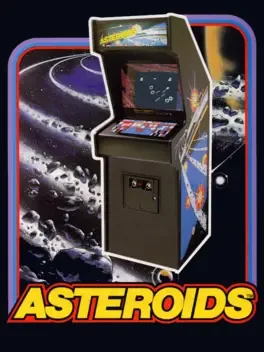
Asteroids is an arcade space shooter released in November 1979. The player controls a spaceship in an asteroid field which is periodically traversed by flying saucers. The objective of the game is to destroy both, asteroids and saucers. The triangular ship can rotate left and right, fire shots straight forward, and thrust forward. Once the ship begins moving in a direction, it will continue in that direction for a time without player intervention unless the player applies thrust in a different direction. The ship eventually comes to a stop when not thrusting. The player can also send the ship into hyperspace, causing it to disappear and reappear in a random location on the screen, at the risk of self-destructing or appearing on top of an asteroid.
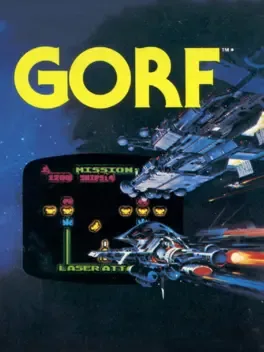
Gorf actually consists in the Arcade version of five different types of space shooters. The first one ist basically is a Space Invaders clone. In the second one a formation of space ships is hovering at the top of the screen while single space ships will disengage from the formation and dive down at you. The third variant is a Glaxian clone and only available in the Arcade version. In the fourth mini-game the enemy will come out of a circular hyperspace field and attack you. After having destroyed four of your attackers the game proceeds to the fifth game stage. Here a huge mothership is dropping bombs at you from the top of the screen. You defeat the mothership with a well placed projectile hitting it between its two major sections. After that the game starts from the gebinning on a higher difficulty level.
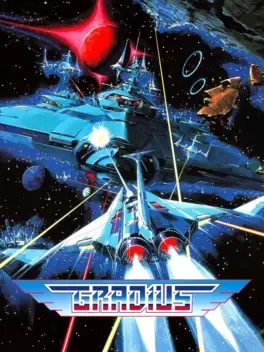
One of the defining characteristics of the Gradius series is the use of a "power meter." The power meter is powered by a power-up item, whose purpose, when collected, is to move a highlight to the next power-up on the power meter. When a power-up that the player wants becomes highlighted, he or she may activate it, also causing the highlight to reset.
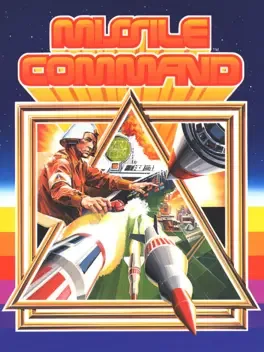
As a regional commander of three anti-missile batteries, the player must defend six cities in their zone from being destroyed. The player's six cities are being attacked by an endless hail of ballistic missiles, some of them even splitting like multiple independently targetable reentry vehicles (MIRVs). New weapons are introduced in later levels: smart bombs that can evade a less than perfectly targeted missile, and bomber planes and satellites that fly across the screen and launch missiles of their own.

Biota is a 2D metroidvania inspired shooter set on a wild and dangerous sci-fi, pixel-art planet. Get ready to face hostile alien life forms and investigate a mysterious mining colony as a group of ragtag heroes from the future, all in glorious 4-color palettes and detailed 8-bit visuals.

Alien Hominid Invasion is a co-op run ‘n’ gun packed with chaos, mayhem, and a whole lot of explosions. Unlock and equip an arsenal of weapons and boosts, level up, then beam down to invade Earth with up to three other friends. Abduct intel from your enemies to sabotage their plans, observe the oddities of human life, blow up bosses, and mutate into a variety of powerful Alien forms in order to take down the not-so-secret Agents that are dead set on ruining your day.