
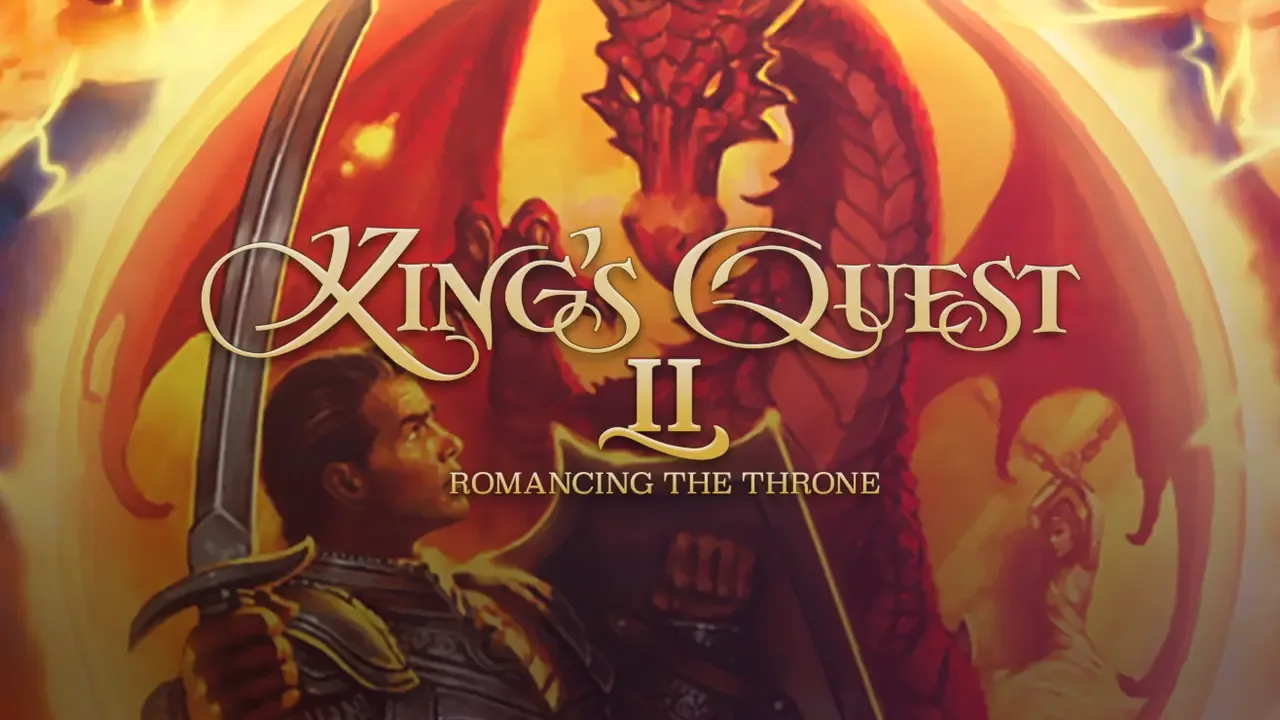
King's Quest II: Romancing the Throne


Buy
Part of collection:
King's Quest
(last 3 games)
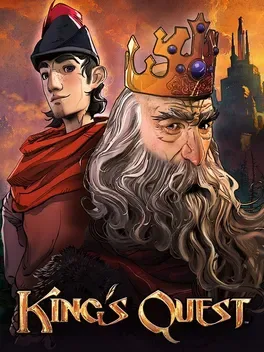
King’s Quest is a collection of five different chapter releases, each focusing on an untold tale in Graham’s past. In each chapter, an aging King Graham reflects on his life of adventure with his granddaughter, Gwendolyn, while players are transported back to influence first-hand the decisions and events that shaped a kingdom. Embark on an extraordinary journey across the world of Daventry.
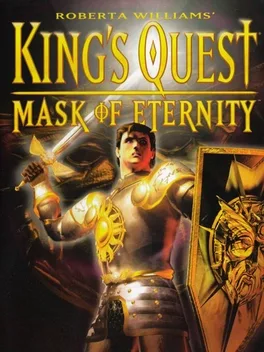
King's Quest: Mask of Eternity (also known as King's Quest VIII: The Mask of Eternity) is an action-adventure video game written and designed by Roberta Williams and released in 1998 by Sierra Studios, is the eighth, and at present remains the final, official computer game in the famous King's Quest series. It is the first and only game in the series where the main character is neither King Graham nor a member of his family, the first in the series to use a full 3D engine as opposed to the 2D cartoon or pixel style of the earlier games and the first to omit the sequel numbering system on box artwork and title screen, though references to it being the eighth game appear in the file structure and the game was marketed as KQ8 on the official website, interviews, and other places.
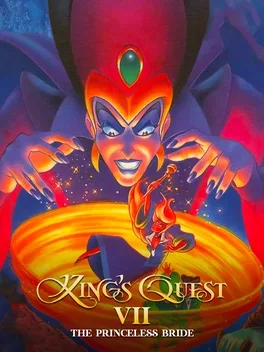
King's Quest VII: The Princeless Bride is an adventure game in the King's Quest series. The game features two playable characters: Queen Valanice and her daughter, Princess Rosella, who become separated in a magical realm called Eldritch. Players alternate between the two characters as they navigate through six chapters, each set in a distinct fantasy world. The story revolves around Rosella's unexpected journey to Eldritch and Valanice's quest to find her daughter, with both facing various challenges and encountering colorful characters along the way. King's Quest VII departs from the series' traditional art style, adopting a more cartoon-like aesthetic inspired by Disney animated films. The game incorporates point-and-click gameplay, puzzle-solving, and character interactions typical of the adventure genre, while expanding on the King's Quest universe with new locations and a focus on female protagonists.
Could be interesting
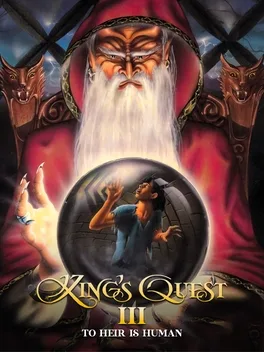
King's Quest III: To Heir is Human is an adventure game in the King's Quest series. Players control Gwydion, a young slave to the evil wizard Manannan in the land of Llewdor. The game follows Gwydion's journey as he learns magic, escapes his captor, and discovers his true identity as the lost prince of Daventry. Players must solve puzzles, avoid the wizard's watchful eye, and navigate various dangers to complete their quest. The game expands on the series' fantasy setting, introducing new locations and characters while maintaining the puzzle-solving and exploration elements that define the King's Quest franchise. As the third installment in the series, King's Quest III continues the story of the royal family of Daventry, connecting to the broader narrative of the King's Quest saga.
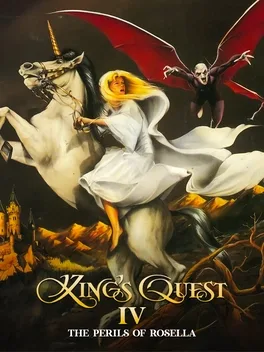
King's Quest IV: The Perils of Rosella is an adventure game in the King's Quest series. Players control Princess Rosella, daughter of King Graham, as she embarks on a quest to save her father's life and rescue a fairy kingdom. The game takes place in the land of Tamir, where Rosella must find a magical fruit to heal her ailing father while also helping the fairy queen Genesta reclaim her stolen talisman from the evil fairy Lolotte. Players navigate Rosella through various environments, solving puzzles and interacting with characters from folklore and fairy tales. King's Quest IV introduces real-time elements and day-night cycles to the series, affecting gameplay and puzzle solutions. The game expands on the series' narrative by focusing on a female protagonist and exploring new themes while maintaining the fantasy setting and puzzle-solving mechanics characteristic of the King's Quest franchise.
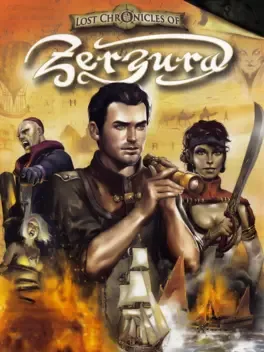
Join a young inventor on the expedition of his life. A remarkable journey from Spain, across the Mediterranean, to distant Africa; a quest to save his own soul and lives of those he holds most dear. Two brothers operate a workshop that is well ahead of its time in Barcelona of 1514. It's the time of the golden epoch of the Renaissance, a time of discoveries and inventions; but also the brutal age of the Inquisition. One brother puts all his efforts into building a flying machine, while the other dreams of Egypt and mysterious art treasures. The advanced ideas and exotic fantasies weaved by the pair arouses the suspicions of the Grand Inquisitor. Quite suddenly their small world is turned upside down as one brother is taken away by the Inquisition; leaving the other alone to search for answers that will set his imprisoned sibling free. Explore the ravishingly beautiful and detailed locations of this remarkable adventure as you become immersed in this mysterious medieval tale and solve a unique combination of puzzles, mini-games, and other challenges that are perfectly integrated within this breathtaking storyline. Evade further attacks by the inquisition, and forge strong alliances with those you meet along the way. Trek across different countries and cultures and eventually to the legendary desert city of ZERZURA, where an ancient terror guards over powerful secrets - and poses the greatest challenge of all.
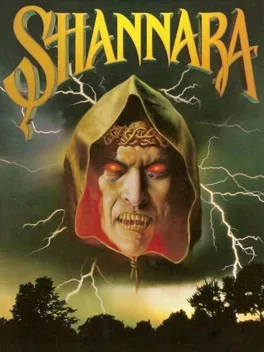
Shannara is a computer game released in 1995 for DOS and Microsoft Windows. It is based on the Shannara series of books by Terry Brooks. The game has some elements taken from RPGs, such as top-down world-map traveling and occasional turn-based battles. However, there is no real role-playing system in the game (statistics, experience points, levels, etc.). The battles serve to emphasize the danger of traveling the wilderness, or appear as story-related events; sometimes, they are treated like puzzles, with specific actions leading to victory.
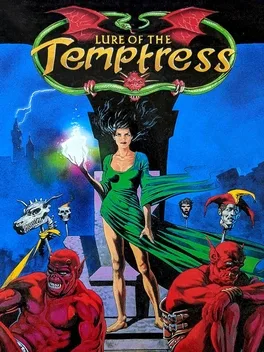
Lure of the Temptress is an Adventure game, developed by Revolution Software and published by Konami, which was released in 1992.
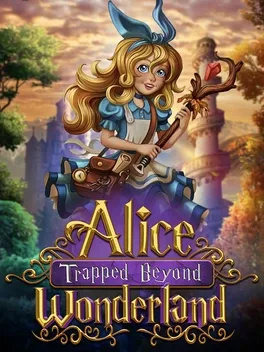
Discover and solve the extraordinary mysteries from the magical kingdoms beyond the incredible Wonderland, Find where the evil red queen banished your friends, gather clues about their whereabouts, and solve multiple puzzles to rescue them once and for all to get them back to their home in Wonderland.
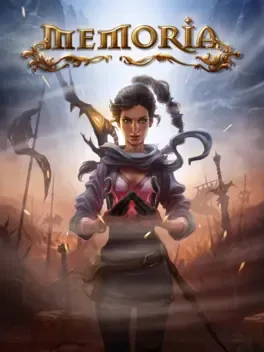
Memoria combines classic point & click adventure gameplay with the features of The Dark Eye, one of the most successful RPG universes known in the fantasy world. Point & click adventure game puzzles get a unique twist by adding magical features - and a wise, talking staff. Over eight chapters, players control both Sadja's and Geron's fates, involuntarily interacting with each other and bridging over 500 years of time. Each chapter in Memoria features opulent graphics, epic locations, a thrilling fantasy crime story and a unique puzzle design that differs from chapter to chapter.
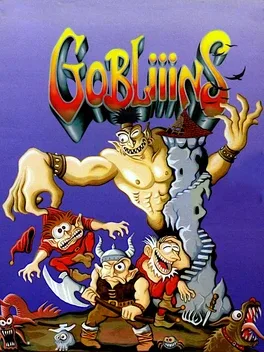
Gobliiins is an adventure game where the player controls a team of three goblins: Oups, Ignatius and Asgard (Hooter, Dwayne, and BoBo in the US release) to find four magic components. A voodoo doll has turned their king Angoulafre mad and by collecting the components they can track down Niak the Wizard, the only one who can put things right. The player needs to solve various puzzles by combining the different skills of the three goblins. It's possible switch between them and control them separately. Most of the puzzles are based on coordinated actions. One can cast powerful but erratic spells, another can collect and use objects, and the last can hit things. Action icons are activated at the bottom of the screen. The game takes in 22 landscapes, each of which has puzzles which must be cleared. The characters have limited energy, which can be sapped by traps.
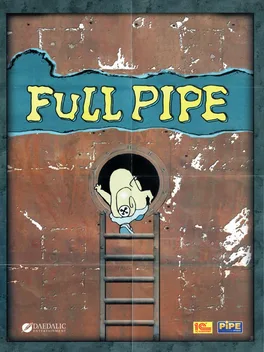
The game revolves around navigating a main character named Dude from the third-person perspective about a secret landscape under his bed in search of a lost slipper. The game is in 2D and consists of a number of puzzles centered on using items collected and interacting with other NPCs. There is no dialogue in the game and the difficulty often derives from trying to determine why a character behaves in the way it does. Solutions to the puzzles are often illogical, in keeping with the atmosphere of the game which has been described as psychedelic.
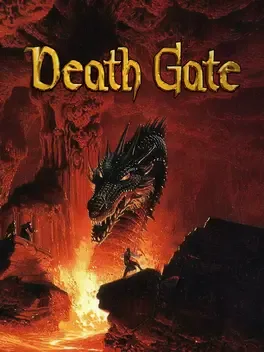
Death Gate is a classic adventure game from the much revered Legend Entertainment. The studio is known for developing games that include exceptionally well crafted puzzles and a wacky sense of humor which frequently breaks the fourth wall and plays to a wide assortment of offbeat puns. Moreover, the company has emerged with a winning streak of fantasy and sci-fi games based on popular literature adaptations. The most famous of these are Frederick Pohl's Gateway and Terry Brooks' Shannara. In 1994, Legend Entertainment has chosen to adapt not 1 book but the whole series of 7 books by Margaret Weis and Tracy Hickman known as The Death Gate Cycle. The original release of the game even includes a special gift for fans of the book series, namely an exclusive short story written by the same authors that tells some of the history of the mysterious Assassin's Guild from the series. In Death Gate, the player is cast in the role of a freshly freed Patryn—a young, brave wizard named Haplo. By his deeds in the Labyrinth, he has gained Xar's trust to be sent as a scout to the other 4 realms. The way between them leads through a mystical portal known as the Death Gate. For his journey, Haplo is handed not a single but several quests to complete. He must first explore the realms, learn about the new lands, and find the pieces of the World Seal that will allow the reformation of the world to its original whole. He must also retrieve as much of forgotten magical lore as he can, and find runes that will allow him to enter all the other realms. Finally, and most importantly, he must find out what has happened to the Sartan who seem to have vanished somewhere long ago, so that Xar will be able to bring them to the proper Patryn justice. The game, by taking inspiration from the first 4 books, creates a certain unique experience for the player that stands out among other fantasy adventures. There is an unusually layered structure based on the initial premise of the 5 separate realms, since the consequences of the sundering run much deeper than mere differences in landscapes. From realm to realm life conditions vary enormously, including geography, history, fauna, flora and astronomical bodies. For each realm, the population is divided into very specific societies, although many attributes of each race remain common. Several royal families, powerful guilds, and wealthy, independent merchants all have their own specific goals and ambitions that are not at all connected to the grand schemes of the Patryn and the Sartan, which they mostly are unaware of at this time after centuries of their absence. The distinctiveness of each culture's circumstances and the individual diversity of the larger and smaller schemers within the cast of characters give a special magic and wonder to the proceedings in the game, especially when the player visits a new realm for the first time and starts exploring it. The worlds possess a mysterious, intriguing flavor, but with a touch of whimsical surprises from nearly everywhere. Each encounter with Xar between travels reveals more information concerning the whole mechanics that connect these realms. Death Gate contains some exceptionally good voice acting. This is especially true for Henry Strozier who plays the role of Xar. He carries a low, charismatic, and authoritative voice that perfectly befits a character with a brave heart, long experience, deep wisdom, but a good share of arrogance. He shines for good measure too, since the player will spend more time conversing with his character than any other in the game. Haplo, who is only heard in conversations, voiced by David DeBoy, does not have a plain, uninteresting voice either. He sounds slightly arrogant and lordly like his master, but also rather youthful, yet manly enough to give an air of independency. The MIDI music in Death Gate is very well done. The compositions are perfect for an epic fantasy setting. The tunes are often light and comforting, but they can change dramatically to a more majestic tone when visiting the king's palace and to a darker motif when exploring the undergrounds of Abarrach, the vicious Labyrinth, or the deadly Assassin's Guild. Aside from Haplo and Xar, several other characters from the books also make an appearance in the game. Many of them, however, have been greatly simplified and reduced to only episodic roles with little development. Many major characters from the books are missing altogether, most notably Alfred, whose role is crucial in bringing out Haplo's characterization in the literary originals. On the other hand, some of the memorable archetypes from the books are used in new, interesting ways. For example, a boy named Bane has been recast into a different child with a different life and social standing, though both share a very similar personality. The character that stays most true to the canon is the whimsical, crazy wizard Zifnab, who appears in all his pun infested glory. In general, the plotlines are less violent and happier than those in the books, and the characters show less moral ambiguity. Death Gate plays like a traditional point-and-click adventure game, but like a role-playing game it is as much about being free to explore the fictional world as about following a foreordained storyline thread. There is quite a bit of narrative text, diaries, historical documents, and dialogs to sieve through. They are all well written and are rather fascinating, since everything is directly connected to the quests the player needs to complete or the puzzles the player needs to solve. There is a fine dose of humor in the game too, but nothing so unsubtle that may distract from taking the main conflicts of the story seriously. From this stance, Death Gate is actually quite a departure from the largely comical gallery of previous game titles from Legend Entertainment. The puzzles in Death Gate are a bit on the easy side, but the enjoyment they give is very well balanced by their ingenuity. The wealth of subplots, quests, plot twists, and deceptions add a lot of tension to the player's own proceedings. There is a certain logic and buttons based puzzle that is rather hard to beat. However, the player can ask for help from the game to solve it (or even skip over it). In general, the difficulty level of the game lies somewhere between easy and medium. The player can die in the game, but there is an option available to undo the player's last fatal action. Comparison with the books quickly reveals some of the obvious budgetary or time constraints the developer must have faced during Death Gate's development. Pryan, the realm of fire, is build of elements taken not only of this realm in its original form but also of Chelestra, the realm of water. Consequently, the latter realm has shrunken to a very limited scope in the game. The smallness of Chelestra comes in the game as a particular disappointing revelation, since it is the last of the elemental realms that the player visits. The interface used in Death Gate has evolved from the original Legend Entertainment's interactive fiction interface. There is an always available standard list of commands (such as Take, Look at, or Use) for the player to choose from, reminiscent of Lucasarts' SCUMM interface. In addition, extra action commands specific to an object appear when it is clicked. For example, when clicking on a door, apart from the standard list of verbs, there are added options to unlock, knock, or eavesdrop on the door. There are many actions which are not necessary to complete the game but which trigger funny responses specific to the situation. Altogether, the interface is a clever compromise between the sense of freedom achieved through a text parser and the simplicity of contemporary point-and-click style. Gameplay in Death Gate draws on a few gimmicks that are typical of role-playing games. For some parts of the game, the player is able to have a party of several characters. There is also a process of collecting magical spells, even though they have been tweaked for solving puzzles instead of combat. A spell is constructed by connecting runes in a combination. After that, it is traced in the air by Haplo with his hands to bring the spell into motion. The player will be able to learn many spells in the game, mostly from the mensch. This is an important diversion from the canon, as the mensch from the books possess a different kind of magic altogether. The high resolution graphics of the game will remind fans strongly of fantasy literature illustrated covers. The characters are beautifully detailed in high resolution, but rarely fully animated. However, their faces are always incredibly alive, especially in conversational close-ups. When exploring the game world, the player will notice many intricate but small animations in otherwise generally static sceneries. Major events occurring in the game are partially described in narrative text and partially presented as cut scenes. Sadly, the number of background illustrations in the game is a bit limited. All locations are shown from only a single point of view. Sometimes, the player is drawn to something interesting drawn at the edge of an illustration but is unable to look closely to find out more about it.