
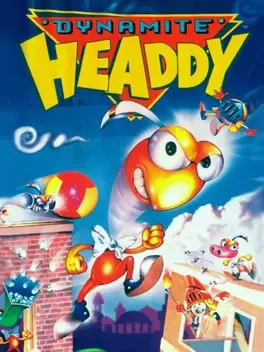
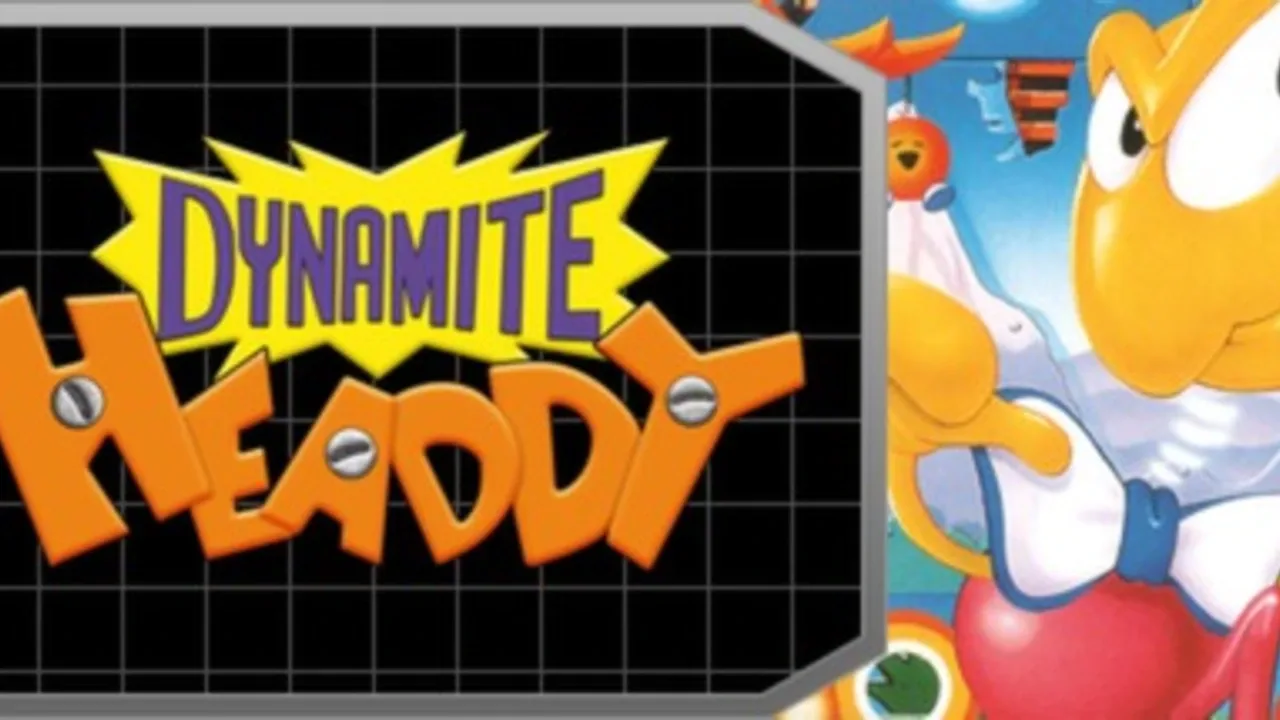
Dynamite Headdy






Buy
Could be interesting
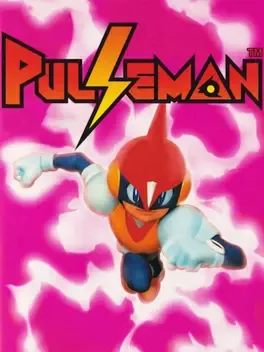
Pulseman is a platform game only released on cartridge for a Japanese audience, but was available to North American consumers via the Sega Channel. The game was not sold in Europe. It was developed by Game Freak, the development team that would later go on to produce the Pokémon series of games for Nintendo. Many of Pulseman's staff, including director Ken Sugimori and composer Junichi Masuda worked on both games.

Alex Kidd: The Lost Stars features Alex Kidd and Stella searching for the twelve Zodiac signs.
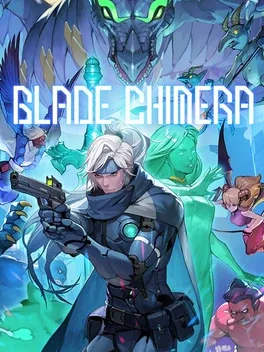
In this exploration-heavy 2D action game, use your demon sword to interfere with the past, create platforms, and shield yourself from danger to explore a dystopian cyberpunk world depicted in gorgeously animated pixel art.
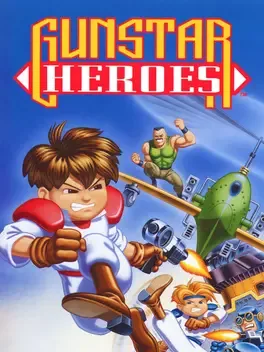
The Gunstar family are the protectors of the planet Gunstar 9. After many years of peace, vicious dictator Colonel Red kidnapped the Gunstar twins’ older brother and used mind control to make him his slave.
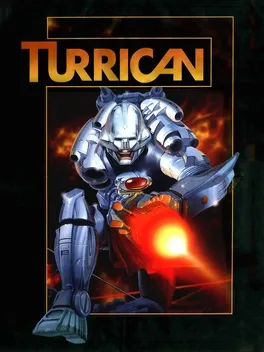
Turrican is a 1990 video game programmed and designed by Manfred Trenz. It was first developed for the Commodore 64 by Rainbow Arts, but was ported to other systems later. In addition to concept design and character creation, Trenz personally programmed Turrican on the Commodore 64. A sequel, Turrican II, followed 1991 for the Commodore 64 and other platforms.
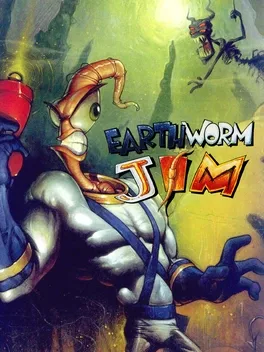
A crow is chasing a worm named Jim while in outer space Psy-Crow is chasing a renegade ship. The ship's captain has stolen an ultra-high-tech-indestructible-super-space-cyber-suit and Queen Slug-for-a-Butt has ordered Psy-Crow to get it, since it can make her more beautiful than Princess-What's-Her-Name. Psy-Crow blasts the captain and the suit falls to Planet Earth. Back on earth Jim wonders if he is finally safe when an ultra-high-tech-indestructible-super-space-cyber-suit lands on him. Luckily Jim rests in the neck ring of the suit. Then the space particles begin interacting with Jim, causing a light-speed evolution. Jim soon realizes he is in control of the suit. Jim overhears the Queen's plans for the suit and decides to meet this Princess...

Psycho Fox must get to the right hand side of the level. However, there are many enemies in the way. He can use a Shinto stick to change into characters/animals like a hippopotamus, a monkey or a tiger, each of which has its own special ability. The hippopotamus is slow and cannot jump very high, but can punch through special destructible blocks in the game world. The monkey can jump higher than the other creatures and the tiger can run faster. Psycho also has an ally named Birdfly, who can be used as armor or as a boomerang. If Psycho is hit while carrying Birdfly, Birdfly goes away and the player does not lose a life.
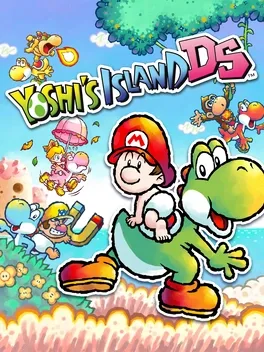
Yoshi's Island DS is a 2D platformer for the Nintendo DS in the Yoshi's Island series. It is the sequel to Super Mario World 2: Yoshi's Island, where Kamek and the Toadies have kidnapped all the babies in the world in search for the star children, a group of seven babies who possess powerful stars in their hearts. While the game is heavily derivative from Super Mario World 2: Yoshi's Island, including general gameplay, themes, and graphics, the game primarily differentiates itself from its predecessor by taking advantage of the Nintendo DS's dual screen to display levels while introducing multiple babies to carry on Yoshi's back, who all have special abilities that are required to complete levels.
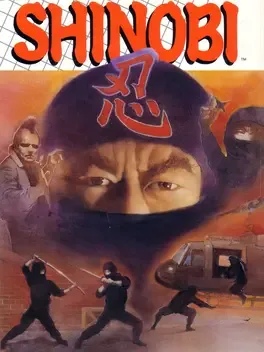
The five missions in the game are each three or four stages long. Several hostages are being held in each stage; Joe must rescue all of them before he is allowed to finish the stage. The last stage in each mission has no hostages, but instead features a powerful boss character whom Joe must defeat. After completing each of the first four missions the player is taken to a bonus stage, where he can earn an extra life if he is able to kill all of the ninjas leaping towards him. Completing the fifth mission ends the game. Also, once the fifth mission begins, continues are no longer allowed; the player has to finish the game with however many lives he has left at that point. If the player earns a place on the high score board, the number of credits it took him to get that score is displayed along with his score. Joe's standard weapons are an unlimited supply of shuriken, along with punches and kicks when attacking at close range. One hostage per stage gives him a power-up. When powered-up, his throwing stars are replaced by a gun that fires large, explosive bullets, and his close-range attack becomes a katana slash. Joe can also perform "ninja magic," which may be used only once per stage and kills (or damages, in the case of bosses) all enemies on the screen. The game also allows the enemies to hide behind boxes or use shields to block Musashi's shurikens.[4] Joe can be killed with one hit, provided he is hit by a projectile or melee attack, but if he does not find himself in those situations, the player can touch regular enemies and just be pushed back without being damaged. Since most enemies appear in the same place on each level, it is possible to master the game by memorizing their locations and devising patterns to defeat them. At the end of each stage, the player receives score bonuses based on performance. Completing the stage without using ninja magic or without using any throwing stars or bullets earns the player a point bonus. The player has three minutes to complete each stage; remaining time at the end of the stage is also converted to bonus points and added to the player's score.
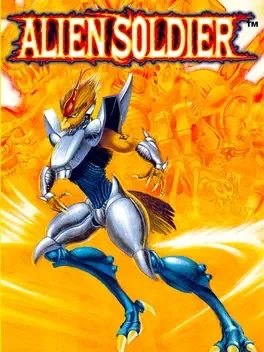
The planet Sierra is being attacked by Scarlet, a terrorist group lead by a vicious creature named Xi-Tiger who is plotting to destroy the human race. With vengeance, our hero Epsilon-Eagle will fight against Xi-Tiger as well as the terrorist organization that he formerly led.