
Scramble


Buy
Could be interesting
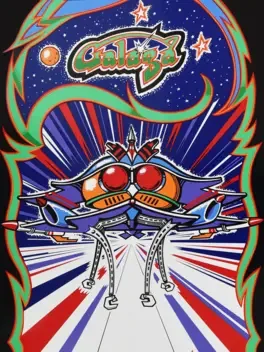
The objective of Galaga is to score as many points as possible by destroying insect-like enemies. The player controls a starfighter that can move left and right along the bottom of the playfield. Enemies swarm in groups in a formation near the top of the screen, and then begin flying down toward the player, firing bombs at the fighter. The game ends when the player's last fighter is lost, either by colliding with an enemy or one of its bullets, or by being captured. Galaga introduces a number of new features over its predecessor, Galaxian. Among these is the ability to fire more than one bullet at a time, a count of the player's "hit/miss ratio" at the end of the game, and a bonus "Challenging Stage" that occurs every few levels, in which a series of enemies fly onto and out of the screen in set patterns without firing at the player's ship or trying to crash into it. These stages award a large point bonus if the player manages to destroy every enemy. Another gameplay feature new to Galaga is the ability for enemies to capture the player's fighter. While the player is in control of just one fighter, a "boss Galaga" (which takes two shots to kill) periodically attempts to capture the fighter using a tractor beam. If successful, the fighter joins the enemy formation. If the player has more lives remaining, play resumes with a new fighter. The captured fighter flies down with the enemy that captured it, firing upon the player just like normal enemies, and can be shot and destroyed. The player can free the fighter by destroying the boss Galaga while in flight, causing the captured fighter to link up with the player's current fighter, doubling his or her firepower but also making a target twice as large. Galaga has an exploitable bug that can cause the attackers to stop firing bullets at the player, due to a coding error. In addition, similar to the famous "Split-Screen bug" in Pac-Man, a bug exists in Galaga in which the game "rolls over" from Level 255 to Level 0. Depending on the difficulty setting of the machine, this can cause the game to stall, requiring that the machine be reset or power-cycled in order to start a new game.
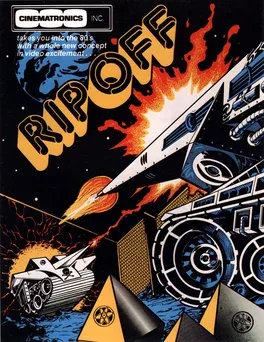
Rip-Off is a vector shoot 'em up released in arcades by Cinematronics in 1980. It is the first shoot 'em up arcade game to feature cooperative gameplay and the first game to exhibit "flocking" behavior. The objective is to prevent computer-controlled enemies from stealing eight canisters set in the center of the screen. One or two players control tank-like vehicles while game-controlled "pirate" tanks rush onto the field and attempt to drag the canisters off the edge of the screen. Enemies can be defeated by shooting or colliding with them. The game speed and difficulty increase with each successive wave until all the canisters have been taken ("ripped off").
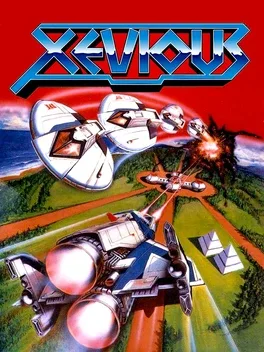
It's a nightmare, but it's true! Research shows that we are the actual aliens on Earth, and the ruthless Xevions are the original inhabitants. Now the Xevions want Earth back -- minus humans! Their invasion forces are fierce -- the land is crawling with deadly Domogram Rovers; the sky is black with Toroid Patrol Fleets and Zoshi Death Squads. Our puny weapons offer no defense. Earth's only hope is our powerful new Solvalou Fighter Plane. Its pilot will have a single mission: Penetrate the enemy ranks and destroy the Xevious Mother Ship. The mission is dangerous. We can't guarantee success. But at this point, it's do or die! One small problem. We still need a pilot. Any volunteers?
Spanning light-years the Fusion: Genesis universe allows you to adventure through a vast array of levels and missions. Escort imperial convoys, defend your base from invading fleets, infiltrate enemy lines or mine for rare and exotic minerals to become the wealthiest trader alive! Choose to fight epic battles in player versus player warzones, or cooperate to defend space stations from Dark Legion Raids or join other heroes to overcome the terrible guardians of the mysterious Ark.The game features dynamic missions to give it an MMO like feel.
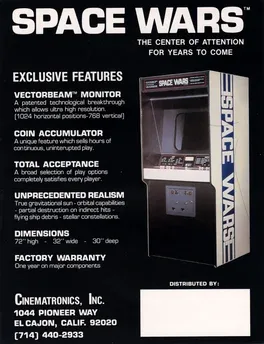
Space Wars is an early vector graphics arcade game. It is based on Spacewar!, a PDP-1 program. It was ported to the Vectrex in 1982. Space Wars was the brainchild of Larry Rosenthal, an MIT graduate who was fascinated with the original Spacewar! and developed his own custom hardware and software so that he could play the game. Cinematronics worked with Rosenthal to produce the Space Wars system. Two players controlled different ships. One button rotated the ship left, another rotated the ship right, one engaged thrust, one fired a shell, and one entered hyperspace (which causes the ship to disappear and reappear elsewhere on the playfield at random). The game offered a number of gameplay options, including the presence or absence of a star in the middle of the playfield (which exerted a positive or negative gravitational pull), whether the edges of the playfield "wrapped around" to their opposite sides, and whether shells bounced. Three other fascinating features were unique to this game. First, the game could not be played in "one player" mode; a human opponent was required. Second, the player's ship could take a glancing hit without dying, but would suffer damage; a cloud of loose ship fragments would break off and float away, after which the ship would be visibly damaged on screen and would turn and accelerate more slowly. Third and most memorable was that the duration of play for any contest was solely governed by the amount of money deposited; each quarter bought a minute and a half of play. A dollar bought six minutes, and for a ten dollar roll of quarters two players could play non-stop for an hour.
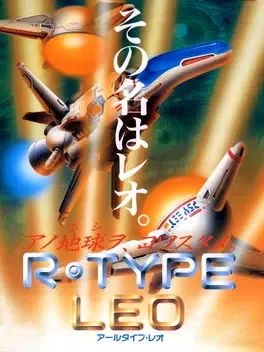
R-Type Leo is a horizontally scrolling shooter arcade game. It is a spin-off of the R-Type series and the last entry to be released in Arcades. R-Type Leo was initially an original shoot 'em up game in development by Nanao before Irem retooled it into an R-Type project instead. It is also the first R-Type game to feature simultaneous two player gameplay.
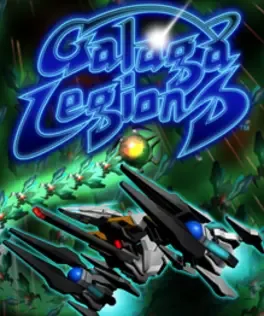
Galaga Legions is an Xbox Live Arcade exclusive video game created by Namco Bandai Games. The title was developed by the same team who created Pac-Man Championship Edition. This game is also included in the Namco Museum Virtual Arcade collection, and in Pac-Man & Galaga Dimensions for Nintendo 3DS. A DX version of the game was released on Xbox Live Arcade as part of the Namco Generations series on June 29, 2011, with the PlayStation Network version released in August 2, 2011.
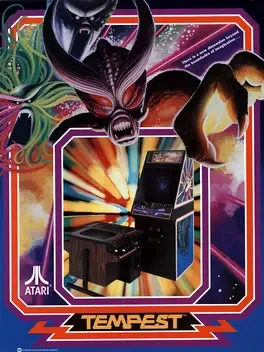
Tempest is a 1981 arcade game by Atari Inc., designed and programmed by Dave Theurer. It takes place on a three-dimensional surface, sometimes wrapped into a tube, which is viewed from one end and is divided into a dozen or more segments or lanes. The player controls a claw-shaped spaceship (named Blaster) that crawls along the near edge of the playfield, moving from segment to segment. Tempest was one of the first games to use Atari's Color-QuadraScan vector display technology. It was also the first game to allow the player to choose their starting level (a system Atari dubbed "SkillStep"). This feature increases the maximum starting level depending on the player's performance in the previous game, essentially allowing the player to continue. An official port was released for the Atari ST. An official port that bears the Atari logo was released by Superior Software for the BBC Micro and Acorn Electron in 1985, and another by Electric Dreams for the ZX Spectrum and Amstrad CPC in 1987. Versions for the Atari 2600 and 5200 were in the works in Atari, Inc. during 1984, and unfinished prototypes exist for both of them.
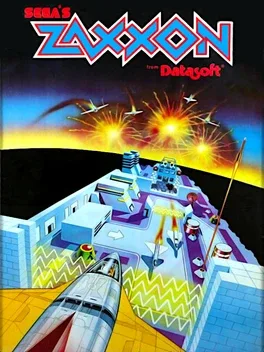
Zaxxon is a 1982 isometric shooter arcade game developed and released by Sega. The game gives the player the experience of flying a fighter craft through a fortress while shooting at enemy entities (missiles, enemy gunfire, etc.) The object of the game is to hit as many targets as possible without being shot down or running out of fuel, which can be replenished paradoxically, by blowing up fuel drums.
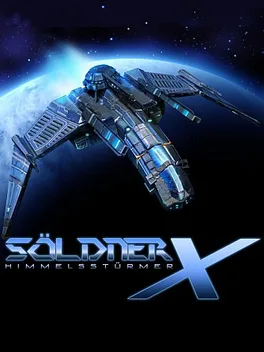
The celestial planet Conceyta orbits with its moon in a dust- and gas-covered solar system. Within lurks an evil unknown to man that bears a danger so much greater than any threat yet witnessed. A dark, mysterious power has manifested itself in the depths of the gas giant, absorbing life and technology, and assimilating all in its wake. Spacecraft, pilots, androids, and computers: Nothing is safe. No one can escape the virus that infects all life forms, turning once brave heroes and peaceful colonists alike into ravaging, chaotic forces, fighting each other and infecting more in the process. Soulless technology and hate-driven humanoids are all that's left of Earth's once-proud fleet. The galaxy as we know it is threatening to fall apart. War, death, and bedlam have taken hold of civilisation. Humankind is at the brink of extinction. Those who aren't yet infected--the resistance, a band of mercenaries, soldiers and civilians--are Earth's final hope, and they have one goal in common: To stop the deadly infection and destroy the core of all evil, hidden in the depths of Conceyta. Scouts have undertaken a merciless mission to bring detailed plans and data on the location of the power and its defence line in a last attempt to save humankind. So it has come to be that the last remaining pilot, a mercenary and bounty hunter, is the only chance of survival, ironically driven by the desire for wealth and fame. Left with little choice, the resistance has developed a star fighter capable of intercepting the evil force, equipped with a deadly weapon system and of utmost agility. With no time to lose, the 10th and final prototype of the ship is handed to the pilot. Its name: "Sldner-X". Should the pilot succeed, his name shall live on in the memories of man forever to come. And so the battle begins.