
Dezaemon Kids!


Buy
Part of collection:
Dezaemon
(last 3 games)
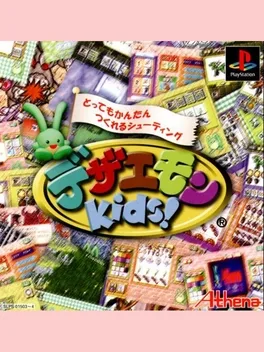
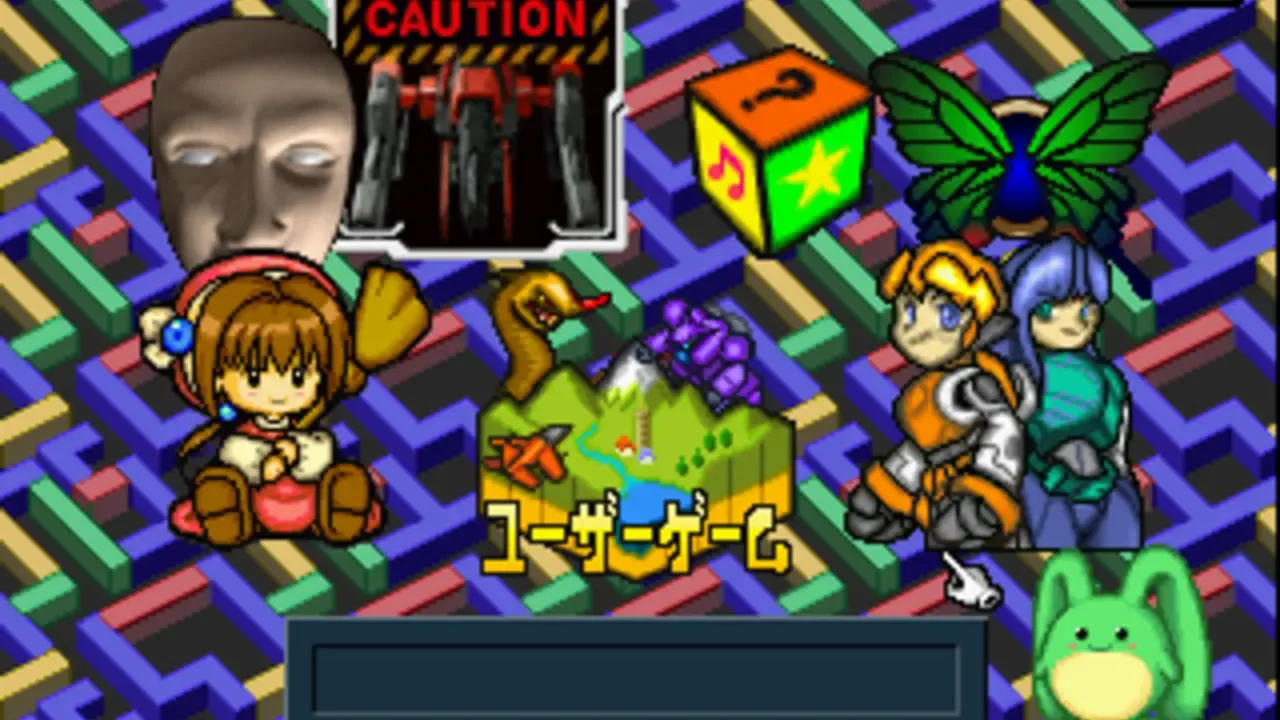
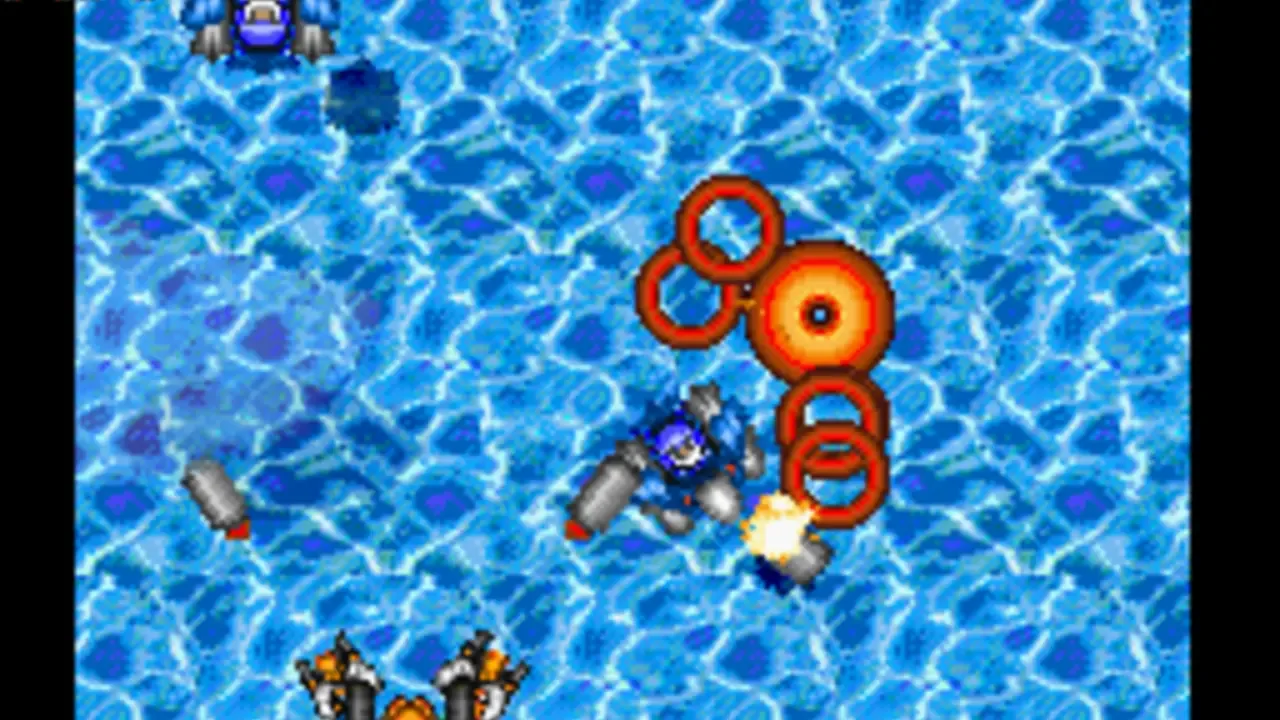
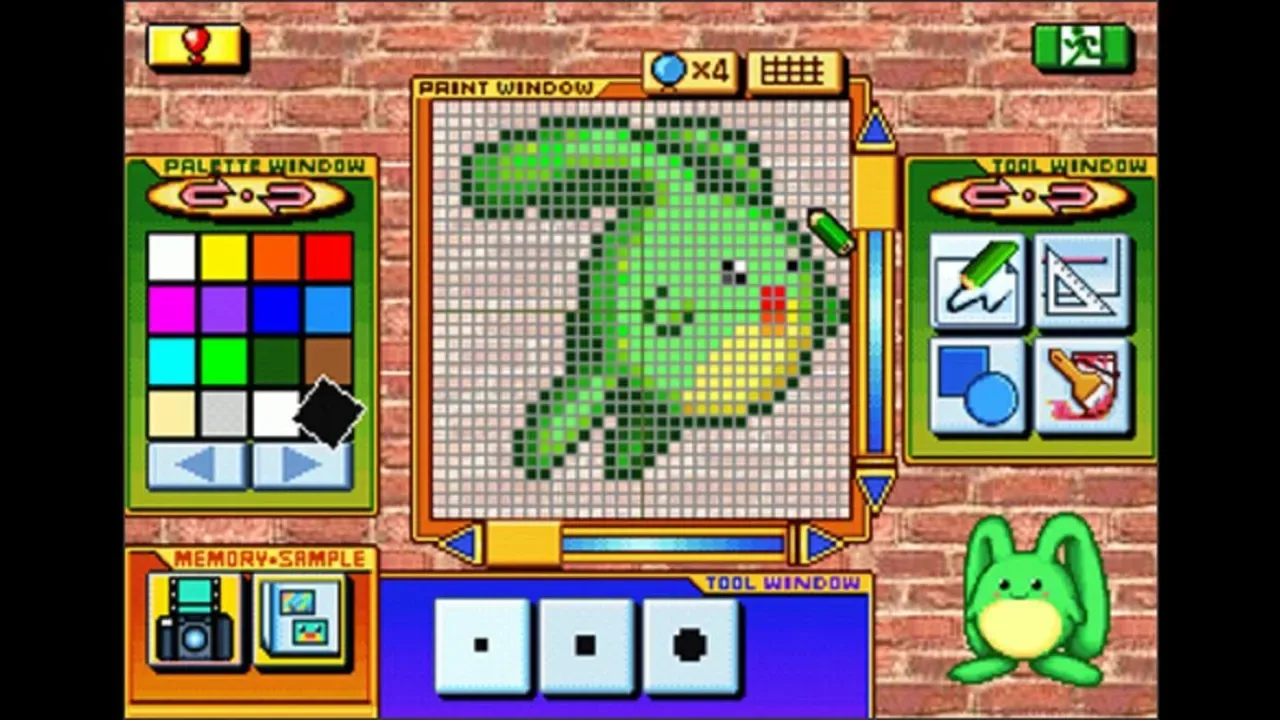
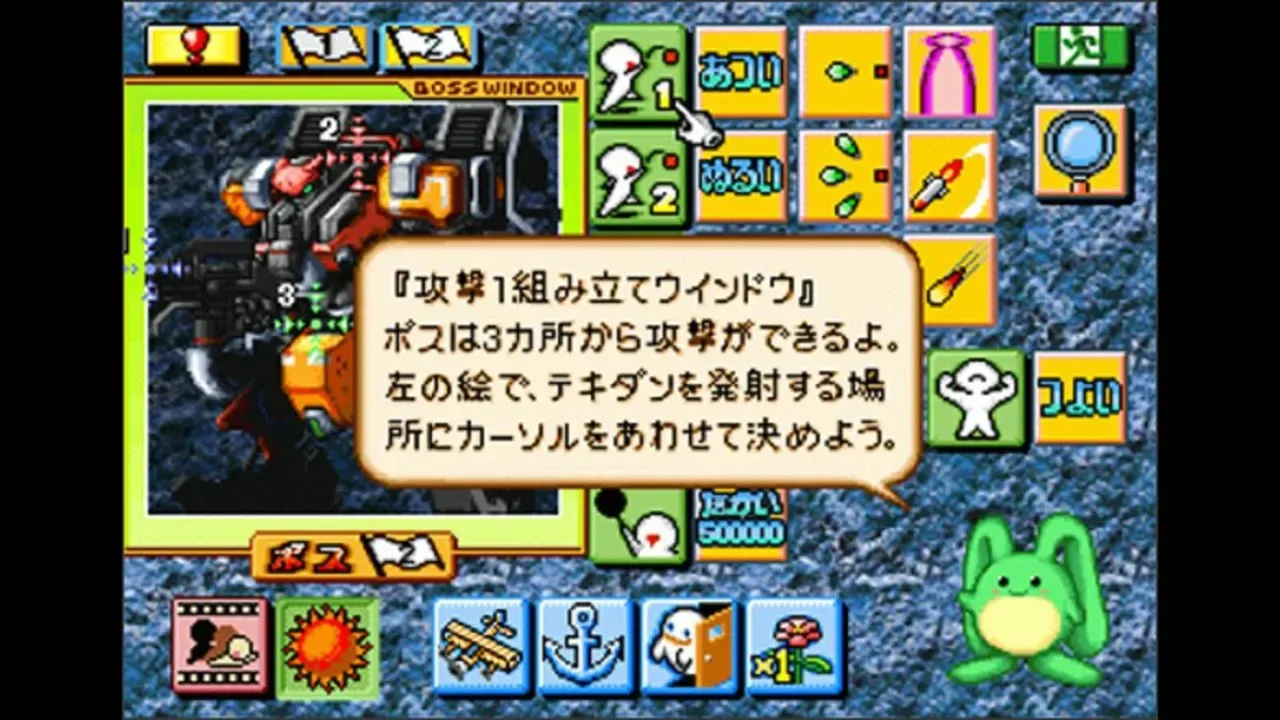
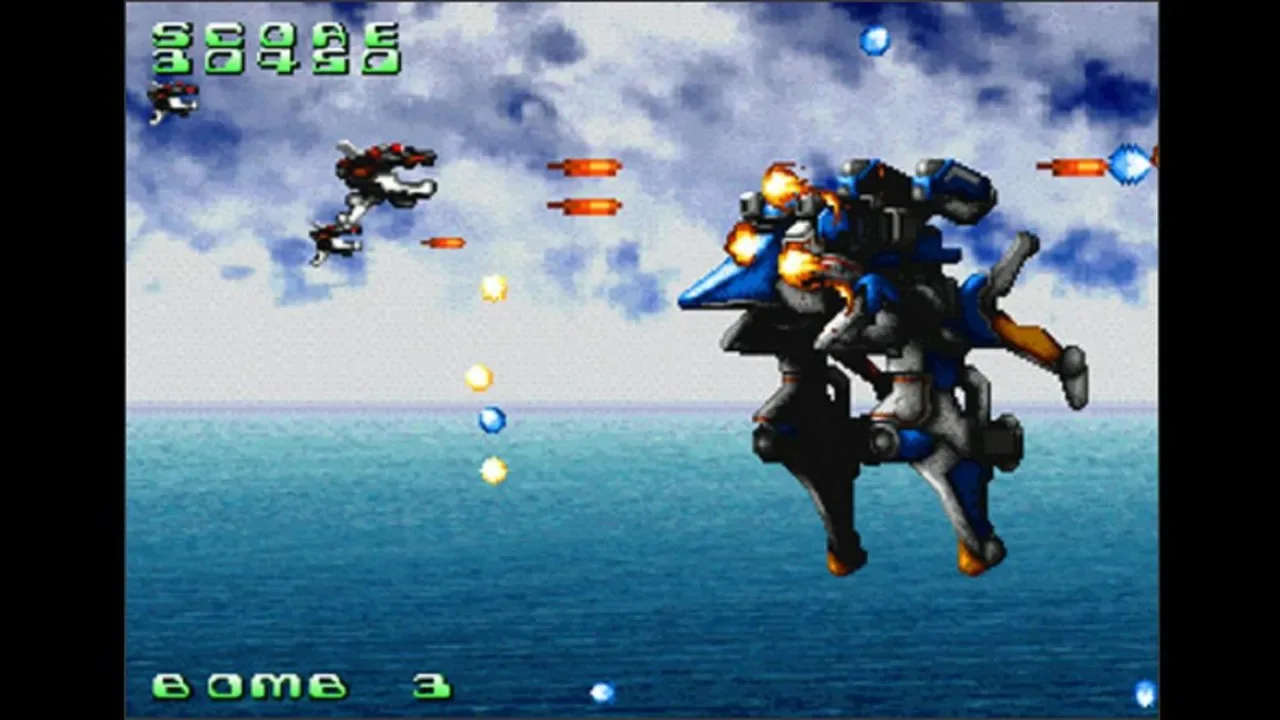
Dezaemon Kids! is a title in the Dezaemon series that allows players to create their own shoot-'em-up games. The players can design levels and enemies by themselves or choose from a number of presets, as well as compose musical themes for the levels. The game has a simplified colorful interface which makes it targeted for younger audience. It also boasts fully-voiced tutorial, a large amount of sample data, a horizontal scroll option, and 2-player simultaneous play option. The second game disc contains 102 sample games created in Dezaemon Plus.
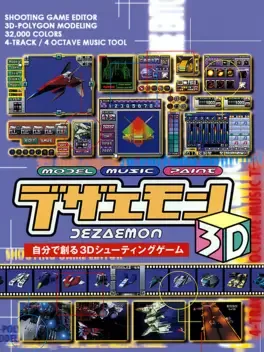
Dezaemon 3D is a video game and game creator for the Nintendo 64. It was released only in Japan in 1998. The game's editor allows players to design their own shooting game levels similar to the levels shown in Star Soldier: Vanishing Earth. The game has a large number of options, from creating the stage boss or adding a custom soundtrack for each level. It was originally developed alongside an ultimately unreleased accompanying expansion disk title for 64DD.
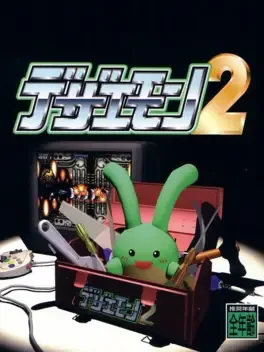
Technically 4th in the series of shoot'em-up creation games by Athena (1997).
Part of collection:
SuperLite 1500
(last 3 games)
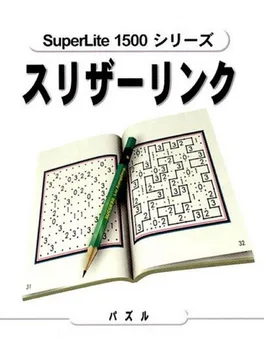
Slitherlink (also known as Fences, Takegaki, Loop the Loop, Loopy, Ouroboros, Suriza and Dotty Dilemma) is a logic puzzle developed by publisher Nikoli. Slitherlink is played on a rectangular lattice of dots. Some of the squares formed by the dots have numbers inside them. The objective is to connect horizontally and vertically adjacent dots so that the lines form a simple loop with no loose ends. In addition, the number inside a square represents how many of its four sides are segments in the loop. Other types of planar graphs can be used in lieu of the standard grid, with varying numbers of edges per vertex or vertices per polygon. These patterns include snowflake, Penrose, Laves and Altair tilings. These add complexity by varying the number of possible paths from an intersection, and/or the number of sides to each polygon; but similar rules apply to their solution. SuperLite 1500 Series - Slither Link is a puzzle game based on the Slitherlink logic puzzle featuring over 200 different stages.
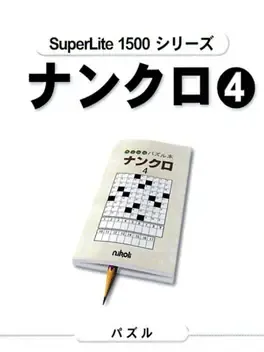
A crossword is a word puzzle that normally takes the form of a square or rectangular grid of white and shaded squares. The goal is to fill the white squares with letters, forming words or phrases, by solving clues which lead to the answers. In languages that are written left-to-right, the answer words and phrases are placed in the grid from left to right and from top to bottom. The shaded squares are used to separate the words or phrases. Squares in which answers begin are usually numbered. The clues are then referred to by these numbers and a direction, for example, "4-Across" or "20-Down". At the end of the clue the total number of letters is sometimes given, depending on the style of puzzle and country of publication. Some crosswords will also indicate the number of words in a given answer, should there be more than one.
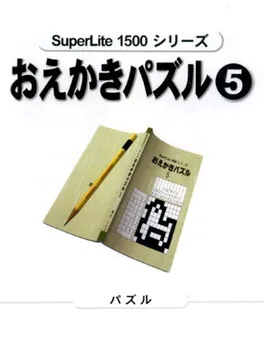
Popular collection of puzzle games will fill the picture will be completed based on the mass number of vertical and horizontal scratching puzzles first whenever visiting. The 200 questions included a wide range of offers from beginner to advanced, the size 10x10, 15x15, 20x20 sizes available 3. Configuration of the popular features button operation, and display position adjustment function, you can enjoy a comfortable play.
Could be interesting
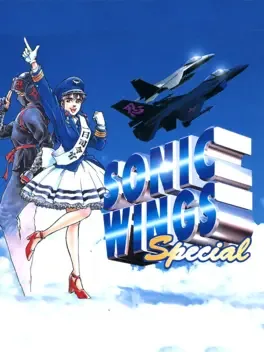
Sonic Wings Special is a 1996 vertical-scrolling shoot 'em up that combines the features in Sonic Wings, Sonic Wings 2, and Sonic Wings 3. It was ported to arcade as Sonic Wings Limited. The home console version adds new characters and endings, new bosses, updated graphics and unlockable planes. There are also Time Attack and 2-player modes. The game uses a branching stage system, so it is impossible to see all levels in one sitting. There is a total of 14 playable characters and many different endings (some of which are reused from previous games in the series). Overall the game has a comic feel. As of Summer 2012, the Android version of Sonic Wings Special has only 4 playable characters with 4 endings and 9 stages. However, the publisher is planning to add further elements of the original version.
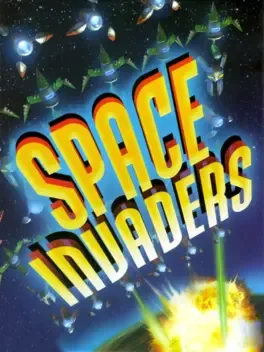
Space Invaders is a game in which the player controls a laser cannon by moving it horizontally across the bottom of the screen and firing at descending aliens. The aim is to defeat five rows of eleven aliens—some versions feature different numbers—that move horizontally back and forth across the screen as they advance towards the bottom of the screen. The player defeats an alien, and earns points, by shooting it with the laser cannon. As more aliens are defeated, the aliens' movement and the game's music both speed up.
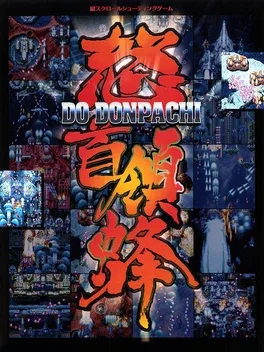
Compared to DonPachi, DoDonPachi is generally known for introducing new gameplay elements while improving or changing existing ones. The overall background of the game, unlike following sequels, remains more or less centered around a supposed invasion by a mysterious race of mechanized aliens, which the player is called to face throughout its run. However, more sinister and shocking secrets lie beneath the surface, accessible only to those brave and skilled enough to clear the entire game.
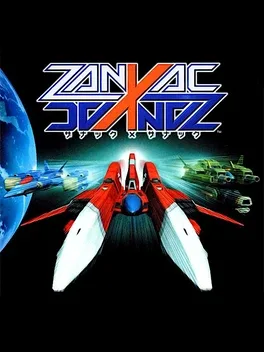
Zanac X Zanac is a shoot'em up game released by Compile to commemorate the 15th anniversairy of the original game. This title includes two games - a reimagination of the original game, called Zanac Neo and 3 different versions of the NES port of Zanac.
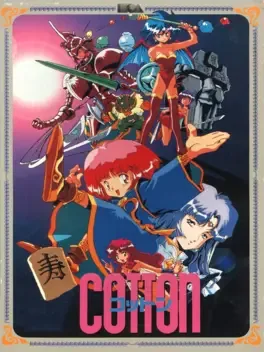
Cotton: Fantastic Night Dreams is a scrolling shooter arcade game, released on Sega's Sega System 16B Arcade system board in 1989. It is the first in the Cotton series of videogames. It was ported to both the Sharp X68000 and the NEC TurboGrafx-CD in 1993. The TurboGrafx-CD version was released on Super CD-ROM and features an enhanced redbook audio soundtrack and voice acting on the Japanese release. The game was later ported to Sony PlayStation under the title Cotton Original in 1999. The PlayStation release combines the enhanced digital CD-ROM soundtrack of TurboGrafx-CD release and the gameplay/graphics of the original Arcade version. A version was ported to the Neo Geo Pocket Color in 2000. Due to hardware limitations the Neo Geo Pocket Color features less detailed graphics and sound compared to previous versions, however it is still a faithful version of the original in terms of gameplay.
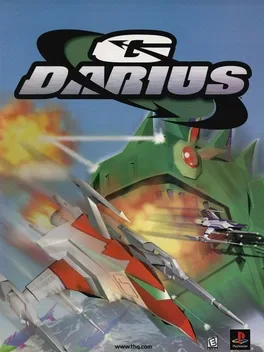
G-Darius is a shoot'em up arcade game, released by Taito in 1997. It is the fourth arcade installment of the Darius series and the first in the entire series to feature three-dimensional polygonal graphics. Much like previous installments in the Darius series, G-Darius is a two-dimensional horizontally scrolling shoot'em up set in a fictional future.
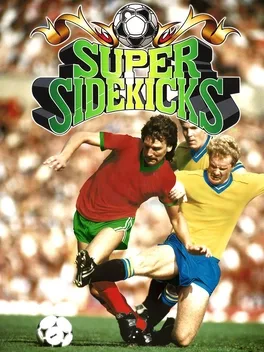
Published in 1993, the original Super Sidekicks (known as Tokuten Ou, "Goal-Scoring King" in Japan) was SNK's first soccer video game. It features 12 teams divided into two groups which compete for the "SNK Cup" (the main differences between teams is their formations on the field): Group A: Germany, Italy, Spain, England, Mexico, Japan Group B: Argentina, Holland, Brazil, France, United States, South Korea The players' team plays against all the others in their group, then it goes into an elimination tournament's semifinals and then the final to win the cup. There was also a hidden feature in the game, which wasn't documented, and affects a single player game. During a free kick for the CPU if the player has tapped button A for player two, the CPU performs a short-shot, while pressing the button A performs a longer kick.
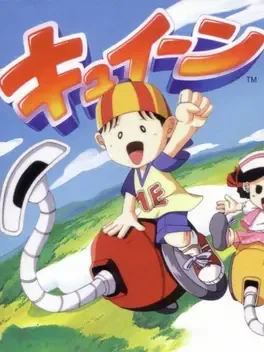
Kyuiin is a horizontal shoot-'em-up set in a fairy tale world. The players control a boy (and a girl in 2-player mode) who flies around on a vacuum cleaner fighting an array of fairy tale characters like Snow White, The Big Wolf, Frog Prince etc. In addition to a standard primary attack there is an ability to suck up certain enemies and projectiles into the vacuum thus building up a special power. Once activated this special power sends back all enemies that have been sucked in into a beam of energy and it grants a short period of invincibility. There is also a backfire cannon helpful against enemies attacking from the left side of the screen. If the boy is hit once he loses all his weapon upgrades, and a second hit destroys the boy.
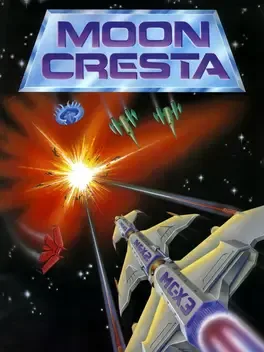
Moon Cresta is an arcade game released in 1980 by Nichibutsu. A moving starfield gives the impression of vertical scrolling, but the game is a fixed shooter in the vein of Namco's Galaxian. Incentive Software published a version of this arcade game for many 8-bit home computers of the time. Dempa also released a port of both Moon Cresta and Terra Cresta for the X68000. It was also released on the Wii Virtual Console in Japan on March 9, 2010 and PlayStation 4 (Arcade Archives) in 2014.
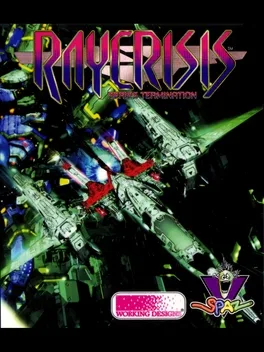
RayCrisis, known as RayCrisis: Series Termination in North America, is the third game released in the "Ray" series of Taito shooting games. Chronologically, it is considered a prequel to the first game, RayForce. First released for arcades in 1998, it supported co-op mode for two players, which the PlayStation ports released in 2000 lack; these ports are the only games in the "Ray" series to lack co-op.